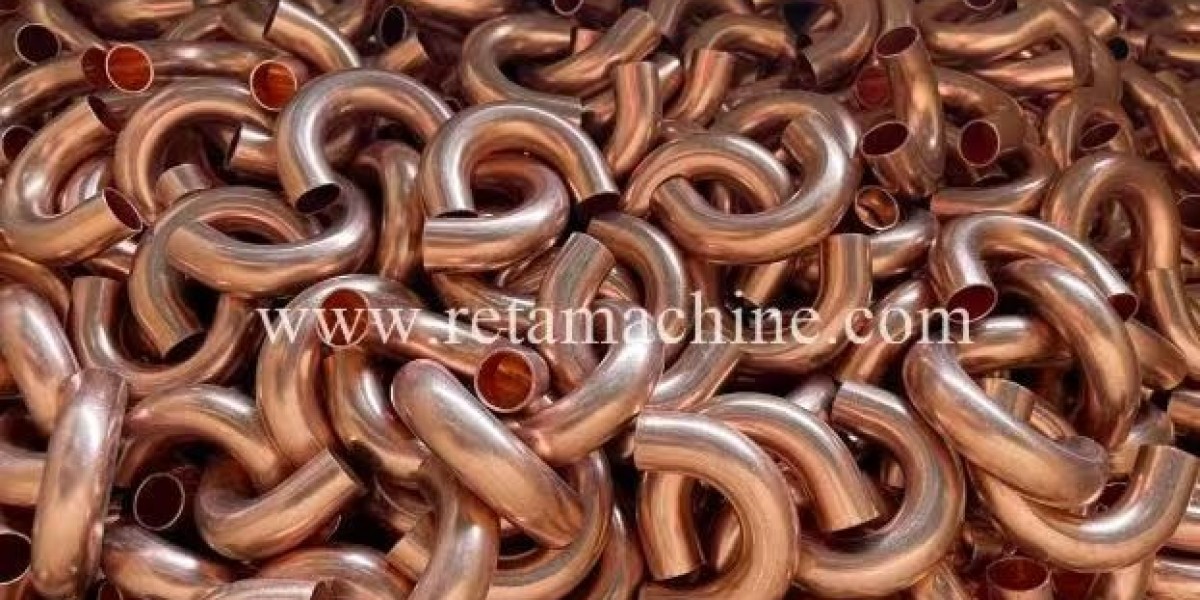

U-tube bending machines are core industrial equipment widely used in HVAC, refrigeration, automotive and pipeline manufacturing industries. Different from ordinary straight pipe bending equipment, they are specially designed for integral U-shaped pipe forming. Their manufacturing process faces prominent technical barriers and precision challenges, making them high-precision mechanical equipment with strict production requirements. The manufacturing difficulties are mainly reflected in structural design, forming technology, precision control and system debugging.
The primary manufacturing difficulty lies in structural design and space interference control. U-shaped bending requires one-time forming of ultra-small radius bends, which easily causes mechanical interference between the bending die, positioning fixture and feeding mechanism. Traditional bending machine structures cannot adapt to compact U-bend processing. Manufacturers need to optimize the modular mechanical structure to avoid component collision while ensuring sufficient bending torque. This customized structural design abandons universal mechanical layouts and requires precise mechanical calibration, greatly increasing structural development and processing difficulty.
Secondly, tube forming quality control poses a major technical challenge. During U-bend processing, the outer wall of the tube bears huge tensile stress while the inner wall is squeezed, easily causing common defects such as excessive wall thinning, tube wrinkling and pipe cracking. Especially for small-radius U-tubes that exceed conventional bending standards, the stress deformation is more severe. To solve this problem, the equipment must be equipped with an accurate axial feeding and compensation system. It requires highly matched mechanical auxiliary feeding and material compensation technologies to balance tube deformation, which is difficult to achieve in conventional mechanical manufacturing.
In addition, high-precision dimensional accuracy control increases manufacturing complexity. Industrial U-tubes have strict requirements on bend symmetry, arc smoothness and overall dimensional tolerance. Tiny deviations in die processing, servo motor operation or equipment assembly will lead to unqualified U-tube products. The key components such as bending dies and positioning parts need ultra-precision machining and surface treatment. Meanwhile, the servo control system must realize real-time speed and torque adjustment to ensure consistent bending radian for each workpiece.
Finally, system debugging and adaptive optimization is a non-negligible difficulty. U-tube bending machines need to adapt to pipes of different materials and diameters. Different metal materials have distinct yield strength and deformation characteristics, requiring personalized parameter calibration. The integration of mechanical structure, electrical control and hydraulic system needs repeated testing and fine-tuning. Mature debugging technology and rich manufacturing experience are essential to ensure stable and efficient operation of the equipment.
In conclusion, the manufacturing difficulties of U-tube bending machines stem from the integration of precision machinery, material mechanics and automatic control technology. With the upgrading of industrial manufacturing standards, higher requirements for U-tube processing quality continue to raise the manufacturing threshold of such equipment, making its R&D and production a high-tech link in the mechanical processing industry.