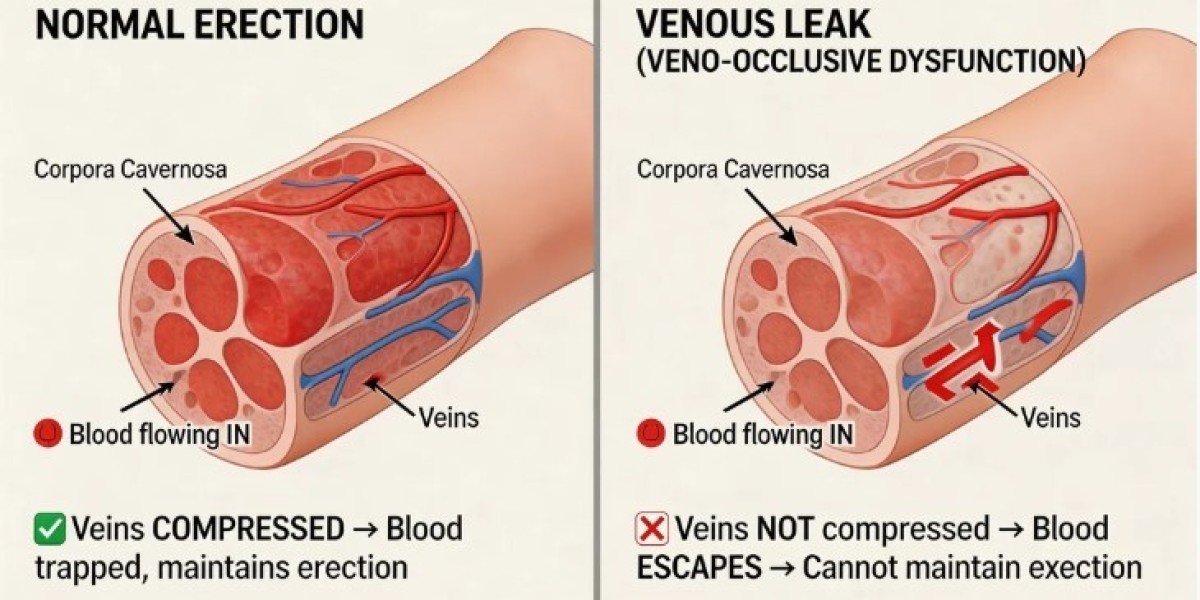

Maintaining a firm erection is an important part of sexual health, but many men experience difficulty maintaining an erection once it has developed. One term frequently associated with this problem is venous leak .
Despite the name, venous leak does not usually mean that a vein is physically damaged and “leaking” blood. The term is commonly used when the normal mechanism responsible for keeping blood inside the penis during an erection does not function properly. In medical terminology, this may be described as erectile veno-occlusive dysfunction .
The condition can be frustrating, particularly when a man can initially achieve an erection but loses firmness during sexual activity. Fortunately, erection-maintenance problems can have several causes, and many treatment approaches are available depending on the underlying issue.
What is Venous Leak?
An erection depends on a carefully coordinated process involving blood vessels, nerves, hormones, erectile tissues, and sexual stimulation.
When a man becomes sexually aroused, blood flow into the erectile tissues of the penis increases. As the erectile chambers fill, pressure rises within them. This pressure helps compress the veins that normally carry blood away from the penis.
The result is that blood becomes temporarily trapped within the erectile tissue, allowing the penis to remain firm.
With suspected veno-occlusive dysfunction, the penis may not adequately restrict blood outflow. Consequently, an erection may become softer sooner than expected.
However, difficulty maintaining an erection does not automatically mean that a man has venous leak . A proper medical evaluation is needed to identify the actual cause.
Venous Leak vs. Erectile Dysfunction
These terms are related but not identical.
Erectile dysfunction (ED) is a general term for difficulty achieving or maintaining an erection adequate for sexual activity.
Venous leakage refers to a possible vascular mechanism behind erection-maintenance difficulties.
ED may occur because of:
Poor circulation
Diabetes
High blood pressure
High cholesterol
Nerve damage
Hormonal problems
Certain medications
Psychological stress
Performance anxiety
Penile structural conditions
Previous surgery or trauma
A combination of physical and psychological factors
Therefore, assuming that erection loss is caused by venous leak without an appropriate assessment can lead to the wrong treatment approach.
Common Signs of Venous Leak
The symptoms can differ from one man to another. A typical pattern is the ability to obtain an erection followed by difficulty keeping it firm.
Possible signs include:
Difficulty Maintaining Firmness
A man may initially develop a satisfactory erection but notice that it gradually becomes softer.
Losing an Erection During Intercourse
Some men may lose firmness during sexual activity, particularly when stimulation changes or pauses.
Needing Constant Stimulation
An erection may be maintained only while continuous stimulation is present.
Reduced Erection Quality
The penis may become erect but not reach the firmness experienced previously.
Repeated Erection Problems
The problem may occur repeatedly rather than as an isolated event.
These symptoms are not enough to diagnose venous leak. They can also occur with other forms of erectile dysfunction.
Why Does Venous Leak Occur?
A number of conditions can affect the tissues and blood vessels involved in erection.
Age and Vascular Changes
Blood vessels and connective tissues can change with age. These changes may affect erectile function, although persistent difficulties erection should not simply be dismissed as a normal consequence of getting older.
Diabetes
Diabetes can damage blood vessels and nerves over time.
Men with poorly controlled diabetes may therefore have a higher risk of erectile dysfunction.
High Blood Pressure
Long-term high blood pressure can affect vascular health. Since erections depend on healthy circulation, vascular problems may contribute to sexual difficulties.
High Cholesterol
Cholesterol-related changes in the arteries can affect blood circulation throughout the body, including the blood vessels supplying the penis.
Pelvic Trauma
Injury involving the pelvis, perineum, or penis can sometimes affect the structures involved in erectile function.
Previous Surgery
Some pelvic or prostate surgeries can affect nerves and blood vessels associated with erections.
Peyronie's Disease
Peyronie's disease involves scar tissue within the penis and can cause curvature, discomfort, and changes in erection quality.
Neurological Problems
The nerves involved in sexual stimulation and erection can be affected by certain neurological conditions or injuries.
Hormonal Changes
Hormonal disorders can contribute to erectile problems. Testosterone is particularly relevant to sexual desire and overall sexual function, although low testosterone is not itself proof of venous leak.
Medications
Some prescription medications can contribute to erectile dysfunction as a side effect.
Anyone who suspects medication-related ED should speak with their doctor rather than discontinuing treatment independently.
Can Stress Cause You to Lose an Erection?
Yes.
Sexual performance is influenced by both physical and psychological factors.
Stress, anxiety, relationship problems, fear of losing an erection, depression, and previous unsuccessful sexual experiences can interfere with sexual arousal.
For example, a man may experience one episode of erection loss. He may then become worried that the same thing will happen again. During the next sexual encounter, that anxiety may interfere with arousal and make it harder to maintain the erection.
Physical and psychological causes can also exist at the same time.
How Is Venous Leak Diagnosed?
A diagnosis should be based on a medical evaluation rather than symptoms alone.
A doctor may begin by asking questions about:
Sexual history
Erection quality
How long the problem has existed
Ability to achieve an erection
Ability to maintain an erection
Morning erections
Sexual desire
Medical conditions
Previous operations
Injuries
Medication use
Lifestyle habits
Psychological stress
A physical examination may also be performed.
Penile Doppler Ultrasound
One of the tests that may be considered when a vascular cause is suspected is a penile duplex Doppler ultrasound.
This imaging test can provide information about blood entering and leaving the erectile tissue.
It is often performed after medication is administered to produce an erection so that penile blood-flow patterns can be evaluated.
The results should be interpreted by an appropriately trained clinician. A single measurement should not be used in isolation to diagnose a complex erectile problem.
Blood Tests for Erectile Problems
Blood tests do not directly diagnose venous leak.
However, laboratory testing can help identify conditions that may contribute to erectile dysfunction.
Depending on the patient's circumstances, a physician may consider evaluating:
Blood glucose
HbA1c
Lipid profile
Testosterone
Other hormone levels when clinically appropriate
Testing is generally selected according to the individual's symptoms, medical history, and examination.
Treatment for Venous Leak
There is no single treatment that is appropriate for every man with erection-maintenance problems.
Treatment depends on the underlying cause, severity of symptoms, general health, and previous response to therapy.
1. Lifestyle Improvements
Improving general health can support erectile function.
Recommended habits may include:
Exercising regularly
Maintaining a healthy body weight
Eating a nutritious diet
Avoiding tobacco
Limiting excessive alcohol consumption
Managing blood sugar
Controlling blood pressure
Managing cholesterol
Getting sufficient sleep
Addressing chronic stress
These measures support cardiovascular health and may improve erectile function, although they cannot guarantee correction of a structural vascular problem.
2. Oral ED Medicines
Phosphodiesterase type-5 inhibitors, commonly known as PDE5 inhibitors, are widely used for erectile dysfunction.
Examples include:
Sildenafil
Tadalafil
Vardenafil
Avanafil
These medications enhance the natural erectile response to sexual stimulation by improving blood flow.
They may help some men who have difficulty maintaining erections, but they do not necessarily correct the underlying cause of suspected veno-occlusive dysfunction.
They are also not appropriate for everyone. In particular, some heart medications, including nitrate drugs, can interact dangerously with PDE5 inhibitors.
3. Vacuum Erection Devices
A vacuum erection device creates negative pressure around the penis, helping draw blood into the erectile tissues.
A constriction ring may then be used to help maintain the erection.
This approach can be useful for some men, including those who cannot take certain oral medications.
4. Constriction Devices
A properly used constriction ring can reduce blood outflow and help some men maintain an erection.
Medical guidance is important because excessive or prolonged use can cause injury.
5. Penile Injections
Certain medications can be injected directly into the erectile tissue to produce an erection.
This treatment can be effective when oral medications are insufficient.
However, correct medication selection, dosage, and technique are important. Patients should receive proper instruction from a qualified healthcare professional.
6. Penile Implants
A penile prosthesis may be considered for men with persistent, severe erectile dysfunction who have not achieved satisfactory results with other approaches.
The device is surgically implanted and allows the patient to produce an erection when desired.
Because implantation requires surgery, patients should have a detailed discussion with an experienced urologist about benefits, risks, alternatives, and long-term expectations.
What About Shockwave Therapy?
Low-intensity shockwave therapy has been studied as a potential treatment for certain forms of erectile dysfunction.
The goal is generally to influence vascular function and tissue health.
However, research is still evolving, and results can vary according to patient selection and treatment protocols.
Men should be cautious about advertisements promising that shockwave therapy will permanently “seal” a venous leak or provide guaranteed results.
What About PRP Treatment?
Platelet-rich plasma, or PRP, has also been investigated in sexual medicine.
The proposed concept is that growth factors within concentrated platelets may influence tissue repair.
However, evidence for PRP in erectile dysfunction remains under development, and it should not be presented as a proven cure for venous leak.
Anyone considering PRP should discuss the evidence, uncertainties, costs, and alternatives with a qualified physician.
Can Venous Leak Be Treated Naturally?
There is no specific food, herb, supplement, or exercise that has been proven to permanently repair a confirmed structural venous outflow problem.
Nevertheless, healthy lifestyle habits can improve the factors that influence erectile function.
A balanced diet, regular exercise, healthy weight, adequate sleep, smoking cessation, and good management of diabetes and cardiovascular risk factors can all contribute to better sexual health.
Supplements marketed specifically as a “venous leak cure” should be approached cautiously, especially when they promise guaranteed or permanent results.
Does Exercise Improve Erectile Function?
Regular physical activity supports cardiovascular health and can benefit overall sexual function.
Aerobic exercise such as walking, swimming, or jogging can improve general cardiovascular fitness.
Strength training can also contribute to overall health and weight management.
Exercise should be viewed as part of a broader health strategy rather than a guaranteed treatment for veno-occlusive dysfunction.
Can Venous Leak Affect Fertility?
Venous leak does not automatically cause infertility.
Sperm production and sperm quality are separate issues from the mechanisms responsible for maintaining an erection.
However, severe erectile dysfunction can make intercourse difficult and may indirectly interfere with attempts to conceive.
Men experiencing both erection problems and fertility concerns may benefit from a broader reproductive evaluation.
Does Venous Leak Cause Low Libido?
Not necessarily.
Venous leak primarily concerns erection maintenance rather than sexual desire.
A man may have a normal sex drive but struggle to maintain an erection.
However, repeated sexual difficulties can cause stress, embarrassment, and anxiety, which may eventually affect interest in sex.
If low libido is also present, hormonal, psychological, relationship, medication-related, and other medical causes should be considered.
What Does It Mean If You Have Morning Erections?
Morning erections are one aspect of erectile function but cannot be used by themselves to diagnose or exclude venous leak.
Some men with erection difficulties continue to experience spontaneous erections, while others notice changes in frequency or firmness.
The presence or absence of morning erections should therefore be discussed as part of the overall medical history rather than treated as a definitive diagnostic test.
How Long Does Treatment Take?
Treatment timelines vary significantly.
Some medications can work relatively quickly, while lifestyle improvements may require weeks or months to produce measurable changes.
Treatments such as penile implants involve a surgical process and recovery period.
The expected timeline depends on the diagnosis, selected treatment, overall health, and individual response.
When Should You Consult a Urologist?
It is sensible to seek professional evaluation when erection difficulties become persistent or repeatedly interfere with sexual activity.
A consultation is particularly important when symptoms occur alongside:
Diabetes
High blood pressure
Cardiovascular disease
High cholesterol
Penile pain or curvature
Previous pelvic surgery
Pelvic or genital trauma
Neurological symptoms
Significant changes in sexual function
A urologist can help determine whether the issue is vascular, hormonal, neurological, psychological, medication-related, or due to a combination of factors.
Frequently Asked Questions About Venous Leak
Can venous leak be permanently cured?
The outcome depends on the underlying cause. Some contributing conditions can be treated or improved, while persistent structural problems may require long-term management.
Is venous leak the same as weak blood flow?
No. Blood-flow problems can involve either insufficient blood entering the penis or difficulty keeping blood inside the erectile tissue. These are different mechanisms and may require different approaches.
Can Viagra cure venous leak?
Sildenafil and similar medications can improve erections in many men, but they do not necessarily correct an underlying structural veno-occlusive problem.
Can a young man have venous leak?
Erection-maintenance difficulties can occur at any age. In younger men, psychological factors, medications, hormonal issues, injuries, and other conditions should also be considered.
Is venous leak dangerous?
The erection problem itself is not usually an emergency, but persistent erectile dysfunction can sometimes be associated with underlying cardiovascular or metabolic health issues. Medical evaluation can help identify these conditions.
Can venous leak affect relationships?
Repeated erection difficulties may cause frustration, anxiety, embarrassment, or relationship stress. Open communication and appropriate medical support can help address these effects.
Conclusion
Venous leak is a commonly used term for a problem involving the mechanism that helps maintain blood within the penis during an erection. It may result in an erection that develops but does not remain firm.
However, erection loss can have many different causes, and symptoms alone cannot establish that veno-occlusive dysfunction is responsible.
A comprehensive assessment can help identify contributing factors such as vascular disease, diabetes, hormonal problems, medications, neurological conditions, structural abnormalities, stress, or anxiety.
Depending on the diagnosis, treatment may involve lifestyle changes, oral ED medications, vacuum devices, injections, counseling, or surgical treatment such as a penile implant.
If erection-maintenance problems are persistent, consulting a qualified urologist is an appropriate way to determine the underlying cause and discuss suitable treatment options.
This article is intended for general educational information and should not replace individualized advice, diagnosis, or treatment from a qualified healthcare professional.