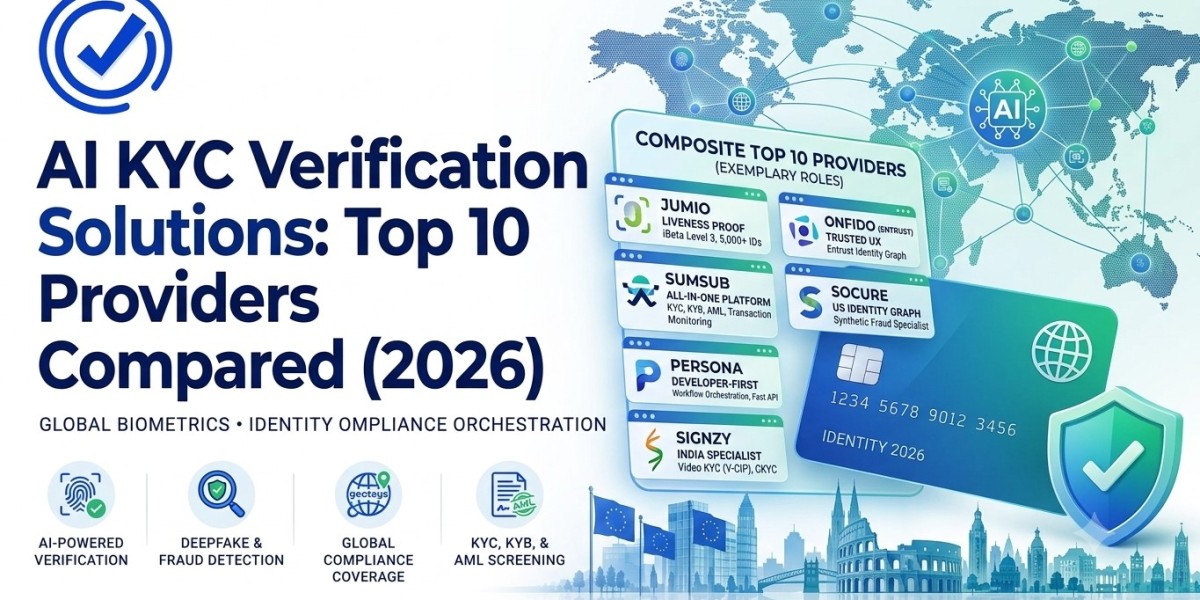

AI KYC verification solutions confirm who a customer is by checking an ID document, matching a selfie to it, running liveness checks and screening the result against risk and watchlist data. For banks, fintechs, payment providers and merchants, the right choice affects onboarding speed, fraud losses, compliance exposure and customer drop-off. This guide compares ten widely used providers so you can match one to your business and risk profile.
Quick answer
- All-in-one KYC, AML and monitoring: Sumsub
- Large, audited enterprises: Jumio
- Fast automated global onboarding: Veriff
- Configurable workflows for several user types: Persona
- US financial services and fraud signals: Socure
- Enterprise onboarding and account recovery: Entrust Identity Verification (formerly Onfido)
- Deepfake and injection-attack defense for banks: Incode
- Broad database coverage across countries: Trulioo
- Document, address and AML checks for payments, crypto and gaming: AU10TIX
- Merchants already on Stripe: Stripe Identity
“Top” here means a strong fit for a defined need based on published features and public information. It is not a guarantee of performance or regulatory acceptance for your business.
What AI KYC verification does
Know Your Customer (KYC) is the process regulated businesses use to confirm customer identity and assess risk. In the US, these duties stem from the Bank Secrecy Act and FinCEN’s customer identification and due diligence rules, and similar regimes apply in the UK, EU and elsewhere. AI helps by reading and authenticating documents, matching faces, detecting spoofed or synthetic media, scoring risk and routing edge cases to human reviewers. Merchants and payment businesses face the same checks when they apply for processing, as covered in our merchant account providers directory.
How we compared them
- Document, biometric and liveness checks
- Deepfake and injection-attack defense
- AML screening and ongoing monitoring
- Geographic coverage and document breadth
- Pricing model and integration effort
- Best-fit business type
Pricing differs widely between providers and across third-party reports. Fee notes are indicative, so confirm current terms with each vendor.
Comparison table
| Provider | Core strength | Coverage focus | Pricing model | Best for |
|---|---|---|---|---|
| Sumsub | KYC, KYB, AML and monitoring in one platform | Global | Per verification, plan minimums may apply | Fintech, crypto |
| Jumio | Identity verification, AML, continuous monitoring | Global | Sales-led, custom | Large regulated enterprises |
| Veriff | Automated document and biometric checks | Global | Published per-verification rates | Fast consumer onboarding |
| Persona | Configurable identity workflows | Global | Usage-based, varies by setup | Marketplaces, multi-flow teams |
| Socure | Identity, fraud and risk decisioning | US-strong | Quote-based | US banks and fintechs |
| Entrust Identity Verification | AI document and biometric checks, orchestration | Global | Sales-led, quote-based | Enterprise onboarding |
| Incode | Deepfake and injection-attack defense | Global | Quote-based | Banks, high-risk B2C |
| Trulioo | Database-driven identity and business checks | Global | Custom | Multi-country coverage |
| AU10TIX | Document, address, age, biometric and AML checks | Global | Confirm with provider | Payments, crypto, gaming |
| Stripe Identity | Document and selfie checks inside Stripe | Stripe markets | Per verification | Stripe merchants |
Compare Payment Providers and Find the Right Solution for Your Business
The top 10 AI KYC verification solutions
1. Sumsub: best for all-in-one KYC and AML
Sumsub combines KYC, KYB, AML screening, transaction monitoring, fraud prevention and case management, and offers a non-document mode that checks users against authoritative databases.
- Limits: Plans and minimums vary, and verification latency differs by flow
- Suits: Fintechs, crypto platforms and fast-scaling businesses
2. Jumio: best for large regulated enterprises
Jumio is one of the longer-established providers, covering ID verification, biometrics, liveness, AML screening and risk assessment. It launched a continuous monitoring product, Jumio Watch, in 2026 to flag identity risk changes after onboarding.
- Limits: Sales-led contracts and custom pricing, so budgets start with a conversation
- Suits: Banks and audited enterprises with strict vendor review
3. Veriff: best for fast, automated onboarding
Veriff focuses on automated document and biometric verification with fraud-network signals. It acquired KYB specialist Vespia in February 2026 to extend into business verification.
- Limits: Core strength is identity verification, so AML and some workflow depth may need add-ons
- Suits: Consumer apps and marketplaces prioritizing conversion
4. Persona: best for configurable workflows
Persona is a configurable platform covering KYC, KYB, fraud prevention and lifecycle verification, popular with teams that want to design their own flows.
- Limits: Flexibility means more setup decisions, and pricing varies by configuration
- Suits: Companies with several customer types and verification paths
5. Socure: best for US financial services
Socure combines identity verification with fraud and risk decisioning, using signals such as phone, email and behavior alongside documents. It raised additional growth funding in August 2026 and acquired Fravity.
- Limits: Strongest in the US, and pricing is quote-based
- Suits: US banks, lenders and fintechs
6. Entrust Identity Verification (formerly Onfido): best for enterprise onboarding
Onfido is now part of Entrust, and its AI document and biometric verification connects to Entrust’s wider digital trust and authentication portfolio.
- Limits: Enterprise, sales-led contracts
- Suits: Organizations needing onboarding, account recovery and step-up checks
7. Incode: best for deepfake and injection-attack defense
Incode focuses on banks and high-risk consumer onboarding at scale, with in-house defenses against deepfakes and injection attacks.
- Limits: Quote-based pricing, aimed at higher-volume buyers
- Suits: Banks and fraud-exposed platforms
8. Trulioo: best for database coverage
Trulioo is known for broad identity and business verification data across many countries, which helps where document checks alone fall short.
- Limits: Custom pricing, and data coverage varies by market
- Suits: Multi-country businesses and marketplaces
9. AU10TIX: best for payments, crypto and gaming checks
AU10TIX offers document, address, age and biometric verification with AML screening for payments, crypto and gaming use cases.
- Limits: Confirm pricing and integration options with the provider
- Suits: Platforms needing identity plus AML in one flow
10. Stripe Identity: best for Stripe merchants
Stripe Identity adds document and selfie verification inside the Stripe ecosystem and publishes per-verification pricing, which keeps setup simple for existing Stripe users.
- Limits: Less suited as a standalone compliance platform with deep AML and monitoring
- Suits: SaaS and eCommerce businesses on Stripe
AI KYC pricing models
- Per verification: A fee each time a user is verified. Veriff, Sumsub and Stripe Identity are described as publishing usage-based rates.
- Plan minimums: A monthly minimum with usage on top.
- Enterprise contracts: Annual, sales-led agreements, common with Jumio and Entrust.
- Add-ons: AML screening, liveness upgrades, monitoring and KYB are often priced separately.
A cheap first check can cost more once you add AML, monitoring and manual review, so request an all-in price at your expected volume.
Explore Verified Payment Provider Reviews on TheFinRate
How to choose the right AI KYC provider
- Match your risk and regulation. A bank and a SaaS marketplace need different depth.
- Test deepfake and liveness defenses. Ask about injection-attack protection and independent liveness testing.
- Check coverage. Confirm supported documents and countries for your actual customers.
- Review privacy and data handling. Ask about retention, storage location and biometric consent rules such as GDPR and Illinois BIPA.
- Plan for human review. Edge cases need clear manual workflows.
- Model total cost. Include AML, monitoring and failed-verification fees.
Common mistakes
- Choosing on per-check price alone
- Ignoring false rejects that quietly cut conversion
- Skipping ongoing monitoring after onboarding
- Storing more identity data than needed
- Assuming “instant approval” removes underwriting,
Verdict
There is no single best AI KYC provider. All-in-one platforms suit lean compliance teams, enterprise vendors suit audited institutions, fraud-focused providers suit high-attack environments, and bundled options suit merchants already on a payments platform. Shortlist two or three, run a pilot with real customers, and compare conversion, fraud catch and total monthly cost.
Recent News and Developments in the AI KYC Market
- February 2026: Veriff acquired Vespia, adding KYB coverage across more than 300 jurisdictions to its identity platform.
- April 2026: Jumio launched Jumio Watch, a continuous monitoring product that tracks identity risk changes after verification.
- August 2026: Socure raised $156 million in growth funding at a $5.2 billion valuation and acquired Fravity to add automation to its RiskOS platform.
Note: If you require specific details, provider comparisons, or insights that are not currently included in this overview, we are happy to accommodate your request. Please let us know your exact needs, and we will ensure the content is updated accordingly.
About Us:
TheFinRate is a B2B fintech information platform featuring payment provider reviews, comparisons, directories, industry guides, and educational resources. It helps online merchants, eCommerce businesses, SaaS companies, fintech startups, and payment professionals compare providers and make informed payment decisions.
Contact Us:
TheFinRate
Website: https://thefinrate.com/