
The US Personal Cloud Market is expanding as consumers increasingly rely on cloud storage, automated data backup, and connected devices to manage their digital information. Rising smartphone usage, growing photo and video libraries, remote working arrangements, and concerns about data security are encouraging individuals and households to adopt reliable personal cloud solutions.
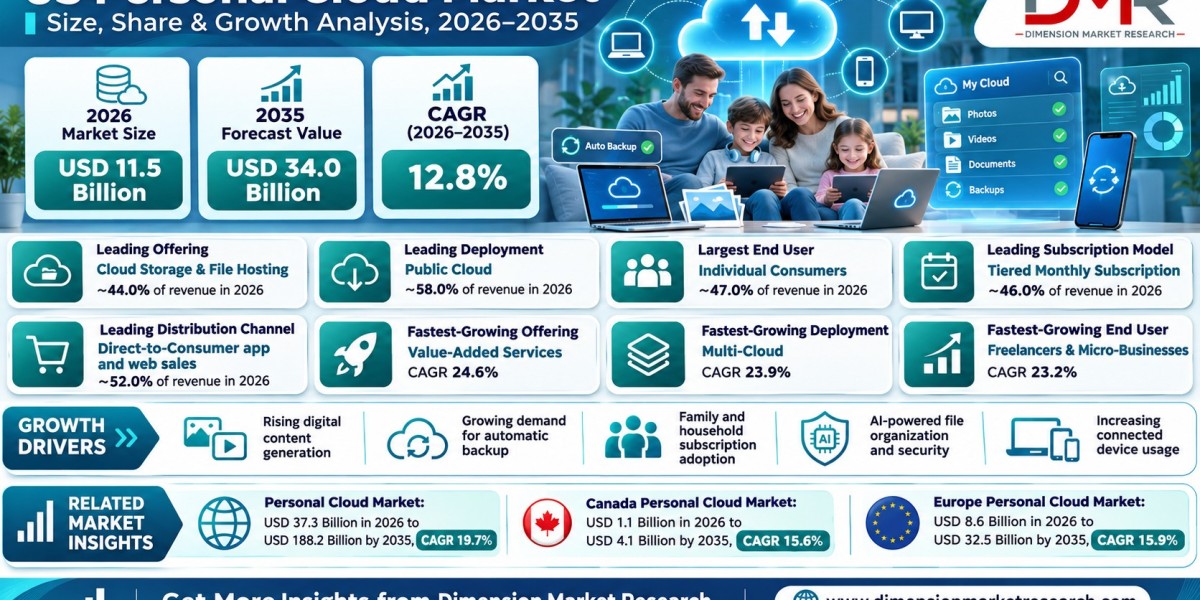
According to Dimension Market Research, the US Personal Cloud Market is projected to reach USD 11.5 billion in 2026 and expand to USD 34.0 billion by 2035, registering a CAGR of 12.8% during the 2026 to 2035 forecast period.
Artificial intelligence, cloud-based synchronization, personal network-attached storage (NAS), and subscription-based services are reshaping how users store, access, protect, and organize digital content.
What Is the US Personal Cloud Market?
The US Personal Cloud Market covers cloud storage services, backup solutions, software platforms, and personal storage hardware designed for individual consumers, households, and home-office users.
Personal cloud technologies allow users to store photographs, videos, documents, and device information while accessing synchronized files across smartphones, laptops, tablets, and connected devices.
The market includes cloud storage and file hosting, data backup and recovery, photo and video management, personal NAS devices, and value-added services such as ransomware recovery and intelligent file organization.
Unlike enterprise cloud infrastructure, personal cloud solutions primarily address consumer storage, convenience, data protection, and household connectivity requirements.
Why Is the US Personal Cloud Market Growing?
Increasing digital content generation is a major factor supporting market expansion.
Smartphones, high-resolution cameras, tablets, smart home devices, and connected electronics generate substantial volumes of photographs, videos, and personal documents.
As local device storage reaches capacity, consumers increasingly adopt cloud subscriptions to retain and access information.
Automated backup is another important driver. Personal cloud services protect files against device loss, hardware failures, and accidental deletion while simplifying recovery.
Growing adoption of family subscription plans is also supporting demand. Shared storage allows multiple household members to synchronize files and manage digital content under a common subscription.
For technology providers, these developments create opportunities in scalable storage plans, improved synchronization, intelligent backup, and premium digital services.
Get a Free Sample of the US Personal Cloud Market Report
Evaluating opportunities in cloud storage, data backup, consumer technology, or connected storage devices? Request a free sample to review the report's market segmentation, competitive landscape, technology trends, and forecast coverage.
https://dimensionmarketresearch.com/request-sample/us-personal-cloud-market/
Cloud Storage and File Hosting Lead the Offering Segment
Cloud Storage & File Hosting is projected to account for approximately 44.0% of US Personal Cloud Market revenue in 2026.
This segment provides the foundational storage infrastructure that allows consumers to upload, synchronize, access, and share digital information across multiple devices.
Its leading position reflects the widespread adoption of cloud storage subscriptions and integration with smartphone and computer operating systems.
Value-Added Services represents the fastest-growing offering segment, projected to expand at a CAGR of 24.6% through 2035.
These services include AI-powered file organization, ransomware recovery, intelligent photo management, and shared family storage features.
For providers, this shift highlights the increasing importance of offering more than basic storage capacity.
Public Cloud Dominates Deployment
Public Cloud is expected to represent approximately 58.0% of market revenue in 2026.
Its popularity reflects accessibility, automatic synchronization, minimal maintenance requirements, and compatibility with widely used consumer devices.
Users can access files from different locations without purchasing or maintaining dedicated storage equipment.
Multi-Cloud deployment is projected to register the fastest growth, with a CAGR of 23.9% during 2026 to 2035.
This approach allows consumers to distribute backups across multiple providers, reducing dependence on a single platform.
Private personal cloud and hybrid storage models also remain relevant for households prioritizing data ownership, local storage, and privacy.
Individual Consumers Represent the Largest End-User Segment
Individual Consumers are projected to account for approximately 47.0% of market revenue in 2026.
Personal cloud adoption commonly begins with smartphone users seeking additional capacity for photographs, videos, and device backups.
Household and family subscriptions represent another important category as consumers increasingly manage multiple connected devices.
Freelancers & Micro-Businesses are expected to be the fastest-growing end-user segment, expanding at a CAGR of 23.2%.
Independent professionals require reliable file synchronization, document sharing, and backup services without the expense or complexity of enterprise storage platforms.
Subscription Models and Distribution Channels
Tiered Monthly Subscription plans are projected to lead with approximately 46.0% of revenue in 2026.
Monthly subscriptions provide flexibility, allowing consumers to increase or reduce storage capacity according to changing requirements.
Annual and bundled subscriptions are gaining importance as technology providers integrate cloud services with smartphones, computers, and other connected devices.
Direct-to-Consumer app and web sales are expected to account for approximately 52.0% of distribution revenue in 2026.
Telecom Carrier Bundled distribution is projected to grow at a CAGR of 21.8% through 2035 as operators integrate storage services into mobile and broadband packages.
How Is Artificial Intelligence Transforming Personal Cloud Storage?
Artificial intelligence is changing personal cloud platforms from passive file repositories into intelligent digital management systems.
AI-powered photo organization allows users to search image libraries by objects, locations, and content without manually categorizing every file.
Automated duplicate detection helps reduce unnecessary storage consumption.
Machine learning can also support ransomware detection by identifying unusual file activity and potentially preventing compromised files from replacing clean backups.
Predictive storage management represents another important development, allowing platforms to identify storage requirements before users reach their capacity limits.
For providers, these capabilities offer opportunities to improve customer retention and differentiate premium subscriptions.
Competitive Landscape and Recent Developments
The US Personal Cloud Market includes established technology companies such as Google LLC, Apple Inc., Microsoft Corporation, Amazon.com Inc., Dropbox Inc., Box Inc., Western Digital Corporation, Seagate Technology, Backblaze Inc., and Synology Inc.
Competition focuses on subscription pricing, storage capacity, device compatibility, security, AI integration, and consumer convenience.
In June 2026, Synology unveiled an expanded BeeStation and BeeStation Plus personal cloud hardware lineup at COMPUTEX, emphasizing privacy-focused storage alternatives.
In May 2026, Google restructured its Google One AI storage tiers, increasing capacity and adjusting pricing to strengthen the competitiveness of bundled storage and AI features.
In April 2026, Synology introduced the BeeStation BST151-4T, designed to simplify personal storage, automatic photo backup, and remote file access.
These developments demonstrate increasing competition between subscription-based services and consumer-controlled storage hardware.
Market Challenges and Future Opportunities
Despite favorable market conditions, free storage alternatives and consumer price sensitivity remain important barriers to subscription growth.
Data privacy concerns, cybersecurity risks, and differing state-level privacy regulations also influence provider operations.
However, opportunities are emerging in AI-powered services, multi-cloud backup, family storage plans, and integrated personal NAS solutions.
Providers offering reliable security, seamless device integration, and convenient subscription models may be better positioned to address changing consumer requirements.
Explore the Complete US Personal Cloud Market Analysis
Explore the complete US Personal Cloud Market report to evaluate storage offerings, deployment models, consumer categories, subscription trends, distribution channels, and competitive opportunities through 2035.
View the report and available purchase options:
https://dimensionmarketresearch.com/checkout/us-personal-cloud-market/
Frequently Asked Questions
1. What is the US Personal Cloud Market size?
The market is projected to reach USD 11.5 billion in 2026 and expand to USD 34.0 billion by 2035.
2. What is the projected CAGR of the US Personal Cloud Market?
The market is projected to grow at a CAGR of 12.8% during the 2026 to 2035 forecast period.
3. Which offering dominates the US Personal Cloud Market?
Cloud Storage & File Hosting is expected to lead with approximately 44.0% of market revenue in 2026.
4. Which deployment mode holds the largest market share?
Public Cloud is projected to dominate with approximately 58.0% of revenue in 2026.
5. What factors are driving US Personal Cloud Market growth?
Increasing digital content generation, automatic backup adoption, AI-powered storage management, connected devices, and growing demand for family subscriptions are key growth factors.
Conclusion
The US Personal Cloud Market is positioned for substantial expansion through 2035 as digital content generation and connected device adoption increase consumer storage requirements.
Cloud Storage & File Hosting and Public Cloud remain the leading segments, while AI-powered value-added services and multi-cloud solutions present important development opportunities.
Future competition will increasingly depend on data security, intelligent storage capabilities, subscription flexibility, and integration across consumer technology ecosystems.
Related Personal Cloud and Digital Storage Market Insights
The global Personal Cloud Market Size is projected to increase from USD 37.3 billion in 2026 to USD 188.2 billion by 2035, registering a CAGR of 19.7%. Growing adoption of online cloud storage, personal NAS systems, remote file access, and connected devices is supporting market development. Increasing demand for secure backup, flexible storage capacity, and cloud synchronization is encouraging consumer and business adoption worldwide.
The Canada Personal Cloud Market Share analysis covers a market projected to reach USD 1.1 billion in 2026 and USD 4.1 billion by 2035, expanding at a CAGR of 15.6%. Cloud Storage Software & Platforms is expected to account for approximately 42.0% of market revenue in 2026, while Photo & Video Backup represents the leading application with approximately 34.0%. Increasing demand for personal data protection, household subscriptions, and connected device synchronization supports regional growth.
The Europe Personal Cloud Market Growth outlook projects an increase from USD 8.6 billion in 2026 to USD 32.5 billion by 2035, registering a CAGR of 15.9%. Cloud Storage & File Hosting is expected to account for approximately 41.0% of revenue in 2026, while Public Cloud-Only deployment holds approximately 57.0%. Data privacy regulations, growing digital content volumes, and demand for secure storage solutions are shaping market development.