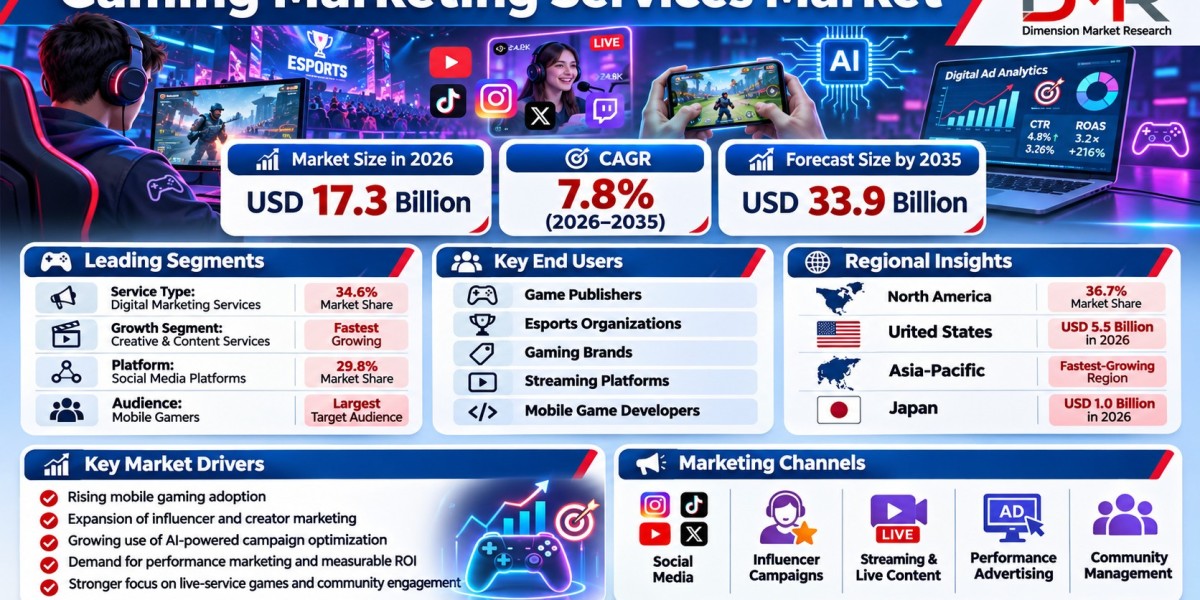

The global Gaming Marketing Services Market is expanding as video game publishers, esports organizations, and gaming brands adopt data-driven strategies to attract players, improve engagement, and strengthen long-term retention. According to Dimension Market Research, the market is projected to reach USD 17.3 billion in 2026 and USD 33.9 billion by 2035, registering a CAGR of 7.8% during the forecast period.
Growing investment in mobile gaming, influencer marketing, performance advertising, and AI-powered campaign optimization is reshaping the gaming marketing ecosystem.
As free-to-play and live-service gaming models expand, publishers increasingly require continuous marketing support rather than promotional campaigns focused exclusively on game launches.
What Is the Gaming Marketing Services Market?
The Gaming Marketing Services Market includes specialized promotional, creative, analytical, and strategic services designed for video games, gaming platforms, esports organizations, and brands seeking to reach gaming audiences.
These services cover digital advertising, social media campaigns, influencer collaborations, content production, performance marketing, community management, and audience analytics.
Unlike conventional marketing, gaming-focused campaigns must account for player preferences, gaming platforms, community behavior, and engagement throughout the game lifecycle.
For example, mobile game publishers use performance campaigns to acquire new users, while esports organizations rely on sponsorship promotion, streaming partnerships, and community engagement to develop audience relationships.
The market also includes services supporting game launches, user retention, in-game advertising, and cross-platform brand communication.
Why Is the Gaming Marketing Services Market Growing?
The expansion of mobile gaming is a major factor supporting demand.
Smartphone accessibility, digital distribution, and free-to-play business models have increased competition for player attention.
Game publishers are investing in specialized marketing strategies to improve discovery, attract suitable audiences, and manage customer acquisition costs.
Influencer-led marketing represents another important development. Gaming audiences frequently discover titles through livestreams, gameplay videos, short-form content, and creator recommendations.
This encourages publishers to develop long-term relationships with content creators rather than relying entirely on conventional advertising.
Performance marketing is also gaining importance because publishers increasingly evaluate campaigns using measurable indicators such as cost per install, return on advertising spend, conversion rates, and player lifetime value.
For marketing agencies, demand is shifting toward integrated services that combine creative development, analytics, and ongoing campaign optimization.
Get a Free Sample of the Gaming Marketing Services Market Report
Explore market forecasts, leading service categories, gaming audiences, platform demand, regional opportunities, and competitive developments.
Request a free sample to evaluate the report's relevance to gaming advertising, agency expansion, technology investment, and digital marketing strategy.
https://dimensionmarketresearch.com/request-sample/gaming-marketing-services-market/
Which Marketing Services Dominate the Market?
Digital Marketing Services are projected to dominate the service type category with 34.6% market share in 2026.
This segment includes social media advertising, search marketing, SEO, display advertising, and programmatic campaigns customized for gaming audiences.
Its leadership reflects demand for measurable user acquisition, real-time campaign optimization, and scalable promotion across multiple gaming platforms.
Creative & Content Services are identified as the fastest-growing service category.
Increasing demand for gameplay trailers, creator-generated content, storytelling, and promotional videos is strengthening investment in creative production.
For gaming publishers, combining performance-driven advertising with authentic creative content is becoming increasingly important for audience engagement.
How Are Social Media and Influencer Platforms Shaping Gaming Marketing?
Social Media Platforms are expected to lead the platform category with 29.8% market share in 2026.
Their importance reflects widespread adoption of interactive video, community discussions, gaming content, and targeted advertising.
Streaming and influencer platforms also play an important role in helping publishers engage audiences through live gameplay, reviews, esports coverage, and creator partnerships.
Mobile Gamers are projected to represent the largest target audience category, supported by the extensive reach of smartphone gaming.
Gaming campaigns increasingly differentiate between casual players, competitive gamers, PC and console users, and esports audiences.
This segmentation allows marketing teams to customize content, select suitable advertising channels, and optimize engagement strategies.
How Is Artificial Intelligence Transforming Gaming Marketing?
Artificial intelligence is becoming a significant part of gaming campaign planning and execution.
AI-powered audience segmentation helps marketers identify player interests, gaming behaviors, and potential engagement patterns.
Predictive analytics can support budget allocation, campaign forecasting, and performance measurement.
Automated creative testing allows publishers to evaluate multiple advertising formats and identify which messages perform effectively.
Fraud detection systems also help identify invalid advertising traffic and suspicious installation patterns.
Another important application is personalized communication throughout the player lifecycle.
Marketing teams can use behavioral insights to develop campaigns for new players, active users, and audiences who have stopped engaging.
However, successful AI adoption still depends on reliable data, transparent measurement, and creative content that resonates with gaming communities.
Regional Analysis: North America Leads While Asia-Pacific Expands
North America is projected to dominate the Gaming Marketing Services Market with a 36.7% revenue share in 2026.
The region benefits from established game publishers, marketing agencies, streaming platforms, esports organizations, and advanced advertising infrastructure.
The United States market is projected to reach USD 5.5 billion in 2026, supported by digital advertising investment and strong demand for gaming-focused marketing services.
Asia-Pacific is expected to be the fastest-growing regional market.
Expanding mobile gaming participation, increasing digital advertising expenditure, and growing esports ecosystems support opportunities across China, Japan, South Korea, India, and Southeast Asia.
Japan's gaming marketing services market is projected to reach USD 1.0 billion in 2026, reflecting its established console and mobile gaming culture.
Europe remains important for multilingual gaming campaigns, influencer partnerships, esports marketing, and localized digital content.
Competitive Landscape and Emerging Opportunities
The competitive landscape includes global advertising companies, specialist gaming marketing agencies, influencer management providers, and performance marketing businesses.
Prominent companies covered in the report include WPP, Publicis Groupe, Omnicom Group, Dentsu, Cheil Worldwide, Viral Nation, Kairos Media, NeoReach, Goat Agency, Freaks 4U Gaming, and Liquid+Arcade.
Competition focuses on gaming industry expertise, creative differentiation, audience analytics, influencer relationships, and measurable campaign performance.
The January 2026 introduction of Agentic AI Digital Marketing services by Techmagnate reflects increasing interest in AI-assisted marketing execution.
The report also highlights Deutsche Telekom's August 2025 announcement of a 5G+ gaming service with NVIDIA, illustrating developments in the digital gaming ecosystem.
Challenges remain, including advertising fraud, platform fragmentation, changing privacy requirements, customer acquisition costs, and rapidly evolving player preferences.
For marketing agencies, opportunities exist in specialized gaming audiences, cross-platform campaigns, retention strategies, and AI-enabled analytics.
Future Outlook: Continuous Player Engagement Will Shape Marketing Investment
Through 2035, gaming marketing services are expected to become increasingly connected with player analytics, creator ecosystems, and performance-based engagement strategies.
Live-service games and continuously updated gaming environments create demand for sustained community management and marketing support.
AI-enabled targeting and personalized content may also improve campaign efficiency.
For publishers, agencies, and gaming technology providers, important considerations include audience acquisition costs, creator partnerships, campaign attribution, and long-term player engagement.
Explore the Complete Gaming Marketing Services Market Analysis
Explore the complete Gaming Marketing Services Market report to evaluate service type demand, platform adoption, target audience opportunities, end-user requirements, regional forecasts, and competitive positioning.
The analysis can support agency expansion, market entry, campaign investment, and strategic business planning.
https://dimensionmarketresearch.com/checkout/gaming-marketing-services-market/
Frequently Asked Questions
1. What is the size of the Gaming Marketing Services Market?
The global market is projected to reach USD 17.3 billion in 2026 and USD 33.9 billion by 2035.
2. What is the expected CAGR of the Gaming Marketing Services Market?
The market is forecast to grow at a CAGR of 7.8% during 2026 to 2035.
3. Which service type dominates the Gaming Marketing Services Market?
Digital Marketing Services are projected to lead with 34.6% market share in 2026.
4. Which region leads the global market?
North America is projected to dominate with a 36.7% market share in 2026, supported by established gaming publishers and digital advertising infrastructure.
5. What is driving the growth of gaming marketing services?
Key factors include mobile gaming adoption, creator-led promotion, performance advertising, live-service gaming, community engagement, and AI-powered campaign optimization.
Conclusion
The Gaming Marketing Services Market is evolving as gaming publishers and brands increasingly prioritize continuous player engagement and measurable marketing performance.
Digital Marketing Services and Social Media Platforms remain important segments, while creator partnerships and specialized content production represent additional opportunities.
Artificial intelligence is strengthening campaign analytics, audience targeting, and marketing automation.
As competition for gaming audiences intensifies, specialized marketing capabilities are expected to remain important for publishers, agencies, and digital entertainment brands through 2035.
Related Digital Marketing and Artificial Intelligence Market Insights
The Digital Marketing Software Market Size report examines platforms supporting customer relationship management, marketing automation, social media management, content marketing, and campaign analytics. The global market is projected to increase from USD 97.6 billion in 2025 to USD 500.2 billion by 2034, registering a CAGR of 19.9%. AI integration, omnichannel engagement, and data-driven marketing strategies are supporting expansion.
The AI for Sales and Marketing Market Share analysis explores artificial intelligence adoption across customer targeting, sales forecasting, marketing automation, and personalized communication. The global market is projected to grow from USD 55.2 billion in 2025 to USD 771.2 billion by 2034, registering a CAGR of 34.1%. Predictive analytics, intelligent recommendations, and automated customer engagement are important growth factors.
The Generative AI in Marketing Market Growth report examines generative AI applications across content development, personalized advertising, and digital marketing automation. The global market was projected at USD 3.3 billion in 2024 and is forecast to reach USD 33.7 billion by 2033, registering a CAGR of 29.6%. Software, text models, and content generation are identified as leading market categories.