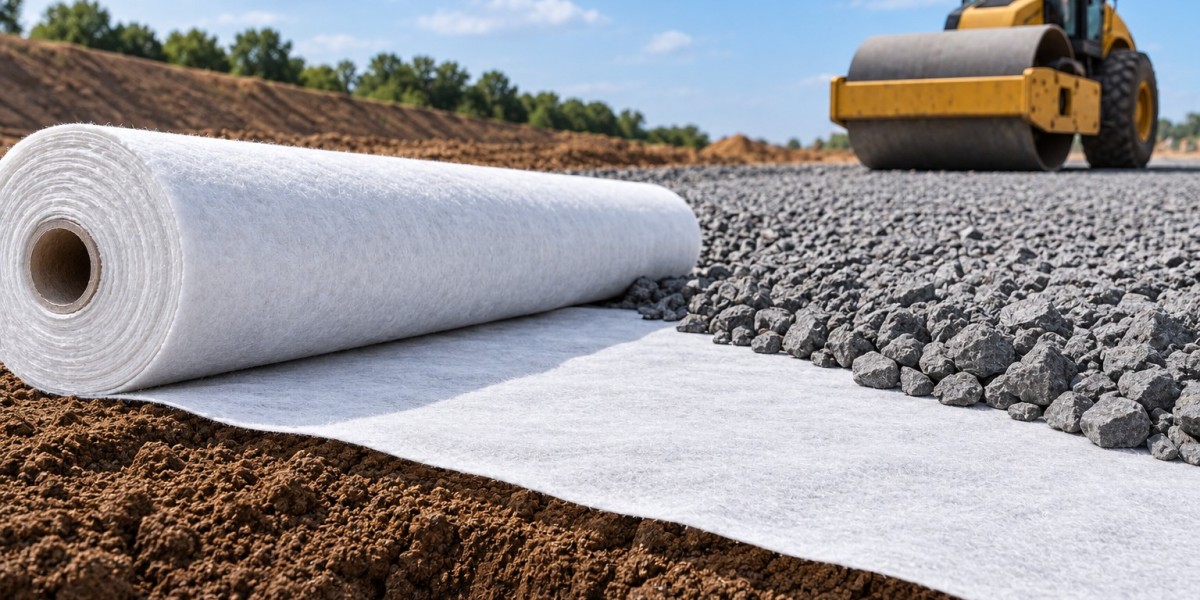

Ground conditions can create significant challenges for roads, construction sites, drainage systems, embankments, and other civil engineering projects. Weak or unstable soils may deform under repeated loading, allow aggregate to migrate into the subgrade, or make it difficult to maintain a stable working surface.
Geotextile soil stabilization is one approach used by engineers and contractors to improve the performance of soil and aggregate systems. By placing an engineered geotextile between or within soil layers, a project can benefit from separation, reinforcement, filtration, and improved load distribution.
The right geotextile, however, depends on the soil conditions, project design, loading requirements, drainage characteristics, and applicable specifications. Understanding how these functions work can help project teams select an appropriate material.
What Is Geotextile Soil Stabilization?
Geotextile soil stabilization involves using a geotextile fabric as part of a soil and aggregate system to improve its structural performance.
Geotextiles are engineered textile materials commonly manufactured from synthetic polymers such as polypropylene. They are available in different constructions and performance characteristics for applications in roads, drainage, erosion control, and civil infrastructure.
In stabilization applications, the geotextile can help create a more stable interface between weak subgrade soil and an aggregate layer. Its function may include reinforcement, separation, or filtration depending on the design and site conditions.
Rather than simply acting as a protective sheet, the geotextile becomes part of the engineered system.
Why Soil Stabilization Is Important
Many construction projects begin with soil that is not ideal for supporting the intended structure or traffic.
Soft, wet, or fine-grained soils can present problems such as:
Rutting under traffic
Aggregate contamination
Loss of bearing performance
Differential deformation
Difficult construction access
Poor drainage performance
Increased aggregate consumption
Traditional approaches may involve removing unsuitable soil and replacing it with better material. While excavation and replacement can work in some situations, it can also increase material, transportation, labor, and disposal requirements.
Geotextiles can provide another tool for engineers to consider when developing the site design.
How Geotextiles Support Soil Stabilization
The effectiveness of geotextile soil stabilization comes from several functions that can work together.
1. Separation
One of the most important functions is separation.
When aggregate is placed directly over soft subgrade, the two materials can mix under construction traffic and repeated loading. Fine soil particles may migrate upward while aggregate particles move downward.
A geotextile creates a physical separation layer between the materials.
This helps maintain the intended aggregate structure and can reduce contamination of the aggregate layer by the underlying soil.
2. Reinforcement
Depending on the product and project design, geotextiles can contribute to reinforcement by improving interaction between the aggregate and underlying soil.
Under loading, the geotextile can help distribute stresses through the system and provide additional resistance to deformation.
The level of reinforcement achieved depends on the geotextile's properties, installation conditions, soil characteristics, aggregate, and engineering design.
3. Filtration
Water movement is another important consideration in civil construction.
A suitable geotextile can allow water to pass through while restricting the migration of soil particles. This filtration function can help maintain drainage pathways without allowing excessive movement of fine soil.
The appropriate opening characteristics and permeability need to be matched to the surrounding soil and drainage requirements.
4. Stabilizing the Construction Surface
On weak or wet ground, maintaining a workable construction surface can be difficult. Heavy equipment can cause rutting or displacement before the permanent pavement or structure is installed.
A properly designed geotextile system can help create a more stable platform for placing and compacting aggregate.
This can make construction operations more predictable, particularly where the existing subgrade presents challenging conditions.
Where Is Geotextile Soil Stabilization Used?
Geotextile stabilization can be considered across a variety of civil and infrastructure projects.
Roads and Pavements
Road construction is one of the most common applications for geotextile stabilization.
Where weak subgrade conditions exist, a geotextile can be incorporated beneath an aggregate base to provide separation and support the overall pavement system.
This can be particularly relevant for roads exposed to repeated vehicle loading.
Temporary Access Roads
Construction sites, mining operations, utility projects, and other developments may require temporary access routes over soils that are difficult to traffic.
A geotextile can help separate the aggregate from the underlying soil and improve the performance of the temporary surface.
Embankments
Embankments constructed over weaker soils can experience settlement and deformation. Geotextiles may form part of an engineered solution designed to improve stability and control interaction between different soil layers.
Parking and Storage Areas
Large parking areas, equipment yards, and material storage surfaces can also benefit from appropriate geosynthetic design where the underlying soil presents stability or drainage challenges.
Construction Platforms
Before permanent structures or infrastructure are installed, contractors may need a stable platform for construction equipment.
Geotextiles can be incorporated into temporary or permanent systems to improve separation and support aggregate layers.
Woven vs. Nonwoven Geotextiles
Selecting the right geotextile starts with understanding the difference between woven and nonwoven constructions.
Woven Geotextiles
Woven geotextiles are produced by interlacing polymeric yarns or tapes into a structured fabric.
They are often considered where higher tensile performance, reinforcement, and separation are important.
Their relatively structured construction can make them suitable for demanding stabilization and infrastructure applications.
Nonwoven Geotextiles
Nonwoven geotextiles are manufactured by bonding or mechanically entangling polymer fibers.
They are commonly used when filtration, drainage, cushioning, or other functions are more important to the application.
Neither construction is universally better. The appropriate choice depends on the required performance and engineering design.
Key Specifications to Consider
Choosing a geotextile based only on thickness or fabric weight is not sufficient for a stabilization project.
Engineers and contractors should evaluate the properties relevant to the intended application.
Tensile Strength
Tensile strength can be important when the geotextile needs to withstand stresses during installation and service.
Grab Strength
Grab strength provides information about the fabric's resistance to localized tensile loading and can be relevant during installation.
Puncture Resistance
The material may encounter aggregate edges, construction equipment, and other sources of localized stress. Puncture resistance can therefore be an important consideration.
Permittivity and Filtration
Where drainage and filtration are part of the design, water flow characteristics and soil retention need to be evaluated together.
Apparent Opening Size
The opening characteristics of a geotextile influence its interaction with surrounding soil. The appropriate value depends on the soil and filtration requirements.
UV and Environmental Exposure
If the material will remain exposed during construction or service, environmental conditions should be considered when specifying the geotextile.
Why Project Specifications Matter
Geotextile selection should be driven by engineering requirements rather than choosing the most readily available product.
Infrastructure projects may include detailed specifications covering mechanical properties, hydraulic performance, testing, installation, and quality requirements.
For projects involving public infrastructure, state transportation departments, or other regulated applications, compliance with the relevant project specification can be particularly important.
This is why contractors and estimators should establish the required specification before purchasing material.
A product that appears suitable based on one performance characteristic may not satisfy the complete project requirement.
Working With Geotextile Suppliers
The supplier's ability to provide consistent material and appropriate documentation is an important consideration for specification-driven projects.
Contractors, engineers, and procurement teams should evaluate suppliers based on factors such as:
Product specifications
Testing documentation
Quality-control procedures
Manufacturing consistency
Available fabric constructions
Technical support
Project-specific requirements
Supply capacity
Relevant certifications or listings
For U.S. infrastructure applications, buyers may also need products that meet specific transportation or project requirements.
Working with experienced geotextile fabric suppliers can help project teams identify fabrics according to the required mechanical and hydraulic properties rather than selecting products solely by price.
Installation Is Part of Performance
Even a properly specified geotextile can perform poorly if installation practices do not follow the project design.
Before installation, the site should generally be prepared according to the engineering requirements. The geotextile needs to be placed without excessive folds or damage, with overlaps and connections handled according to the project specification.
Aggregate placement also needs to be managed carefully to avoid unnecessary damage to the fabric.
The specific installation method depends on the geotextile type, soil conditions, project design, and applicable specification.
Geotextile Soil Stabilization vs. Soil Replacement
Geotextile stabilization is not a universal substitute for excavation and soil replacement.
In some projects, unsuitable soil may need to be removed because of its depth, composition, contamination, groundwater conditions, or structural requirements.
In other situations, incorporating a geotextile into the pavement or aggregate system may provide a more practical approach.
The decision should therefore be based on site investigation and engineering analysis rather than treating geotextiles as a one-size-fits-all solution.
A Practical Approach to Geotextile Selection
A project team can simplify the initial evaluation by working through a structured process:
1. Evaluate the subgrade.
Understand soil type, strength, moisture, and expected site conditions.
2. Define the geotextile's primary function.
Determine whether separation, reinforcement, filtration, or a combination of functions is required.
3. Establish the project specification.
Identify required mechanical and hydraulic properties and any applicable standards.
4. Consider construction conditions.
Account for equipment, aggregate placement, site access, and potential installation stresses.
5. Evaluate suppliers.
Compare technical documentation, quality systems, consistency, supply capability, and project support.
This approach helps ensure that the selected material is connected directly to the project's engineering requirements.
Conclusion
Geotextile soil stabilization can provide an effective component of engineered systems for roads, access routes, embankments, construction platforms, and other civil infrastructure applications.
The value of a geotextile comes from more than simply placing fabric beneath an aggregate layer. Its ability to separate materials, support reinforcement, facilitate filtration, and improve construction-surface stability depends on selecting the appropriate product for the soil, loading, drainage conditions, and project specification.
For contractors, engineers, and procurement teams, the best starting point is a clearly defined performance requirement. Once those requirements are established, an experienced supplier can help identify a geotextile construction that is appropriate for the application and project specifications.