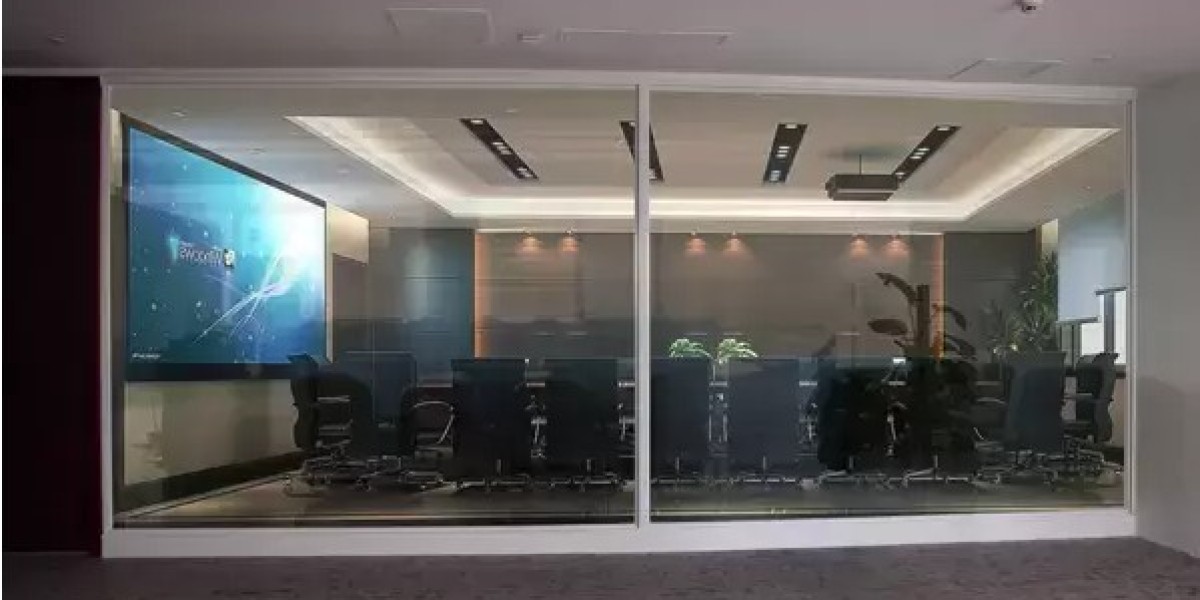

Glass is widely used in modern offices, showrooms, exhibition halls, training rooms, and commercial interiors because it brings in natural light and maintains visual connections between spaces. However, when a presentation or product demonstration begins, transparent glass is not always the ideal surface for displaying visual information.
A conventional projection screen can solve this problem, but it also requires dedicated space and becomes a permanent visual element. PDLC Smart Film offers another approach: the same glass partition can remain transparent during normal use and become a diffused projection surface when needed.
This combination of transparency, privacy, and projection makes Smart Film worth considering for multi-purpose commercial spaces.
How Can Smart Film Become a Projection Surface?
PDLC Smart Film contains a liquid crystal layer between transparent conductive layers. Electrical control changes the optical condition of the film, allowing it to switch between a transparent state and a diffused state.
When the glass is transparent, it can function as an ordinary architectural partition or window. Natural light can pass through, and people can maintain visual connections between different areas.
When the film switches to its diffused state, light is scattered across the surface. This creates a suitable background on which projected images can become visible.
The basic operating sequence can therefore be described as:
Clear glass → Diffused glass → Projection surface → Clear glass
No physical projection screen needs to be lowered or stored. The glass remains integrated into the architecture throughout the process.
Smart Film Projection vs. Conventional Projection Screens
A conventional projection screen is specifically designed for image display. Its optical characteristics are optimized around projected content.
Smart Film starts from a different purpose. It is primarily an architectural glazing solution that can also provide privacy and projection functionality.
The key advantage is therefore not necessarily superior image quality compared with a professional projection screen. Instead, the benefit is that one existing glass surface can perform several functions.
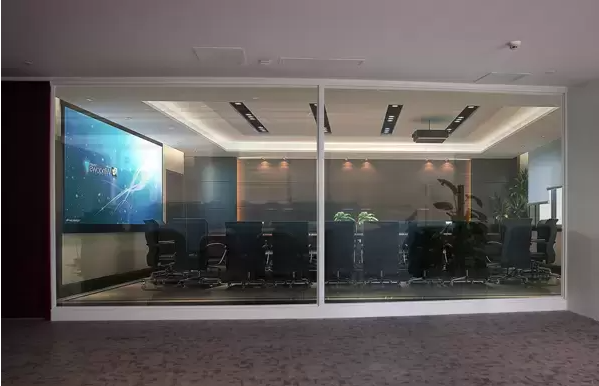
For example, a conference room partition can remain transparent during normal working hours, become private during confidential discussions, and serve as a presentation surface when required.
Similarly, a showroom can use transparent glazing between demonstrations and transform selected glass panels into display surfaces during product presentations.
Where Is Projection Smart Film Most Useful?
Smart Film projection is not intended to replace every dedicated display system. It is particularly relevant in spaces where glass already serves an architectural purpose and presentation functions are required periodically.
Conference and Meeting Rooms
Modern offices frequently use internal glass partitions to create open, collaborative environments. However, transparency can become a concern when confidential information is being discussed or displayed.
A switchable glass partition can become diffused during a private meeting. The same surface can then receive projected presentations without requiring a separate screen.
This gives meeting rooms greater flexibility while preserving the open appearance of the office when privacy is not required.
Showrooms and Product Demonstration Areas
Showrooms often need to display more than static product samples. Videos, technical diagrams, application scenes, installation information, and product presentations can all be part of the customer experience.
A Smart Film panel can remain transparent when no presentation is taking place and become a large projection surface during demonstrations.
This can be particularly useful where wall and floor space are limited because the existing glass itself becomes part of the presentation area.
Exhibition and Event Spaces
Exhibition layouts frequently change according to the event. A glass partition that works as an open divider during one period may need to become a presentation surface later.
Smart Film can allow the same panel to function as:
- An open visual partition
- A privacy divider
- A projection surface
- A branded display background
This flexibility can be useful in temporary or multi-purpose commercial environments where permanent display construction is undesirable.
Training and Education Rooms
Training rooms can also benefit from flexible glass surfaces. Glass partitions can bring daylight into learning spaces and maintain visibility between areas when classes are not taking place.
During a training session, the glass can switch to its diffused state and provide an area for projected content. After the session, transparency can be restored.
However, projection performance depends strongly on projector selection and ambient lighting, so the glass should be considered as part of the overall display system.
Projection Performance Depends on More Than Film
Installing Smart Film on a large glass panel does not automatically guarantee excellent projection performance.
The final result depends on the relationship between glass dimensions, viewing distance, projector resolution, projector brightness, throw distance, ambient lighting, and the optical characteristics of the film.
Before specifying a system, project teams should evaluate:
- Glass width and height
- Audience viewing distance
- Projector brightness
- Projector throw distance
- Ambient lighting
- Film optical characteristics
- Glass construction
For example, an image that appears sharp and readable on a moderate-sized meeting-room surface may not provide the same experience when expanded across a much larger glass wall.
The projector must also illuminate the intended image area consistently. If the projection surface is larger than the projector's practical range, brightness and image uniformity may become concerns.
Ambient Lighting Can Affect Image Quality
Lighting is one of the most important factors in any projection application.
A dark conference room creates very different conditions from a glass-walled showroom exposed to strong daylight. In bright environments, projected images have to compete with surrounding illumination, which can reduce contrast and make small details more difficult to read.
Smart Film can control the transparency of the glass, but it cannot eliminate daylight entering through other windows.
Designers should therefore consider:
- The direction of external glazing
- Direct sunlight during presentation hours
- Curtains and external shading
- Projector brightness
- Viewing distance
- Artificial lighting
- The type of projected content
Large photographs, videos, and graphics may be easier to view than presentations containing small text or detailed technical drawings. The design target should therefore be based on the actual content that audiences need to see.
Projector Position Should Be Planned Early
The projector still needs an appropriate optical path even when Smart Film provides the projection surface.
Front projection requires careful consideration of projector location, throw distance, lens characteristics, installation height, and image geometry. Short-throw or ultra-short-throw projectors may help in rooms where available space is limited, but they also require accurate alignment.
Rear projection can be considered in certain architectural configurations. In this arrangement, the projector is positioned behind the glass and projects toward the viewing side. This may help keep equipment away from the audience and reduce shadows caused by people moving in front of the projector.
The feasibility of rear projection depends on the available construction depth, projector type, film configuration, and optical requirements. For this reason, the projection concept should be tested during the design stage rather than left until installation.
Laminated Smart Glass or Self-Adhesive Smart Film?
The appropriate Smart Film construction can depend on whether the project involves new glazing or an existing glass partition.
For new construction, laminated Smart Glass can be incorporated into the glazing specification from the beginning. This provides an opportunity to coordinate dimensions, edge treatment, electrical connections, and installation requirements.
For renovation projects, Self-Adhesive Smart Film can provide another option when the existing glass is suitable. Instead of replacing the complete panel, the existing glazing can potentially be converted into a switchable surface.
The choice should be based on the actual project conditions rather than projection requirements alone. Electrical routing, glass construction, edge protection, installation access, maintenance, and final appearance also need to be considered.
Smart Film Is Only One Part of the Display System
A successful Smart Film projection installation requires several components to work together.
The film controls the optical state of the glass. The power supply provides electrical power. Control equipment determines how the film switches. The projector generates the image, while room lighting affects contrast and visibility.
For a larger installation, these elements should be planned as one integrated system.
A typical sequence could be:
Presentation command → Smart Film switches to diffused state → projector starts → presentation begins
After the presentation:
Presentation ends → projector switches off → Smart Film returns to transparent state
The system may also be connected to building automation, lighting, blinds, room-booking systems, or other controls when required.
Electrical Planning Is Essential
Smart Film requires electrical connections along its edges, and larger installations may consist of several individually controlled sections.
Before installation, project teams should determine:
- Where the power supply will be installed
- How wiring will reach each panel
- Whether panels should operate together or independently
- How maintenance personnel will access control equipment
- Whether control will use wall switches, remote controls, centralized systems, or building automation
For multi-panel installations, zone control can provide additional flexibility. Different sections of a large partition may be switched independently depending on the requirements of the meeting, exhibition, or presentation.
Let the Content Determine the Specification
The type of information being projected should influence the design.
Large photographs, videos, logos, diagrams, and presentation slides can have different requirements from spreadsheets, CAD drawings, engineering details, or other content containing small text.
Instead of asking only, “How large can the projection surface be?”, project teams should also ask:
“What information must the audience read from that distance?”
A showroom may prioritize large product images, while an engineering meeting room may require detailed technical information. Exhibition spaces may place greater emphasis on video and visual effects.
These differences influence projector selection, image size, glass dimensions, lighting, and viewing geometry.
Smart Film Can Combine Privacy and Projection
Projection is not the only useful function of switchable glass.
In many commercial spaces, glass partitions create privacy requirements even when there is no presentation taking place. Offices may need confidential meetings, consultation rooms may need visual separation, and exhibition areas may require temporary privacy.
Smart Film can use the same diffused state for both privacy and projection.
This means a single glass partition can potentially support three conditions:
Open → Private → Presentation
For example, a consulting room can remain transparent when unoccupied, switch to a private state during a confidential meeting, and then serve as a projection surface when a presentation is required.
What Should Be Checked Before Ordering Smart Film?
Before placing an order, project teams should provide enough information for the supplier to evaluate the complete application.
Important details include:
- Glass dimensions and quantity — including individual panel sizes and joint locations.
- Existing or new glass — to determine whether laminated Smart Glass or retrofit film is appropriate.
- Room dimensions — particularly projector-to-glass distance and audience position.
- Lighting conditions — including daylight direction and artificial lighting during presentations.
- Content type — such as video, graphics, text, technical drawings, or mixed content.
- Control requirements — including independent zones, centralized control, remote operation, or building automation.
- Installation conditions — including cable routes, power supply location, access, and edge details.
Providing this information early allows the Smart Film, glass construction, electrical system, and projection equipment to be evaluated together.
The Architectural Value of Projection Smart Film
The main purpose of Smart Film projection is not to replace every conventional projection screen. Dedicated projection screens remain appropriate for applications where maximum display performance is the primary requirement.
Smart Film serves a different purpose.
It is particularly relevant when a project already includes substantial glass and that glass needs to perform several functions throughout the day.
An office partition could provide daylight in the morning, privacy during a management meeting, and a presentation surface during an afternoon training session. A showroom window could remain transparent between demonstrations and become a large display surface during a product presentation. An exhibition partition could support an open layout during visitor circulation and then become a visual backdrop during an event.
This is where PDLC Smart Film offers a distinctive architectural concept: the glass surface does not need to remain dedicated to one function.
Designing Smart Film as Part of the Display Architecture
The most important planning decisions should be made before the film is installed.
If Smart Film is specified independently and the projector is selected later, practical problems may appear near the end of the project. The glass could be too large for the intended projector, ambient light could be excessive, wiring could be difficult to route, or the viewing distance might not match the required image resolution.
A more effective approach is to consider the glazing, Smart Film, projector, lighting, electrical controls, and room layout together.
For architects, interior designers, and project contractors, the key question is therefore not simply whether glass can become a projection surface. It is:
What should this glass do when it is transparent, and what should it do when it is diffused?
Privacy may be the first requirement, projection may be the second, and visual separation, branding, daylight management, or flexible room division may follow.
When these functions are clearly defined, it becomes easier to determine the appropriate Smart Film configuration and control system.
For commercial interiors where glass already occupies valuable wall space, transforming that surface into an occasional projection screen can add functionality without introducing another permanent architectural element. Smart Film can therefore be viewed not simply as a smart window or a digital display, but as a flexible glass surface capable of adapting to the way a space is used.