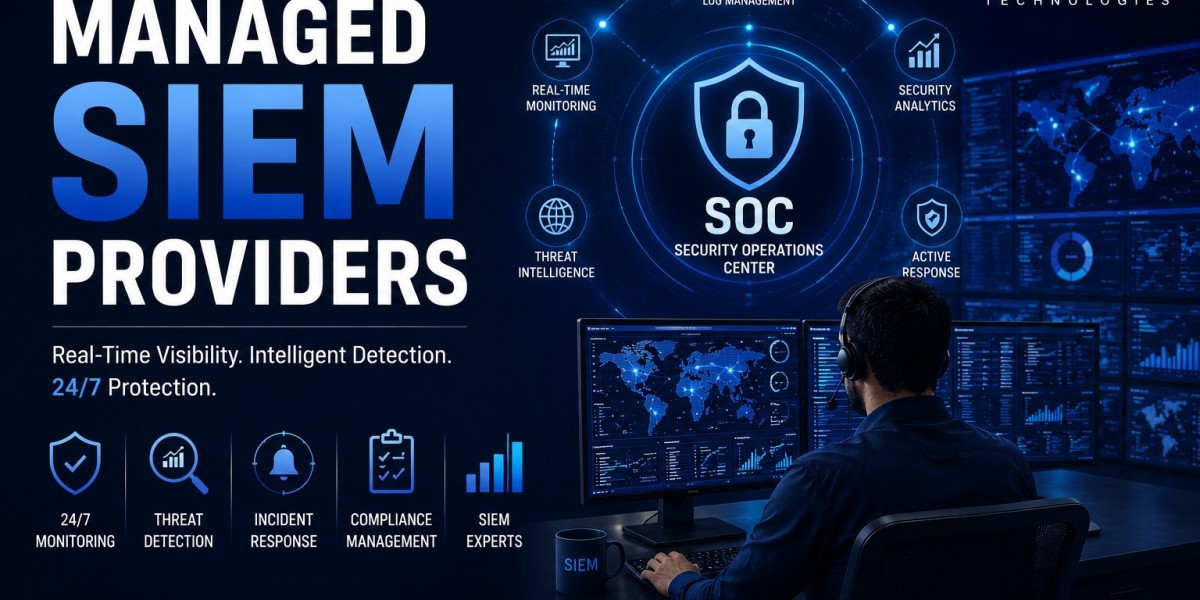

The Changing Security Reality for ICT Businesses
Managed SIEM providers give ICT organizations a way to centralize security information and support ongoing monitoring across increasingly distributed technology environments.
ICT businesses operate in an environment where connectivity is central to daily operations. Networks, communication platforms, applications, cloud infrastructure, endpoints, identity systems, and customer-facing services can all generate security-relevant activity.
That creates a visibility challenge.
A security event occurring on one system may appear insignificant when viewed alone. The same event can become much more important when combined with activity from another system.
For ICT organizations, effective security monitoring is therefore increasingly about connecting individual events into a broader operational picture.
How a Managed SOC Service Complements SIEM
A managed soc service provides operational security support around monitoring, analysis, alert handling, and escalation, while SIEM technology helps collect and correlate security events from multiple sources.
This relationship is important because SIEM technology by itself does not determine what an event means to the business.
Consider a situation where an administrative account suddenly accesses a system outside its normal pattern. A SIEM can record and correlate the relevant events. Security analysts can then examine the activity in context and determine whether it requires investigation or escalation.
The combination of centralized security data and human analysis creates a more complete monitoring process.
For ICT businesses, this can be particularly relevant because their technology environments may change frequently. New services, network connections, applications, users, and infrastructure components can introduce additional sources of security telemetry.
Why ICT Environments Generate Complex Security Signals
ICT organizations often have multiple interconnected technology layers.
A network event may relate to an endpoint event. An authentication event may connect to application activity. A configuration change may coincide with unusual traffic.
Looking at these events separately can make investigation harder.
SIEM platforms are designed to bring relevant information into a centralized environment, allowing relationships between events to be examined more effectively.
The operational challenge is maintaining meaningful visibility as the environment evolves.
This involves deciding which logs and events should be collected, ensuring that relevant data remains available for analysis, and continuously reviewing detection and alerting logic.
A managed approach can provide operational support for these activities.
From Event Collection to Security Investigation
A useful way to understand managed SIEM is to view it as a sequence rather than a single technology.
1. Security Data Enters the Monitoring Environment
Relevant systems generate logs and security events.
These may include authentication activity, network events, endpoint information, application events, or other security-relevant records.
The quality of monitoring depends partly on whether the right information is available. If important systems are not generating usable security data, monitoring will naturally have limitations.
2. Events Are Correlated
Individual events can be analyzed alongside other activity.
Correlation helps identify patterns that may otherwise be difficult to notice.
For example, several failed authentication attempts followed by a successful login and unusual system activity may warrant greater attention than any one event viewed independently.
3. Alerts Are Prioritized
Not every security event requires the same level of attention.
Alert prioritization helps security teams focus their time on activity that has greater potential significance.
This is particularly important in environments where large volumes of security telemetry are generated.
4. Analysts Investigate Relevant Activity
Security analysts can review the available evidence and determine whether an alert represents normal activity, suspicious behavior, or a potential incident.
Context is essential at this stage.
5. Incidents Are Escalated
When activity requires action, defined escalation procedures can connect the monitoring function with the organization's internal IT and security teams.
Clear ownership helps prevent uncertainty during security events.
Why Alert Noise Can Become an ICT Problem
One of the less visible challenges of SIEM management is alert volume.
A monitoring environment can generate a large number of notifications. If too many are irrelevant, security teams may spend substantial time reviewing events that do not require action.
Over time, excessive noise can make it harder to identify meaningful activity.
This is why monitoring requires continuous tuning.
Detection logic needs to reflect the organization's actual environment. Legitimate administrative activity should be understood in context, while unusual behavior should receive appropriate attention.
Managed security operations can help provide an ongoing process for reviewing and improving alert quality.
The objective is not simply to produce more alerts. It is to make security monitoring more useful.
What ICT Leaders Should Look for in a Managed SIEM Model
The right service should fit the organization's operational environment.
Visibility Across Relevant Systems
Before discussing service features, ICT leaders should establish which systems require monitoring.
A provider should be able to explain how relevant security data is incorporated and where monitoring coverage begins and ends.
Defined Operational Responsibilities
The organization and provider should have clear responsibilities.
Questions should cover monitoring, alert review, investigation, escalation, reporting, and internal incident handling.
Ambiguity can create delays when an important security event occurs.
Flexible Monitoring
ICT environments can change quickly.
Monitoring arrangements should therefore accommodate infrastructure changes without making security visibility unnecessarily difficult to maintain.
Actionable Reporting
Security reports should help stakeholders understand what happened and what requires attention.
Useful reporting can support operational decision-making rather than simply presenting technical event counts.
Communication During Incidents
A monitoring service becomes more valuable when its communication process is clear.
ICT teams should understand how significant events are communicated, what information accompanies an escalation, and how follow-up activities are coordinated.
A Different Way to Think About SIEM Value
SIEM is sometimes evaluated primarily as a technology purchase.
For ICT organizations, it can be more useful to view it as part of an operational security workflow.
The platform provides security data.
The monitoring process turns that data into alerts.
Analysts add context.
Escalation connects security findings with people responsible for taking action.
Reporting provides visibility to stakeholders.
This sequence illustrates why managed SIEM providers can be relevant even when an organization already owns or operates security technologies.
The value is not necessarily another layer of software. It is the operational capability surrounding security information.
Where Human Expertise Fits
Automation can process large volumes of events quickly, but security operations still require human interpretation.
An unusual activity pattern may have several possible explanations.
An administrator could be performing an approved task. A system migration could be creating unexpected traffic. A legitimate application update could generate a sequence of events that resembles suspicious behavior.
Without context, an alert can be difficult to interpret.
Analysts can examine related activity, organizational knowledge, and available evidence before determining whether further action is appropriate.
For ICT organizations, this human layer can help reduce the gap between technical detection and business-aware decision-making.
Security Monitoring and the Indian ICT Context
Indian ICT businesses need to consider security monitoring within the broader context of information-security governance.
Organizations may have contractual obligations, internal security policies, regulatory requirements, or certification objectives that influence how security events are monitored and documented.
Centralized monitoring can help organizations maintain greater visibility into relevant activity and support investigation when security events occur.
However, SIEM should not be treated as a universal compliance solution.
The appropriate monitoring scope depends on the organization's systems, data, applicable obligations, and security objectives.
Where ISO/IEC 27001 is relevant, organizations should consider how security monitoring aligns with their broader information-security management processes rather than treating it as an isolated technology activity.
A Practical Operating Model for ICT Teams
A sustainable approach can be built around several connected activities:
- Identify critical systems and security data sources
- Establish which events require closer monitoring
- Centralize relevant security information
- Develop appropriate detection and correlation logic
- Review alerts according to defined priorities
- Investigate suspicious activity using available context
- Escalate significant events through agreed procedures
- Review monitoring quality regularly
- Maintain appropriate security records and reports
- Update monitoring as the technology environment changes
These activities help transform SIEM from a passive collection platform into an active component of security operations.
Making Security Visibility More Operational
ICT businesses do not necessarily need more security information. They need meaningful visibility into what that information represents.
Managed SIEM can help create that visibility by bringing together security telemetry, event correlation, monitoring processes, analyst investigation, and escalation.
A managed SOC model can further support the operational side of this process by providing structured security monitoring and response capabilities.
Contact Us:
IND- 02067680404
IBN Technologies Ltd.
E-mail: - [email protected]