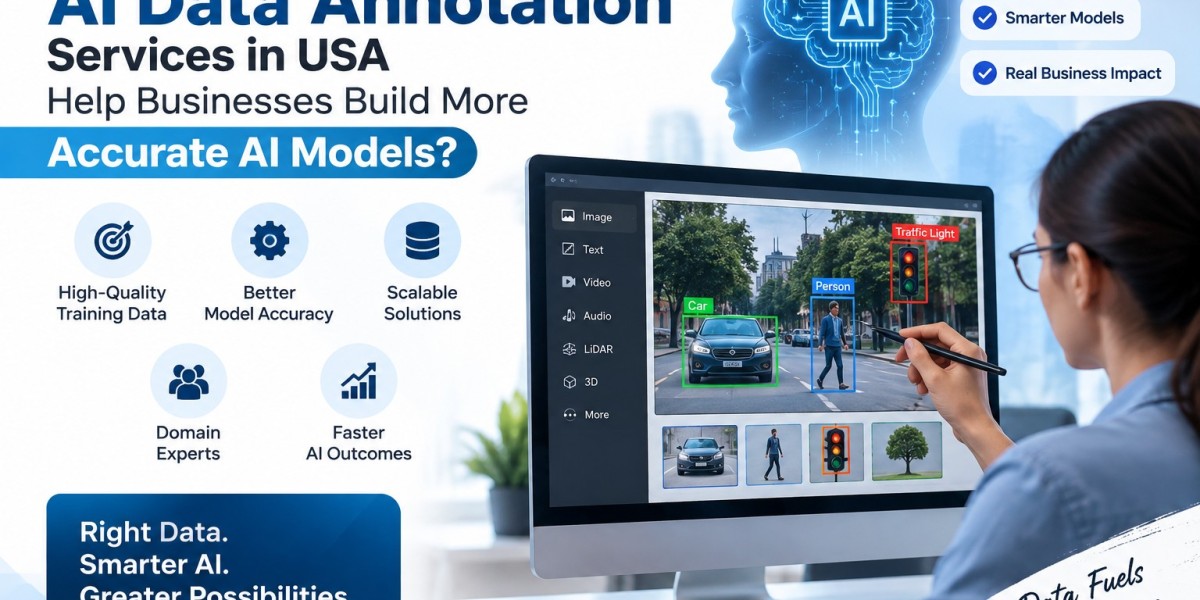

Artificial intelligence is becoming part of everyday business operations, from customer support and fraud detection to medical image analysis, recommendation systems, autonomous technologies, and document processing. But behind every reliable AI model is one important requirement: high-quality training data. Even the most advanced machine learning algorithm can produce poor results when it learns from incomplete, inconsistent, or incorrectly labeled information.
This is where AI Data Annotation Services in USA can make a practical difference. Data annotation transforms raw images, videos, text, audio, and other information into structured training data that machine learning models can understand. Accurate annotations help AI systems recognize patterns, classify information, and make more dependable predictions.
For businesses developing AI products or improving existing machine learning systems, professional annotation can also reduce the workload placed on internal teams. With the right processes, quality controls, and domain knowledge, organizations can create datasets that better represent their real-world use cases.
Vision Infotech helps businesses explore data-focused technology solutions designed around their operational and AI requirements. Understanding how professional annotation works can help companies decide when external expertise is useful and how it can contribute to better AI model development.
What Is AI Data Annotation?
AI data annotation is the process of adding meaningful labels, tags, categories, or descriptions to raw data so that an AI or machine learning model can learn from it.
For example, an autonomous vehicle system may need thousands of images where cars, pedestrians, traffic signs, bicycles, and road boundaries are identified. A natural language processing system may require text labeled according to sentiment, intent, entities, or topics.
Depending on the project, annotation can include:
- Image classification and object detection
- Video annotation and tracking
- Text classification
- Sentiment and intent labeling
- Speech and audio transcription
- Semantic and instance segmentation
- Named entity recognition
- Document and invoice annotation
- Medical image labeling
- LiDAR and 3D point-cloud annotation
The objective is not simply to label a large amount of data. The labels must accurately reflect the rules and requirements of the AI application.
Why Does Data Quality Matter for AI Models?
Machine learning models identify patterns from the examples provided during training. If those examples contain incorrect labels, missing information, inconsistent classifications, or excessive noise, the model can learn the wrong patterns.
Consider an AI system designed to identify damaged products from warehouse images. If images showing minor scratches are inconsistently labeled as either “damaged” or “normal,” the model may struggle to understand the difference.
This is why AI Data Annotation Services in USA can be valuable for organizations that need structured and reliable datasets. Professional annotation teams can establish clear labeling guidelines, review samples, identify inconsistencies, and apply quality assurance procedures throughout the project.
Better data does not automatically guarantee a perfect AI model. Model architecture, training methods, feature quality, testing, deployment conditions, and other factors also matter. However, high-quality training data gives the model a stronger foundation.
How Can AI Data Annotation Services in USA Improve Model Accuracy?
1. Creating Consistent Training Data
Consistency is one of the most important aspects of machine learning data preparation. Different annotators may interpret the same information differently unless clear guidelines are established.
For example, if a company is training an AI model to categorize customer support messages, one annotator may label “I cannot access my account” as a login problem while another may classify it as a security issue.
Professional annotation workflows establish definitions and examples for each category. This creates greater consistency across the dataset and helps the model learn more predictable patterns.
2. Reducing Human Labeling Errors
Manual annotation can become difficult when teams are working with thousands or millions of records. Repetitive work can lead to missed objects, incorrect classifications, incomplete labels, and other errors.
A structured annotation process can include multiple levels of review. Annotated samples can be checked by quality reviewers, and disagreements can be resolved using predefined guidelines.
For businesses using AI Data Annotation Services in USA, this type of quality control can help reduce avoidable errors before datasets reach the model-training stage.
3. Supporting Different Types of AI Data
AI projects rarely depend on only one type of information. A business may need to process product images, customer conversations, documents, audio recordings, or videos.
Professional annotation providers can support different data formats and annotation methods according to project requirements.
For instance, a healthcare technology company developing an image-based AI solution may require carefully labeled medical images. A retail business may need product image classification and customer review analysis. A logistics company may require video or sensor-data annotation.
The annotation approach should therefore be connected to the actual AI use case rather than using the same labeling process for every project.
What Role Does Quality Assurance Play in AI Annotation?
Quality assurance is an important part of professional data annotation because simply completing labels does not mean the dataset is ready for machine learning.
Establishing Clear Annotation Guidelines
Before annotation begins, the project should define what each label means, how difficult cases should be handled, and which situations require escalation.
Clear instructions reduce ambiguity and improve consistency between annotators.
Reviewing Annotated Samples
Quality teams can review a percentage of completed work to identify recurring errors. If a particular label is frequently misunderstood, the annotation guidelines can be clarified before the problem affects a larger portion of the dataset.
Measuring Agreement and Accuracy
Annotation projects can use quality metrics to understand how consistently different annotators apply the same rules. When disagreement is high, the underlying labeling instructions may need to be reviewed.
Continuous Improvement
Annotation is not necessarily a one-time activity. As an AI project develops, new edge cases may appear. Updating guidelines and reviewing difficult examples can help maintain dataset quality over time.
These practices make AI Data Annotation Services more than simple data labeling. They turn annotation into a controlled data preparation process that supports machine learning development.
Can Annotation Help Businesses Reduce AI Development Challenges?
Developing an AI model requires more than selecting an algorithm. Businesses also need to collect suitable data, clean it, organize it, label it, test it, and maintain it.
Internal development teams may have strong technical skills but limited time for large-scale manual annotation. Outsourcing selected annotation activities can allow technical employees to focus on model development, testing, integration, and product improvements.
For example, imagine a software company developing an AI document-processing platform. Its developers need to improve the model while thousands of invoices and business documents require labeling. A specialized annotation team can manage the labeling workflow according to documented requirements while the company's technical team concentrates on the product itself.
This division of responsibilities can make the overall development process more manageable.
How AI Data Partnership Services in USA Support Long-Term AI Projects
AI development is often an ongoing process rather than a single project. As businesses collect new information, models may need additional training data.
This is where AI Data Partnership Services in USA can become relevant. Instead of treating annotation as an isolated task, a long-term data partnership can support recurring data preparation, quality management, annotation expansion, and changing project requirements.
For example, an AI company may initially need 50,000 annotated images. After deploying its model, it may discover that certain environments, lighting conditions, product types, or customer behaviors are underrepresented. Additional annotation can then help create a broader dataset.
A reliable data partner can help businesses adapt their annotation workflow as their AI applications evolve.
What Industries Can Benefit From AI Data Annotation?
Healthcare
Healthcare AI applications can use annotated medical images, clinical documents, patient-related text, and other datasets. Because healthcare information can be highly specialized, annotation guidelines may require domain-specific expertise and careful quality controls.
Retail and E-Commerce
Retail businesses can use annotation for product recognition, image categorization, recommendation systems, customer sentiment analysis, and visual search.
Automotive
Autonomous and advanced driver-assistance technologies can require annotated road images, video frames, objects, lane markings, traffic signs, and 3D sensor information.
Financial Services
Financial organizations can use annotated documents, transaction information, customer communications, and other structured or unstructured data for AI-based applications.
Manufacturing
Manufacturers can apply computer vision to identify defects, inspect products, monitor production environments, and improve quality-control processes.
For these use cases, AI Data Annotation Services in USA can help transform large volumes of raw information into datasets that are more useful for supervised machine learning and computer vision applications.
What Should Businesses Consider Before Choosing an Annotation Provider?
Not every annotation project has the same requirements. Before selecting a provider, businesses should understand the type of data involved, required annotation formats, expected volume, quality requirements, turnaround expectations, security considerations, and project complexity.
Data security should receive particular attention when datasets contain confidential business information, customer records, proprietary images, or other sensitive material.
Businesses should also ask how the provider manages quality assurance, annotator training, project monitoring, revisions, and communication.
A provider should be able to explain its workflow clearly rather than focusing only on the number of records it can annotate.
How Vision Infotech Can Support AI Data Requirements
Vision Infotech works with businesses looking to adopt and improve technology solutions based on their operational needs. For organizations developing AI applications, data preparation is an important part of building a dependable technology foundation.
Our approach can focus on understanding the project's data type, business objective, annotation requirements, workflow, and expected output before defining the appropriate solution.
Why Choose Vision Infotech?
Businesses need more than a team that can simply label data. They need technology expertise, clear communication, attention to data quality, and an understanding of how prepared datasets fit into the broader AI development process.
Vision Infotech brings experience in software development, AI development, AI consulting, automation, and technology solutions. This broader perspective can help businesses connect their data requirements with their overall technology objectives.
When working on an AI data project, Vision Infotech can focus on structured workflows, project-specific requirements, quality considerations, scalability, and practical business outcomes. This makes the process easier to align with an organization's existing AI development strategy.
For companies considering AI Data Annotation Services in USA, working with a technology partner that understands both data requirements and AI development can help create a more connected approach to the project.
How Can Businesses Get Better Results From AI Annotation?
Businesses can improve annotation outcomes by defining the intended AI use case before labeling begins. The team should understand what the model needs to recognize and what types of mistakes could affect business performance.
A representative dataset is also important. If training data does not reflect real-world conditions, the resulting model may perform differently after deployment.
Regular quality checks should continue throughout the project instead of waiting until all data has been annotated. Businesses should also maintain documentation so that annotation decisions remain consistent when new annotators or new datasets are introduced.
Using AI Data Annotation Services in USA with a clearly defined workflow can help organizations manage these requirements more systematically.
The Connection Between Data Annotation and AI Model Performance
AI model performance depends on multiple factors, but training data remains one of the core components. Accurate labels help supervised learning systems understand what they are expected to identify or predict.
Poorly labeled data can introduce confusion into the training process. On the other hand, carefully prepared datasets can provide clearer examples and better representation of the target problem.
This does not mean businesses should simply pursue the largest possible dataset. Data relevance, diversity, consistency, coverage, and accuracy are all important. In some situations, improving the quality of an existing dataset can be more useful than continuously adding unreviewed data.
That is why AI Data Annotation Services in USA should be considered as part of a broader data strategy rather than as a standalone outsourcing activity.
Conclusion
Accurate AI models begin with reliable data. Whether a business is developing computer vision, natural language processing, document intelligence, speech recognition, or another machine learning application, the quality of its training dataset can influence how effectively the system learns.
Professional AI Data Annotation Services in USA can help businesses organize raw data, apply consistent labels, reduce annotation errors, introduce quality assurance, and prepare datasets for machine learning workflows. When supported by clear guidelines and ongoing reviews, annotation can become an important part of a company's AI development process.
Long-term AI Data Partnership Services can also provide businesses with a more flexible approach when their data requirements continue to change as AI products grow.
For organizations looking to build or improve AI solutions, the goal should not simply be to annotate more data. The focus should be on creating relevant, accurate, consistent, and useful training data that reflects real business requirements.
With its broader experience in AI development, software solutions, consulting, and automation, Vision Infotech can help businesses approach AI data requirements as part of a complete technology strategy. Choosing the right process and technology partner can help organizations create a stronger foundation for developing reliable and practical AI applications.