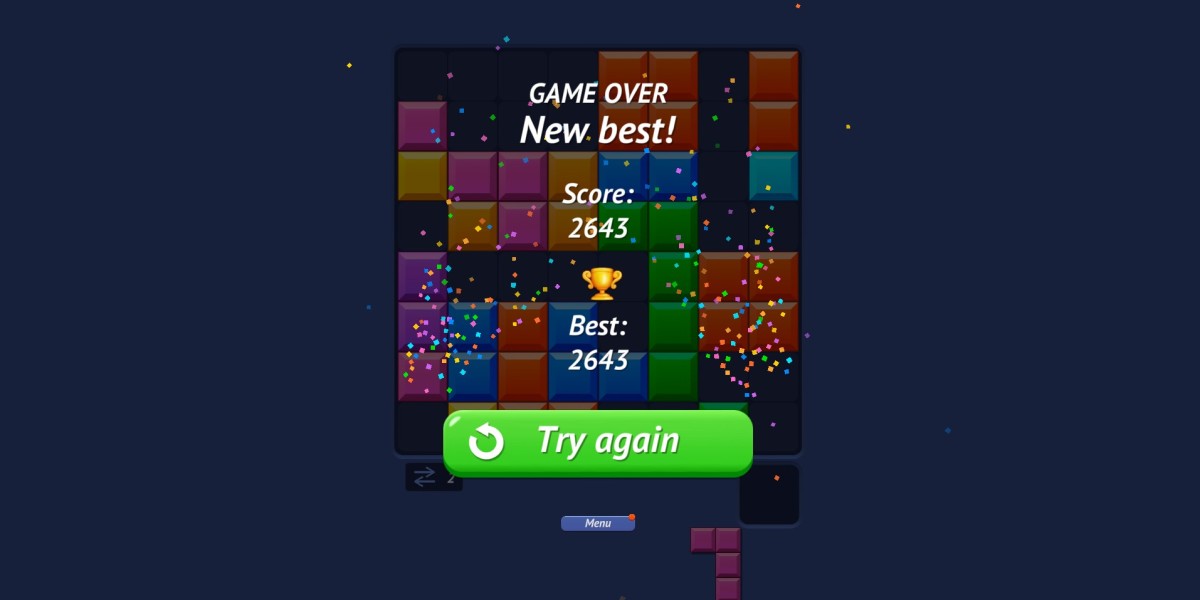

I found Block Blast on a random browser tab moment—one of those “I’ll play for two minutes” situations. The game looks almost harmless at first: you get a set of block shapes, drag them onto a board, and clear lines by filling things in. Easy, right?
Well… the first thing I noticed is that the game does feel simple until it doesn’t. In the early part of a run, you can slap down a piece and enjoy the little win when a row or column clears. But once the board starts filling in, the puzzle part switches on. All of a sudden, I’m staring at the remaining spaces like they’re doing it on purpose. A move that looked “obvious” five seconds ago starts to feel questionable the moment I place it.
And the best (or worst) part is that the game doesn’t have falling pieces or a countdown timer—so you can’t blame chaos on speed. You really have to think about the placement.
The board fills up faster than my confidence
In Block Blast, you don’t rotate pieces, and that matters more than I expected. I had one of those moments where I assumed I could “make it work” by turning a shape… only to realize the piece keeps the orientation it comes with. The first time that happened, I basically stared at the board for a minute, then placed the block anyway in a way that “technically fit.” It did fit. It also immediately started creating problems.
No falling pieces also changes the rhythm. Instead of reacting to what drops next, you’re managing what’s available now—and what might come after. The game shows you a set of shapes, and the way those shapes work as a group is a huge deal. I didn’t treat it like that at first. I’d see the easiest-looking piece, grab it, and place it… then realize I’d probably used up the one area that could have held something awkward later.
Before I knew it, I was dealing with the kind of situation that’s hard to explain to non-puzzle people: you get an isolated little gap—like one weird pocket that feels like it should be fillable. It’s not immediately a problem. But later, when the remaining pieces don’t match that exact pocket shape, you start regretting it in real time.
Clearing rows and columns feels great—until it splits your space
Clearing a full horizontal row or vertical column is super satisfying. It creates room immediately, and sometimes a single placement clears more than one line at once. I actually got a little excited the first time that happened, because it felt like I’d accidentally set up a chain reaction. Like, “Wait… how did that work out?”
But I learned quickly that clearing isn’t always the whole victory. Sometimes you clear one line and, in doing so, you accidentally carve the board into smaller sections. Suddenly there are big open areas over here… and a couple tiny leftover pockets over there that might as well be locked doors. One placement can clear multiple lines, but it can also decide what kind of future placement options you’ll have.
What I started appreciating more and more is the idea of preserving large open space. In a block puzzle game, my instinct is usually to chase clears. In Block Blast, I had to unlearn that a bit. A safe placement that keeps a bigger corridor open can be better than forcing a “bigger-looking” clear that leaves the board awkwardly split.
The “mistake” loop: stuck because I planned one move, not five
I got stuck plenty of times. Usually it was my own fault, and it was never dramatic—it was more like: “I thought this was fine.” Then the board filled a bit more, and the remaining available blocks just couldn’t cooperate with the shape of my earlier decisions.
There’s something humbling about a game that ends when none of the currently available pieces can fit. It makes you feel the consequence of every placement, even the ones that seemed harmless. After a couple failed runs, I started changing how I play. I slowed down—not to optimize every move like a pro, but to check whether I was leaving myself options.
Instead of locking into the first place that fits, I started planning several moves ahead in a very casual way. Not chess-level calculations—more like: “If I put this here, what does that do to the available shapes group?” That small habit is what turned my runs from “place and hope” into “place, reassess, and adjust.”
A few casual tips I wish I’d learned sooner
- Review the whole set before placing your first piece. The easiest block isn’t always the best first move.
- Avoid isolated gaps. Small pockets tend to become impossible when the next shapes don’t match.
- Aim for big open areas, not just quick clears. Space is basically your real resource.
- Don’t chase multi-line clears blindly. If the board becomes fragmented afterward, the win may cost you later.
Try Block Blast—and let’s compare our favorite “oops” moments
If you like block placement puzzle games and don’t mind a little thinking between moves, Block Blast is a great browser game to lose track of time with. I keep coming back because the run-to-run learning feels real: you make a decision, it shapes the rest of your options, and when you lose, you immediately want another shot.
Give Block Blast a try and play a couple rounds. Then tell me what kind of mistake you made—did you chase an easy clear, create a weird little gap, or save the wrong piece too long? We can compare notes, and maybe we’ll both see who can keep the board open longer.