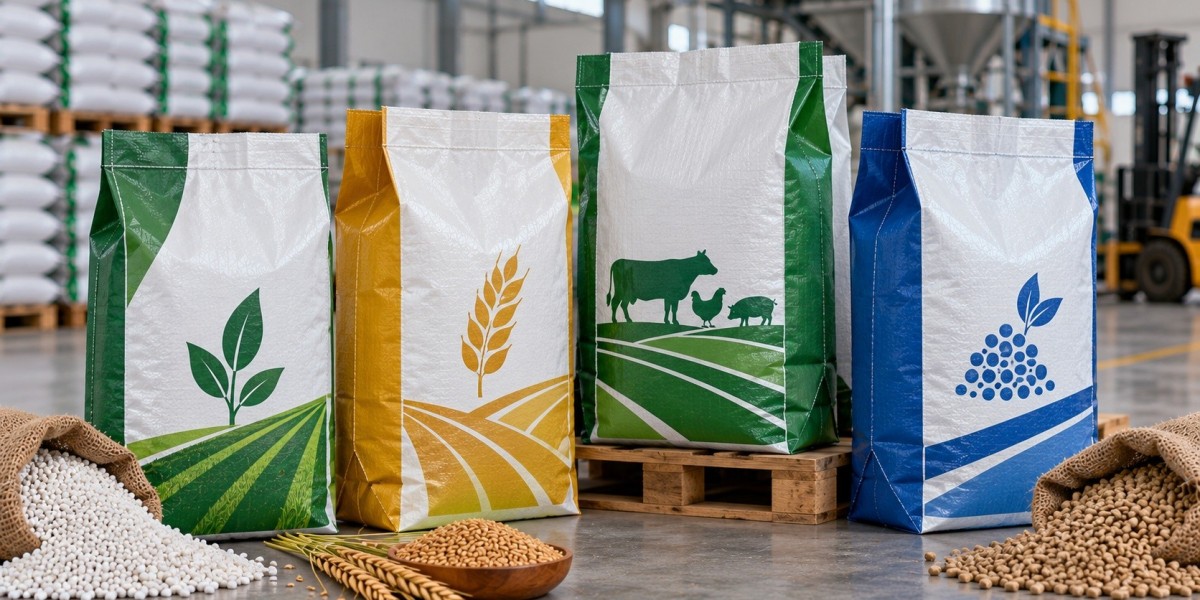

Bulk-product manufacturers need packaging that can handle filling, stacking, storage and transportation without compromising product presentation. A block bottom woven bag is designed around these requirements, offering a stable rectangular shape that can support efficient palletisation and storage.
These bags are used across industries such as fertiliser, animal feed, grains, seeds, flour and other dry bulk products. For businesses purchasing packaging at scale, factors such as bag construction, dimensions, filling compatibility, print requirements and supply consistency are important when selecting a manufacturing partner.
What Is a Block Bottom Woven Bag?
A block bottom woven bag is made from woven polypropylene fabric and features a block-shaped bottom construction. Unlike conventional stitched bags that can have a more flexible base, the block bottom design allows the filled bag to maintain a more stable shape.
The square or rectangular base can help bags stand upright after filling, making them suitable for automated filling, palletisation, warehousing and transportation.
The construction can be customised according to the product, filling process and required packaging specifications.
Why Use Block Bottom Woven Bags?
Stable Shape After Filling
One of the main advantages of a block bottom construction is its ability to maintain a stable shape once filled.
This can make handling and stacking more organised, particularly for businesses managing large volumes of packaged products.
Efficient Palletisation
A more uniform bag shape can support organised pallet loading.
For manufacturers shipping large quantities, efficient palletisation can help make better use of available storage and transportation space.
The actual packing efficiency will depend on the bag dimensions, product density, pallet configuration and transportation requirements.
Suitable for Automated Filling
Block bottom bags can be designed for filling systems used in industrial packaging operations.
The appropriate bag construction should be selected according to the customer's filling equipment and product requirements.
Packaging and engineering teams can evaluate the bag dimensions, opening, filling configuration and closure before finalising the specification.
Professional Product Presentation
Block bottom woven bags can also be produced with printed or laminated surfaces, depending on the application.
This allows manufacturers to include brand information, product details and other required packaging information while maintaining a structured bag appearance.
Where Are Block Bottom Woven Bags Used?
Block bottom woven bags can be considered for several bulk-product applications.
Common applications include:
Fertiliser
Animal feed
Pet food
Rice
Flour
Grains
Seeds
Pulses
Agricultural products
Other dry bulk materials
The appropriate construction depends on the product weight, density, filling method, storage conditions and transportation requirements.
Block Bottom Bags for Fertiliser Packaging
Fertiliser manufacturers often require packaging that can withstand repeated handling through filling, storage, palletisation and distribution.
A block bottom woven bag can provide a stable structure for these operations while offering space for product and brand information.
For larger fertiliser manufacturers, packaging requirements may involve multiple departments. Procurement may focus on supply continuity, packaging teams on specifications, operations on filling performance and quality teams on required documentation.
This makes supplier capability an important consideration alongside the bag itself.
Block Bottom Bags for Animal Feed and Agricultural Products
Animal feed, seeds, grains and other agricultural products often move through several stages before reaching the final customer.
The packaging needs to support handling during filling, warehousing and transportation while maintaining the required product packaging specifications.
Block bottom construction can provide a structured format for these applications. The final bag design should be selected according to the product characteristics and the customer's filling and handling process.
Important Specifications to Consider
Choosing a block bottom woven bag requires more than selecting a standard size. Buyers should define the technical requirements according to their production and distribution process.
Bag Size: Length, width and height should be selected according to the product quantity and filling system. The dimensions can also influence stacking and palletisation.
Fabric Construction: The woven polypropylene fabric should be specified according to the required load, handling conditions and application.
The required GSM and other material specifications should be established before production.
Bottom Construction: The block bottom configuration should be compatible with the customer's filling and handling requirements.
The construction can be evaluated during sampling and line trials where necessary.
Printing and Lamination: Manufacturers may require printed or laminated bags for branding and product information.
Artwork, print requirements and surface construction should be finalised before production to maintain consistency across recurring orders.
Closure: The appropriate closure configuration depends on how the product is filled, sealed and handled.
This should be considered together with the filling equipment rather than treated as an independent bag feature.
What Should B2B Buyers Look for in a Block Bottom Bag Supplier?
For recurring packaging requirements, the supplier's manufacturing capabilities can be just as important as the product specification.
Production Capacity
High-volume buyers need a supplier capable of supporting recurring requirements without creating unnecessary supply interruptions.
Mewar Polytex currently has 8,000+ metric tonnes of production capacity per month across 14+ manufacturing facilities, along with 46+ years of manufacturing experience and a presence across 25+ countries.
Consistent Quality
Repeat orders should maintain the agreed dimensions, material specifications and construction.
Quality control throughout production can help reduce variations between batches.
Custom Manufacturing
Different products and filling systems can require different bag specifications.
A manufacturer with custom engineering capabilities can work around defined dimensions, construction requirements and other application-specific needs.
Testing and Documentation
Industrial buyers may require technical documentation and testing information as part of supplier qualification.
The specific testing and documentation required should be agreed according to the product and intended application.
Export Capability
For international buyers, supplier selection can also involve export documentation, logistics coordination and shipment planning.
A manufacturer with established export experience can support these requirements as part of the wider supply relationship.
Block Bottom Woven Bags and Supply Chain Efficiency
Packaging decisions can affect more than the initial bag purchase.
Bag dimensions and construction influence how products are filled, stacked, stored and transported. For companies shipping large volumes, these factors can have an impact on warehouse utilisation and transportation planning.
A structured block bottom format can support organised palletisation, but buyers should assess the complete packaging configuration with their product, pallet size and logistics requirements.
Why Manufacturing Integration Matters
An integrated manufacturing operation can give buyers greater control over different stages of packaging production.
Mewar Polytex manages manufacturing capabilities across yarn, woven fabric and finished bags. This provides a manufacturing base for businesses looking for recurring woven packaging requirements.
For procurement teams managing multiple bag formats, working with a manufacturer that can support different packaging requirements can also simplify supplier coordination.
Choosing Block Bottom Bag Manufacturers in India
When evaluating block bottom bag manufacturers in India, buyers should look beyond the quoted price and assess the supplier's ability to support the complete packaging requirement.
Key areas to review include:
Manufacturing capacity
Woven polypropylene specifications
Bag dimensions
Block bottom construction
Printing and lamination options
Filling-line compatibility
Quality control
Testing and documentation
Custom manufacturing capability
Export and logistics support
Recurring order capacity
For companies with ongoing bulk packaging requirements, working with experienced block bottom bag manufacturers in India can provide access to customised bag specifications and large-scale manufacturing capabilities.
Block Bottom Woven Bag vs Standard Woven Bag
The right construction depends on the product and packaging operation.
A standard woven bag can be suitable for applications where the bag construction and handling requirements do not require a structured bottom.
A block bottom woven bag provides a more defined base, which can be useful when upright stability, stacking and organised palletisation are important considerations.
The choice should be based on the filling process, product characteristics, handling requirements and logistics configuration rather than the bag format alone.
Conclusion
A block bottom woven bag provides a structured packaging format for manufacturers handling bulk products such as fertilisers, animal feed, grains, rice, flour and seeds.
Its stable bottom construction can support filling, stacking, palletisation and transportation, while custom dimensions, printing and material specifications allow the bag to be adapted to different applications.
For B2B buyers, the manufacturing partner is an important part of the decision. Production capacity, quality consistency, custom engineering, testing, documentation and supply capability should all be evaluated before selecting a supplier.
For recurring and high-volume packaging requirements, a manufacturer with established infrastructure and experience can provide a more reliable foundation for long-term supply.










