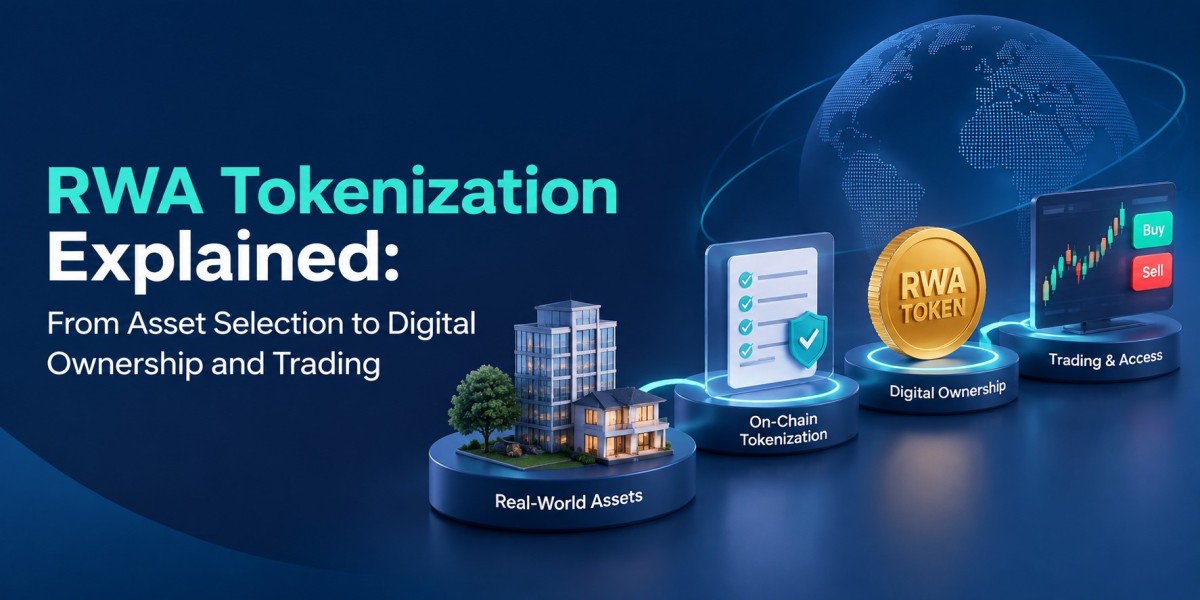

Real-world asset (RWA) tokenization is changing how ownership, investment, and asset transfers can be represented in digital markets. Instead of relying entirely on paper certificates, centralized databases, and lengthy settlement processes, tokenization can represent claims or ownership interests in assets through digital tokens recorded on a blockchain or another distributed ledger.
The concept applies to a wide range of assets, including real estate, government bonds, private credit, commodities, investment funds, artwork, and other financial or physical assets. The Bank for International Settlements (BIS) describes tokenization as a way to record claims on real or financial assets on programmable platforms, potentially combining information, reconciliation, and transfer within a common infrastructure.
However, RWA tokenization is not simply the process of putting an asset on a blockchain. The underlying legal rights, asset ownership, custody arrangements, compliance requirements, valuation processes, and transfer restrictions must also be addressed. Understanding the complete journey from selecting an asset to issuing, owning, transferring, and trading its digital representation is therefore essential.
1. Selecting and Structuring the Real-World Asset
The first stage is identifying an asset that can be represented effectively through tokenization. Not every asset has the same suitability. Developers and issuers generally need to examine the asset's ownership structure, valuation method, legal status, cash flows, liquidity characteristics, documentation, and transfer restrictions.
Real estate provides a useful example. A commercial property could generate rental income but may require substantial capital to acquire and involve lengthy legal procedures when ownership changes. A tokenization structure could represent ownership interests in the property or in a legal entity that owns it. Investors would then hold digital tokens associated with the defined economic or legal rights.
Government securities and investment funds can also be suitable candidates. BIS research notes that tokenized government bonds have already developed as an emerging market and reported approximately $8 billion in issuance at the time of its July 2025 assessment.
At this stage, the most important question is not simply whether an asset can be tokenized. It is whether the legal and economic relationship between the physical or traditional asset and its digital representation can be clearly established.
2. Legal Structuring, Token Design, and Secure Infrastructure
Once an asset is selected, the next step is creating the legal and technical structure that connects the real-world asset to its digital representation. RWA Token Development Services, Secure RWA Tokenization Services can support this stage by combining token architecture, smart contracts, wallet integration, compliance features, investor interfaces, and security controls into a coordinated platform.
The structure varies depending on the asset and jurisdiction. A company might issue tokens representing shares or interests in an investment vehicle that owns an underlying property. In another arrangement, an issuer may directly tokenize a security. The U.S. Securities and Exchange Commission stated in January 2026 that tokenized securities can be issuer-sponsored or created through third-party structures, with the applicable legal analysis depending on the structure and rights attached to the token.
This distinction matters because a blockchain token does not automatically create legal ownership of the underlying asset. The legal documentation must define what the token holder actually owns or has a claim to receive. Depending on the structure, this could involve equity, debt, beneficial interests, fund units, revenue rights, or another legally enforceable claim.
Technical architecture is equally important. The token contract can define supply, transfer rules, permissions, distribution mechanisms, and other functions. Smart contracts may also automate actions such as interest payments, dividend distributions, whitelisting, and compliance checks.
3. Asset Verification and Digital Representation
After the legal framework is established, the underlying asset needs to be verified and connected to the tokenization system. This creates the important bridge between the physical or traditional asset and its digital representation.
For a property, verification may involve title documents, ownership records, valuation reports, property inspections, insurance information, and other relevant documentation. For a bond or fund, the process could involve validating the issuer, outstanding amount, maturity, ownership records, and applicable contractual terms.
This stage addresses one of the fundamental challenges of RWA tokenization: the blockchain can verify transactions involving tokens, but it cannot independently verify whether a real-world property, commodity, or financial claim actually exists.
External records, custodians, auditors, legal entities, administrators, and other trusted participants may therefore remain important. The BIS has emphasized that tokenization can improve efficiency but also requires appropriate governance and risk management.
The quality of this connection determines how much confidence investors can place in the digital representation.
4. Minting the RWA Tokens
Once the asset and its legal structure have been verified, tokens can be created according to predefined rules. The number of tokens depends on the structure chosen by the issuer.
Suppose a property-backed investment vehicle has an agreed value of $10 million and decides to issue 1 million tokens. Each token could represent a defined economic interest equivalent to one-millionth of the relevant investment structure, subject to the legal documents and applicable restrictions.
This does not necessarily mean that a token holder owns a physical fraction of the building itself. The token could instead represent an interest in a company or special-purpose vehicle that owns the property. That distinction is critical because the economic rights, voting rights, redemption rights, and distributions depend on the legal structure.
Tokenization can also enable fractional ownership. Instead of requiring an investor to purchase an entire asset, an issuer can potentially divide the investment into smaller digital units. BIS research identifies fractionalization and broader investor access among the potential benefits of tokenization, while also noting that many expected benefits remain subject to practical and regulatory limitations.
5. Investor Onboarding and Digital Ownership
After minting, eligible investors can acquire tokens through the designated platform. This stage commonly includes identity verification, Know Your Customer (KYC) procedures, Anti-Money Laundering (AML) checks, eligibility verification, wallet setup, and payment processing.
For regulated assets, unrestricted transfers may not be appropriate. The token infrastructure can therefore include permissioning mechanisms that determine which wallets are allowed to hold or transfer specific assets.
The ownership record can then be maintained through blockchain infrastructure. The SEC's January 2026 statement describes tokenized securities where ownership records are maintained wholly or partly through crypto networks.
This creates an important difference from conventional asset administration. Instead of ownership information being maintained exclusively within separate databases controlled by different institutions, blockchain-based systems can provide a shared transaction history. Yet blockchain records do not eliminate the need for authoritative legal records, custodians, administrators, or regulated intermediaries where those remain necessary.
6. Managing the Asset After Issuance
Tokenization does not end when tokens are issued. The underlying asset continues to require management.
Consider a tokenized rental property. The property still needs tenants, maintenance, insurance, accounting, taxation, and professional management. Rental income may need to be collected and distributed to eligible token holders according to the governing agreements.
Smart contracts can automate parts of this process. For example, once an authorized payment enters the system, predefined rules may calculate and distribute investor payments. Similar mechanisms can support bond coupons, fund distributions, or other recurring financial obligations.
This is one area where tokenization can extend beyond digital ownership into programmable asset management. BIS research highlights the ability of tokenization to integrate information with rules governing transfers and conditional actions.
7. Secondary Trading and Transfer of Tokens
The final major stage is trading. Depending on the legal structure and regulatory framework, tokenized assets may be transferred between eligible investors or traded through approved marketplaces.
This can potentially reduce some of the friction associated with traditional transfers. Tokenized markets may support faster settlement, automated compliance checks, and more transparent transaction histories.
The SEC has also emphasized that tokenization does not remove securities-law obligations. In its 2026 statement, the agency noted that tokenized securities remain subject to the relevant federal securities laws and that different tokenization structures can provide different rights to holders.
Trading therefore depends on more than blockchain functionality. Investor eligibility, transfer restrictions, custody, market infrastructure, disclosure requirements, and jurisdiction-specific rules can all affect whether and how a token can be traded.
Real-World Example: Tokenized Funds and Securities
Tokenized investment products demonstrate how the model can operate in practice. Rather than creating a completely new asset class, an issuer can represent an existing financial instrument through blockchain infrastructure.
BlackRock's BUIDL fund, for example, brought a traditional investment product into a blockchain-based format. The broader significance of such projects is that tokenization can connect conventional financial assets with programmable settlement and digital ownership infrastructure.
The BIS has similarly identified government securities as an important early tokenization use case because they already have established legal structures, valuation frameworks, and institutional markets.
These examples also illustrate why institutional RWA tokenization increasingly focuses on infrastructure rather than simply launching tokens. Custody, compliance, settlement, asset servicing, investor records, and legal enforceability all have to work together.
Key Benefits and Remaining Challenges
RWA tokenization can potentially improve several parts of the traditional asset lifecycle. Fractionalization can reduce investment minimums. Programmable transfers can automate certain processes. Shared ledgers can improve transaction visibility. Digital settlement can potentially shorten processing times.
However, these benefits should not be treated as automatic outcomes. The BIS has noted that tokenization remains relatively small in scale and that expected advantages such as greater efficiency, transparency, and liquidity involve trade-offs and remain partly unproven.
The major challenges include regulatory uncertainty, cybersecurity, smart-contract vulnerabilities, valuation, custody, privacy, interoperability, liquidity, and the connection between on-chain records and real-world legal rights. For real estate especially, tokenization cannot eliminate the underlying realities of property law, taxation, physical management, and local regulations.
The strongest tokenization models therefore treat blockchain as one component of a broader financial and legal infrastructure rather than as a replacement for every traditional process.
Conclusion
RWA tokenization creates a structured path from a traditional asset to a programmable digital representation that can potentially be owned, transferred, and traded through blockchain infrastructure. The process begins with asset selection and legal structuring, continues through verification, token issuance, investor onboarding, and asset servicing, and can eventually extend to compliant secondary trading. As the market develops, successful implementations will depend on connecting blockchain technology with reliable legal rights, secure infrastructure, transparent asset records, and appropriate regulatory controls. For businesses planning to enter this market, Blockchain App Factory provides best services for building RWA tokenization solutions with technology, security, and platform requirements aligned with the project's structure.










