
Zinc Flake Market Trends, Demand, Growth & Future Outlook 2026–2034
Market Size
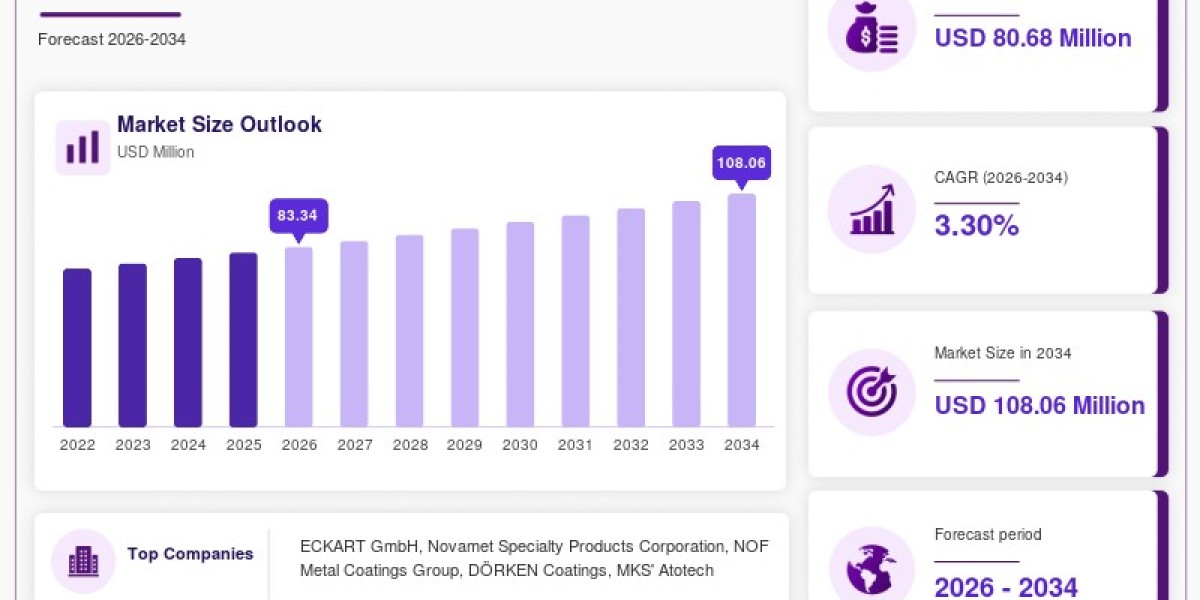
The global Zinc Flake Market was valued at USD 80.68 million in 2025 and USD 83.34 million in 2026. The market is projected to reach USD 108.06 million by 2034, registering a CAGR of 3.30% during the forecast period.
Zinc flakes are lamellar metallic zinc particles used primarily as functional pigments and corrosion-protection materials in protective coatings. Their platelet-shaped morphology creates overlapping layers within coating films, combining the galvanic protection of zinc with a barrier effect. This structure can enable corrosion protection with lower zinc loading in selected coating systems.
Zinc flakes are particularly relevant to anti-corrosion coatings for steel components, fasteners, automotive parts, wind-energy equipment, construction components, and industrial machinery. The material is available in different particle-size grades to address specific coating thickness, surface coverage, durability, and application requirements.
Key Takeaways
The global Zinc Flake Market is projected to reach USD 108.06 million by 2034.
The market is expected to register a 3.30% CAGR from 2026 to 2034.
Particle Size Below 15 μm accounted for 49% of the market in 2026.
Particle Size Above 20 μm is the fastest-growing type segment, with a 4.20% CAGR.
Automotive Application accounted for 48% of the market in 2026.
Wind Electric Application is the fastest-growing major application, with a 4.50% CAGR.
APAC accounted for 40% of the global market in 2026 and is projected to grow at 4.20% CAGR.
Europe is projected to register a 3.60% CAGR, while LATAM is projected to grow at 3.50%.
Request Sample
https://reedintelligence.com/market-analysis/zinc-flake-market/request-sample
Market Trends
The zinc flake market is increasingly influenced by demand for high-performance corrosion protection across automotive, wind energy, construction, machinery, and industrial applications.
A major trend is the development of PFAS-free and waterborne zinc-flake systems. Coating manufacturers are focusing on formulations that maintain corrosion resistance while addressing changing environmental and chemical requirements. Low-temperature curing and reduced-VOC technologies are also becoming important areas of product development.
Another trend is the use of application-specific particle sizes. Fine flakes provide high surface coverage and are suitable for thin protective films, while coarser grades are increasingly relevant for heavy-duty and high-build corrosion-protection systems.
Vehicle electrification is also influencing demand. EVs continue to require corrosion-resistant fasteners and metal components across battery systems, chassis, suspension, braking, thermal-management systems, and other assemblies.
Renewable-energy expansion is creating additional demand, particularly for wind-turbine fasteners and structural components exposed to moisture, salt spray, temperature variation, and mechanical loading.
Drivers
Demand for Corrosion Protection of High-Strength Components
Automotive, wind-energy, construction, and heavy-equipment manufacturers increasingly use high-strength steel for structural performance and weight reduction. These components require corrosion protection while maintaining dimensional tolerances and other performance characteristics.
ISO 10683 covers non-electrolytically applied zinc-flake systems for bolts, screws, studs, nuts, washers, pins, and clips. Fasteners, springs, clamps, brake components, chassis parts, and stamping parts therefore represent important application areas.
Vehicle Electrification
The expansion of electric vehicles is increasing electronic content while maintaining substantial demand for protected metal hardware.
EV components can encounter moisture, road salt, temperature changes, and vibration. Zinc-flake systems therefore provide opportunities for corrosion-resistant protection across battery-related components, structural fasteners, chassis systems, braking hardware, and other vehicle assemblies.
Renewable-Energy Expansion
Wind-energy infrastructure requires long-lasting corrosion protection because turbines and associated components can face moisture, salt spray, temperature variation, and mechanical loading.
Offshore applications are particularly demanding, creating opportunities for zinc-flake technologies designed for severe corrosion environments and long service life.
Restraints
Zinc and Alloy Raw-Material Costs
Zinc-flake producers remain exposed to zinc feedstock costs as well as energy and processing expenses associated with milling, classification, stabilization, surface treatment, and packaging.
Specialty grades requiring tight particle-size distributions or additional stabilization can further increase formulation costs. Customers may also compare zinc flakes with zinc dust and other metallic pigments based on total formulation economics.
Extensive Qualification Requirements
Zinc-flake systems used in automotive and safety-critical applications can require extensive testing and OEM approval. Corrosion performance, coefficient of friction, adhesion, appearance, curing behavior, and environmental compliance can all influence qualification.
These requirements can slow replacement of established coating systems and extend the validation period for new formulations.
Opportunities
PFAS-Free and Waterborne Zinc-Flake Technology
Growing regulatory attention to PFAS is creating opportunities for zinc-flake systems that maintain corrosion protection while avoiding targeted fluorinated components.
Waterborne formulations also provide opportunities for suppliers developing stabilized zinc flakes compatible with aqueous coating systems. Low-temperature curing and reduced-VOC technologies can further support adoption in industrial applications.
Heavy-Duty Infrastructure and Offshore Wind
Infrastructure and renewable-energy projects operating in highly corrosive environments require durable protective coating systems.
Coarse and application-specific zinc-flake grades can address thick-film and heavy-duty requirements. These products can support applications where service life, maintenance reduction, and corrosion performance are more important than commodity pigment pricing.
Market Segmentation Analysis
The Zinc Flake Market is segmented by type, application, and region.
By Type
Particle Size Below 15 μm
Particle Size Below 15 μm accounted for 49% of the global market in 2026 and is projected to register a 3.10% CAGR.
Fine zinc flakes provide high surface area and overlapping platelet structures, making them suitable for formulations where coating thickness, smoothness, surface coverage, and corrosion protection are important.
Particle Size 15–20 μm
Particle Size 15–20 μm is projected to register a 3.40% CAGR. This range provides a balance between fine-particle surface coverage and the higher-build capabilities associated with coarse grades.
It can be used where formulators require controlled rheology, corrosion resistance, and coating-film performance without moving fully toward coarse heavy-duty systems.
Particle Size Above 20 μm
Particle Size Above 20 μm accounted for 29% of the global market in 2026 and is projected to register a 4.20% CAGR, making it the fastest-growing particle-size category.
Coarser flakes are increasingly relevant to thick-film and heavy-duty corrosion-protection systems, particularly for applications operating in severe corrosion environments.
Application Analysis
Automotive Application
Automotive Application accounted for 48% of the global market in 2026 and is projected to register a 3.30% CAGR.
High-strength fasteners, brake hardware, chassis parts, springs, clamps, and stamped parts require corrosion protection together with controlled friction and reliable assembly characteristics.
Vehicle electrification is further expanding the addressable application base as EV manufacturers continue to require durable protection for metal components and hardware.
Wind Electric Application
Wind Electric Application accounted for 23% of the global market in 2026 and is projected to register a 4.50% CAGR, making it the fastest-growing major application.
Wind-turbine components experience substantial mechanical and environmental loads, especially in offshore locations. This supports demand for zinc-flake systems designed for severe corrosion conditions.
Mechanical Application
Mechanical Application represents another important use area for zinc-flake coatings across industrial components and equipment. The supplied source does not provide a separate market share or CAGR for this application.
Others
Other applications are included in the market segmentation, but the supplied source does not provide separate market-share or CAGR figures.
Regional Analysis
APAC
APAC accounted for 40% of the global market in 2026 and is projected to register a 4.20% CAGR, making it the largest and fastest-growing regional market.
China, Japan, India, South Korea, and Southeast Asia combine major automotive production bases with extensive fastener, machinery, construction, and renewable-energy supply chains.
The region's expanding automotive and electric-vehicle manufacturing base provides an important platform for corrosion-protection technologies. India is also gaining importance through automotive, two-wheeler, rail, industrial, and wind-energy applications.
North America
North America is projected to register a 3.20% CAGR. Automotive, commercial vehicles, construction machinery, industrial fasteners, wind energy, and general manufacturing support regional demand.
The region also has an established ecosystem of specialty coating suppliers, applicators, and metal-powder processors.
Europe
Europe is projected to register a 3.60% CAGR. Automotive engineering, commercial vehicles, industrial machinery, renewable energy, construction, and advanced surface-treatment industries support demand.
Europe is also an important center for zinc-flake technology development, including PFAS-free and lower-energy coating solutions. Increasing chemical-management requirements are contributing to development of alternative formulations.
Middle East and Africa
The Middle East and Africa market is projected to register a 3.30% CAGR. Construction, oil and gas, industrial equipment, transportation, renewable energy, and infrastructure support demand.
Corrosion-prone coastal and hot-climate environments create requirements for durable surface-protection systems for fasteners, machinery, and steel structures.
LATAM
LATAM is projected to register a 3.50% CAGR. Automotive manufacturing, agricultural equipment, mechanical engineering, infrastructure, and wind-energy projects contribute to market development.
Brazil and Mexico are particularly relevant because of their automotive and industrial bases, while Brazil's wind-energy sector provides additional demand for corrosion-resistant components.
Competitive Landscape
The Zinc Flake Market is characterized by competition among specialty metallic-pigment manufacturers, zinc-flake coating technology suppliers, and surface-treatment companies.
ECKART is a major supplier of zinc-flake pigments for corrosion-protection applications, with products covering different particle sizes and application requirements. Its portfolio includes coarse grades for heavy-duty applications and water-compatible products for aqueous coatings.
Novamet Specialty Products supplies zinc flakes for decorative and high-performance coatings, powder coatings, solvent coatings, aerosols, and galvanized-surface repair. The company also provides processing, screening, and milling capabilities across its specialty-metal portfolio.
Competition is increasingly focused on corrosion performance, particle-size control, formulation compatibility, environmental requirements, qualification performance, and application-specific coating technology.
Key Market Players
ECKART GmbH
Novamet Specialty Products Corporation
NOF Metal Coatings Group
DÖRKEN Coatings
MKS' Atotech
Magni Coatings
Changzhou Junhe Technology
Aalberts Surface Technologies
Nonfemet International
Regional Zinc Flake and Metallic Pigment Manufacturers
Recent Developments
May 2026 – NOF Metal Coatings Introduced GEOMET LT
NOF Metal Coatings launched its GEOMET LT low-temperature curing product range. The zinc-flake technology is designed to reduce curing energy and environmental impact while maintaining corrosion resistance. The formulation is positioned as water-based, chrome-free, nonylphenol-free, and PFAS-free.
March 2026 – DÖRKEN Received Additional Automotive Specification Approval
DÖRKEN achieved an additional automotive specification approval for PFAS-free zinc-flake systems. Volvo Car Corporation incorporated DÖRKEN's PFAS-free coating combinations into its VCS 5737,41 specification, including approval of a black topcoat.
Market Segments
By Type
Particle Size Below 15 μm
Particle Size 15–20 μm
Particle Size Above 20 μm
By Application
Automotive Application
Mechanical Application
Wind Electric Application
Others
By Region
North America
Europe
APAC
Middle East and Africa
LATAM
Frequently Asked Questions
What is the size of the Zinc Flake Market?
The global Zinc Flake Market was valued at USD 80.68 million in 2025 and USD 83.34 million in 2026. The market is projected to reach USD 108.06 million by 2034, registering a 3.30% CAGR.
What is driving the growth of the Zinc Flake Market?
Growth is supported by demand for corrosion protection of high-strength components, vehicle electrification, renewable-energy expansion, and the need for durable surface protection across automotive, wind-energy, construction, and industrial applications.
Which particle-size segment holds the largest market share?
Particle Size Below 15 μm accounted for the largest share, representing 49% of the global market in 2026.
Which application is projected to grow at the highest CAGR?
Wind Electric Application is projected to register the highest CAGR among the major application categories at 4.50%.
Which region holds the largest market share and which region has the highest CAGR?
APAC held the largest regional share at 40% in 2026 and is also projected to register the highest regional CAGR at 4.20%.
Conclusion
The Zinc Flake Market is expanding steadily as manufacturers across automotive, wind energy, construction, machinery, and industrial sectors seek durable corrosion-protection solutions. Demand is supported by the use of high-strength components, vehicle electrification, renewable-energy infrastructure, and increasing requirements for long-lasting surface protection.
Particle Size Below 15 μm remains the largest type segment, while Particle Size Above 20 μm is growing more rapidly as heavy-duty corrosion-protection applications expand. Automotive remains the leading application, while Wind Electric Application is projected to experience the fastest growth.
APAC represents the largest regional market and is also projected to record the fastest regional growth. Meanwhile, PFAS-free, waterborne, lower-temperature-curing, and application-specific zinc-flake technologies are creating opportunities for suppliers to address evolving environmental and performance requirements.
Report URL
https://reedintelligence.com/market-analysis/zinc-flake-market