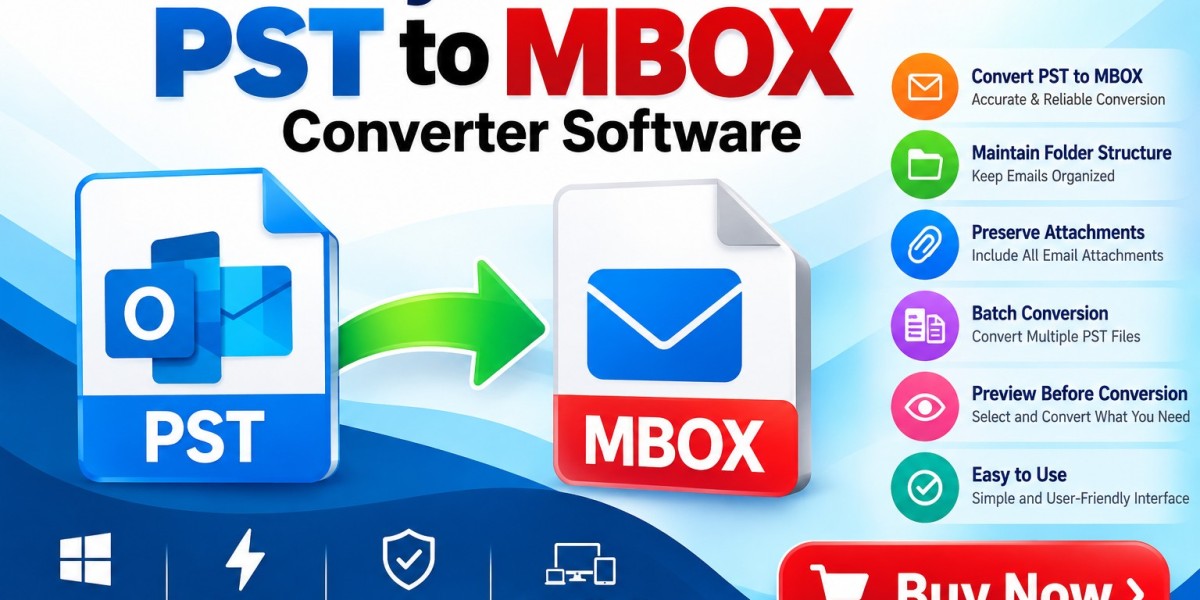

Moving email data from Microsoft Outlook to another email application can be challenging when the two platforms use different mailbox formats. Outlook commonly stores emails, contacts, calendars, and other mailbox information in PST files, while many other email clients use the MBOX format.
If you need to migrate Outlook emails to an MBOX-compatible application, you may be searching for how to convert Outlook PST to MBOX without losing important emails or attachments.
The good news is that PST-to-MBOX conversion can be approached using several methods. The right method depends on the size of your mailbox, your technical experience, whether Outlook is available, and the features required during migration.
What Are PST and MBOX Files?
Before discussing conversion methods, it helps to understand the two formats.
PST, or Personal Storage Table, is a mailbox data file associated with Microsoft Outlook. It can contain emails, attachments, folders, calendar items, contacts, and other Outlook data.
MBOX is a mailbox storage format used by several email applications and systems. Instead of storing mailbox information in Outlook's PST structure, MBOX generally stores multiple email messages in a mailbox file.
Think of PST and MBOX as two different containers for email data. The messages may be similar, but the containers organize and store that information differently.
Therefore, you cannot simply rename a .pst extension to .mbox and expect the mailbox to work. The underlying data structure needs to be converted.
Why Convert Outlook PST to MBOX?
There are several reasons users may need to convert PST files into MBOX format.
Common scenarios include:
- Migrating away from Microsoft Outlook
- Moving email archives to an MBOX-compatible application
- Accessing historical Outlook emails on another platform
- Consolidating old email archives
- Migrating business mailboxes
- Preserving email data before changing email applications
- Converting PST archives for long-term storage
For small mailboxes, manual migration may be possible. For large or complex PST files, specialized conversion software can provide a more structured approach.
Methods to Convert Outlook PST to MBOX
There is no single method that works best for every situation. Below are the major approaches you can consider.
Method 1: Use Outlook and an Intermediate Email Client
One approach is to use Outlook to export or move email messages and then use an email client that supports MBOX to create or export mailbox data.
The general workflow is:
- Open the PST file in Outlook.
- Create or configure the required mailbox folders.
- Move or export the required emails.
- Import the messages into an MBOX-compatible email client.
- Use the client or an appropriate extension to create MBOX data.
- Verify the resulting mailbox.
This approach may work for smaller migrations, but it can become complicated when dealing with thousands of emails, multiple folders, or large attachments.
Folder structures may also require additional manual work.
Method 2: Use Dedicated PST to MBOX Converter Software
A dedicated PST to MBOX Converter Software is another option.
These applications are specifically designed to read Outlook PST data and convert supported mailbox information into MBOX format.
A typical workflow is:
Step 1: Install the Converter
Install a reputable PST to MBOX conversion application on your computer.
Step 2: Add the PST File
Launch the software and select the Outlook PST file you want to convert.
Step 3: Preview the Mailbox
If the application supports preview functionality, inspect the available folders and emails before conversion.
Step 4: Select the Required Data
Some tools allow you to select specific folders or mailbox items rather than converting the entire PST file.
Step 5: Select MBOX
Choose MBOX as the target format.
Step 6: Choose the Output Location
Select a destination folder for the converted MBOX data.
Step 7: Start Conversion
Begin the conversion process and allow the application to process the PST file.
Step 8: Verify the Converted Data
Open or import the resulting MBOX file into the target email application and check important messages, folders, and attachments.
This approach can be particularly useful for large PST files or migration projects requiring additional conversion features.
How to Convert PST to MBOX Without Outlook
Users sometimes ask whether it is possible to convert PST to MBOX without having Microsoft Outlook installed.
The answer depends on the conversion method.
Dedicated PST conversion applications may be able to process a PST file directly without requiring a fully configured Outlook installation. However, this is software-dependent, so you should verify the requirements of the particular converter before purchasing or installing it.
A direct conversion workflow can be useful when Outlook is unavailable or when you only have an archived PST file that needs to be migrated.
Can You Convert Multiple PST Files to MBOX?
Yes, depending on the software being used.
If you have multiple PST files, look for a converter that supports batch conversion. Batch processing can allow several PST files to be processed in a single workflow instead of repeating the same steps manually.
This can be useful for:
- Business email archives
- Multiple employee mailboxes
- Historical Outlook backups
- Department-level email migrations
- Large-scale mailbox projects
Before starting a batch conversion, organize the source PST files and ensure you have enough disk space for the output data.
What About Attachments and Folder Structure?
Email migration is not just about converting message text. Important information may also exist in attachments and mailbox organization.
When evaluating a PST to MBOX converter, check whether it supports:
- Email attachments
- Sender and recipient information
- Email dates
- Subject lines
- HTML formatting
- Plain-text messages
- Folder hierarchy
- Multiple PST files
- Large mailboxes
Not every converter handles every Outlook item in exactly the same way. Therefore, review the software's documented capabilities before beginning a production migration.
How to Convert Large PST Files to MBOX
Large PST files require additional planning.
Before conversion:
- Create a backup of the original PST.
- Check available disk space.
- Close applications that are not required.
- Use a reliable conversion application.
- Test a smaller portion of the mailbox first.
- Verify the output after conversion.
Large mailbox conversions can take longer depending on the PST size, number of messages, attachment volume, storage speed, and computer performance.
Avoid deleting the original PST immediately after conversion. Keep it available until you have verified that the converted MBOX data contains the information you need.
Common Problems During PST to MBOX Conversion
Users can encounter several issues during mailbox migration.
Large File Size
Very large PST files may require additional processing time and storage space.
Corrupted PST Files
If the source PST is damaged, conversion software may have difficulty reading some mailbox items.
Missing Attachments
Some conversion methods may not preserve every attachment or formatting element. Always verify important messages after conversion.
Folder Organization
Manual migration can make it difficult to reproduce the original Outlook folder hierarchy.
Incompatible Email Clients
Before importing MBOX data, confirm that the destination email application supports the MBOX structure generated by your conversion method.
Best Practices for PST to MBOX Conversion
For a smoother migration, follow these practices:
- Always keep a backup of the original PST.
- Test the conversion before processing an entire mailbox.
- Use selective conversion when only specific folders are required.
- Check the destination application's MBOX requirements.
- Verify attachments and important emails.
- Maintain sufficient free storage space.
- Keep the original PST until the migration has been validated.
These simple precautions can reduce the risk of losing access to important email information.
Frequently Asked Questions
Can I simply rename PST to MBOX?
No. Changing the file extension does not convert the underlying mailbox structure. PST and MBOX use different storage formats.
Can I convert PST to MBOX without Outlook?
Some dedicated converters can process PST files without requiring Outlook, but requirements vary by product. Check the software's system requirements before proceeding.
Can multiple PST files be converted?
Yes, when the selected software supports batch conversion.
Will attachments be converted?
Many dedicated converters support attachments, but capabilities vary. Test the software with a copy of your PST before a full migration.
Is PST to MBOX conversion safe?
The safest approach is to preserve the original PST as a backup, use a reputable conversion method, and verify the resulting MBOX data before deleting anything.
Conclusion
If you are searching for how to convert Outlook PST to MBOX, you have several options, ranging from manual migration workflows to dedicated conversion software.
Manual approaches can be suitable for small and simple migrations, but they may become difficult when working with large mailboxes, multiple PST files, attachments, and complex folder structures.
A dedicated PST to MBOX Converter Software can provide a more organized workflow with features such as preview, selective conversion, batch processing, and attachment handling, depending on the product.
Regardless of the method you choose, always back up your original PST file and verify the converted MBOX data before removing the source mailbox. A careful migration process helps protect important emails and makes the transition to an MBOX-compatible environment more manageable.