
Japan Carbon Credit Market to Reach USD 97.1 Billion by 2035
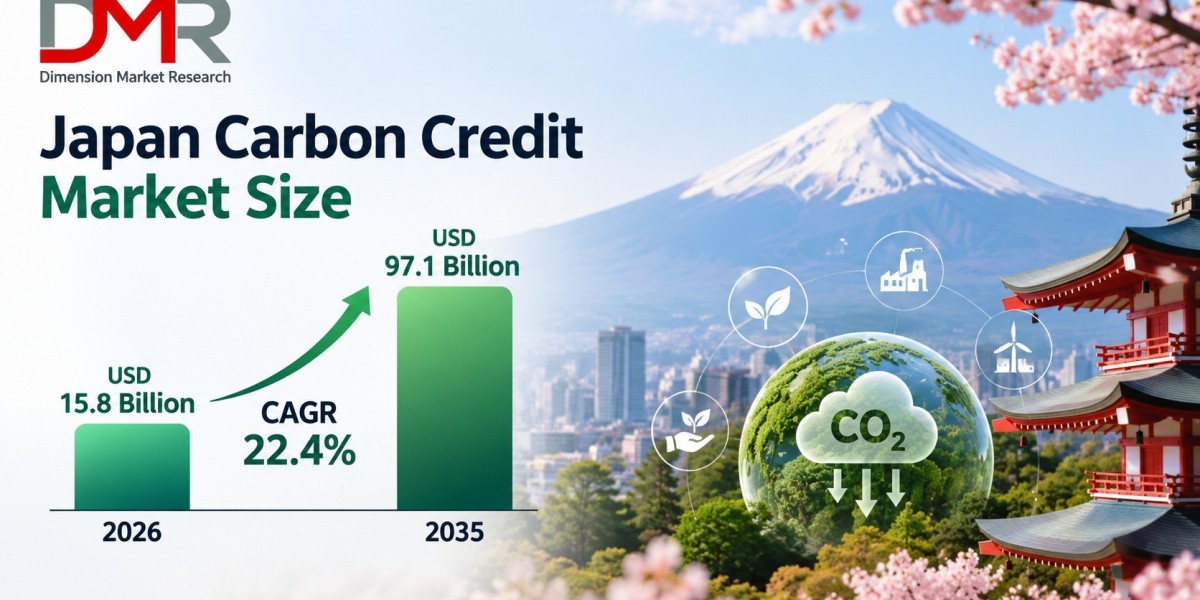
The Japan Carbon Credit Market is expected to reach USD 15.8 billion in 2026 and is projected to reach USD 97.1 billion by 2035, expanding at a 22.4% CAGR from 2026 to 2035, according to Dimension Market Research. The market is being shaped by Japan's decarbonization strategy, carbon pricing mechanisms, corporate emissions management, demand for verified offsets, and the continued development of domestic carbon trading infrastructure.
Japan's transition toward a more structured carbon market is creating opportunities for businesses involved in carbon credit generation, trading, verification, analytics, consulting, and emissions management. Corporate buyers are increasingly examining carbon credit quality, traceability, compliance requirements, procurement strategies, and long-term carbon management as part of their sustainability and business planning.
Request a Free PDF Brochure (latest forecast include) - Download Now
Japan Carbon Credit Market Growth Drivers
The expansion of Japan's carbon credit ecosystem is closely associated with the country's broader decarbonization objectives and the development of market-based mechanisms for emissions reduction. The GX League and emerging emissions trading frameworks are increasing the importance of emissions monitoring and carbon management for large businesses.
Companies across power and utilities, manufacturing, transportation, buildings, and other energy-intensive industries are assessing carbon credits as part of their broader emissions strategies. Demand is also supported by growing interest in verified carbon offsets and more transparent monitoring, reporting, and verification systems.
● Market value is projected to reach USD 97.1 billion by 2035.
● The market is forecast to grow at a 22.4% CAGR.
● Compliance credits are projected to hold a 63.5% share in 2026.
● J-Credits are projected to account for a 51.6% share.
● OTC trading is projected to represent a 71.4% share.
● Power and utilities are projected to hold a 34.2% share.
J-Credits Remain Central to Japan's Carbon Market
J-Credits are projected to represent the leading credit mechanism in the Japan Carbon Credit Market in 2026. Government backing and domestic applicability make the J-Credit Scheme an important mechanism for organizations seeking verified emissions reductions.
J-Credits can support projects involving renewable energy, energy efficiency, waste management, forestry, and other emissions reduction activities. Their role is particularly relevant as Japanese companies seek greater transparency and traceability in carbon credit procurement.
The market also includes Joint Crediting Mechanism (JCM) credits and credits associated with the global voluntary carbon market (VCM). This creates a broader ecosystem in which businesses can assess different credit mechanisms according to project characteristics, availability, compliance requirements, and corporate sustainability objectives.
Compliance Demand Supports Market Expansion
The compliance segment is projected to lead the market in 2026, reflecting the increasing importance of emissions management for large industrial organizations. Carbon pricing and emissions trading initiatives are encouraging companies to establish more structured approaches to carbon accounting, credit procurement, and retirement.
Power utilities, manufacturing companies, steel producers, chemical companies, and other major emitters are among the organizations examining carbon market mechanisms as Japan develops its emissions trading framework.
At the same time, companies are balancing carbon credit procurement with direct emissions reduction investments. Renewable energy adoption, electrification, energy efficiency, fuel switching, and process improvements remain important components of corporate decarbonization strategies.
AI and MRV Technology Transform Carbon Credit Management
Technology is becoming increasingly important in the Japan carbon market. AI-driven carbon analytics can help businesses analyze emissions data, forecast credit requirements, monitor portfolios, and identify potential irregularities.
Monitoring, Reporting, and Verification (MRV) systems are also gaining importance because accurate emissions data and transparent verification are fundamental to carbon market credibility. Cloud-based carbon management platforms can integrate emissions information, reporting workflows, credit procurement, and portfolio management into centralized systems.
● AI can support carbon demand and supply forecasting.
● MRV systems improve emissions data transparency.
● Cloud platforms can streamline carbon portfolio management.
● Analytics can support credit procurement decisions.
Japan Carbon Credit Market Opportunities
The market presents opportunities for carbon credit developers, exchanges, financial institutions, technology providers, consulting companies, aggregators, and organizations involved in emissions reduction projects.
AI-based credit portfolio management represents one emerging opportunity as companies manage multiple credit types and increasingly complex sustainability requirements. Cloud-based carbon analytics is another growth area, particularly for organizations seeking integrated emissions reporting and carbon procurement capabilities.
The market is also seeing interest in multi-layer credit strategies involving J-Credits, JCM credits, and voluntary international carbon credits. Such approaches allow companies to consider factors including availability, project characteristics, geographic coverage, cost, and credit integrity.
Competitive Landscape
The competitive environment includes Japanese trading houses, financial institutions, energy companies, exchanges, carbon aggregators, technology providers, and specialized carbon market participants. Prominent organizations identified in the market include Japan Exchange Group, Tokyo Stock Exchange, Sumitomo Corporation, Marubeni Corporation, Mitsui & Co., Mitsubishi Corporation, Itochu, Mizuho Bank, MUFG Bank, JERA, ENEOS Holdings, Tokyo Gas, Chubu Electric Power, Osaka Gas, Nippon Steel, Green Carbon, Bywill, and Carbon EX.
Competition is increasingly focused on access to quality carbon credit supply, project partnerships, trading infrastructure, analytics capabilities, verification, and portfolio management.
Report Also Cover
What is the Japan Carbon Credit Market size?
The Japan Carbon Credit Market is projected to reach USD 15.8 billion in 2026 and USD 97.1 billion by 2035, registering a 22.4% CAGR during 2026 to 2035.
What is driving Japan Carbon Credit Market growth?
Growth is supported by carbon pricing initiatives, decarbonization targets, emissions trading development, demand for verified offsets, and corporate sustainability requirements.
What are J-Credits?
J-Credits are government-backed carbon credits generated through approved emissions reduction and carbon removal projects in Japan.
Which credit mechanism leads the Japan carbon market?
J-Credits are projected to lead the credit mechanism segment in 2026, with an estimated 51.6% market share.
Which market type is projected to dominate?
The compliance segment is projected to dominate, with a forecast 63.5% share in 2026.
Which project type leads the market?
Avoidance and reduction projects are projected to lead the project type segment with an estimated 68.4% share in 2026.
Which trading platform dominates Japan?
Over-The-Counter (OTC) trading is projected to dominate, accounting for approximately 71.4% of the market in 2026.
Which industry represents the largest end-use segment?
Power and utilities are projected to lead the end-use industry segment, with an estimated 34.2% share in 2026.
How is AI affecting carbon credit management?
AI can support emissions forecasting, credit portfolio analysis, procurement planning, anomaly detection, and carbon market data management.
What is the Japan Carbon Credit Market forecast to 2035?
The market is projected to increase from USD 15.8 billion in 2026 to USD 97.1 billion in 2035 at a 22.4% CAGR.
Browse more reports:
● Waterproofing Chemical Admixture Market
● Thermal Runaway Prevention Chemical Market
● CO₂ Mineralisation Chemical Market
About Us
Dimension Market Research (DMR) is a global market intelligence and consulting firm delivering data-driven insights that help organizations make informed strategic decisions. With expertise across 12+ industries and global markets, DMR provides syndicated reports, custom research, competitive analysis, white space analysis, and business strategy consulting.
Our research solutions combine analytical rigor, industry expertise, and forward-looking intelligence to identify opportunities, reduce risks, and support sustainable growth. Trusted by clients across diverse sectors, DMR is committed to delivering accurate, actionable insights that enable businesses to navigate evolving market landscapes with confidence.
Contact Us
Phone USA: +17323699777
Phone India: +919310023843
E-mail: [email protected]
Address USA: 957 Route 33, Suite 12 #308, Hamilton Square, NJ-08690
Address India: D44, Sector 6, Noida 201301, India