
The Self-Healing Materials Market is gaining strong attention as industries look for materials that can repair minor damage, extend product life, reduce maintenance requirements, and improve sustainability. Self-healing materials are being developed for applications across construction, automotive, aerospace, electronics, energy, healthcare, and consumer products. Their ability to respond to cracks, scratches, or structural damage can help manufacturers improve durability and reduce the frequency of replacement and repair.
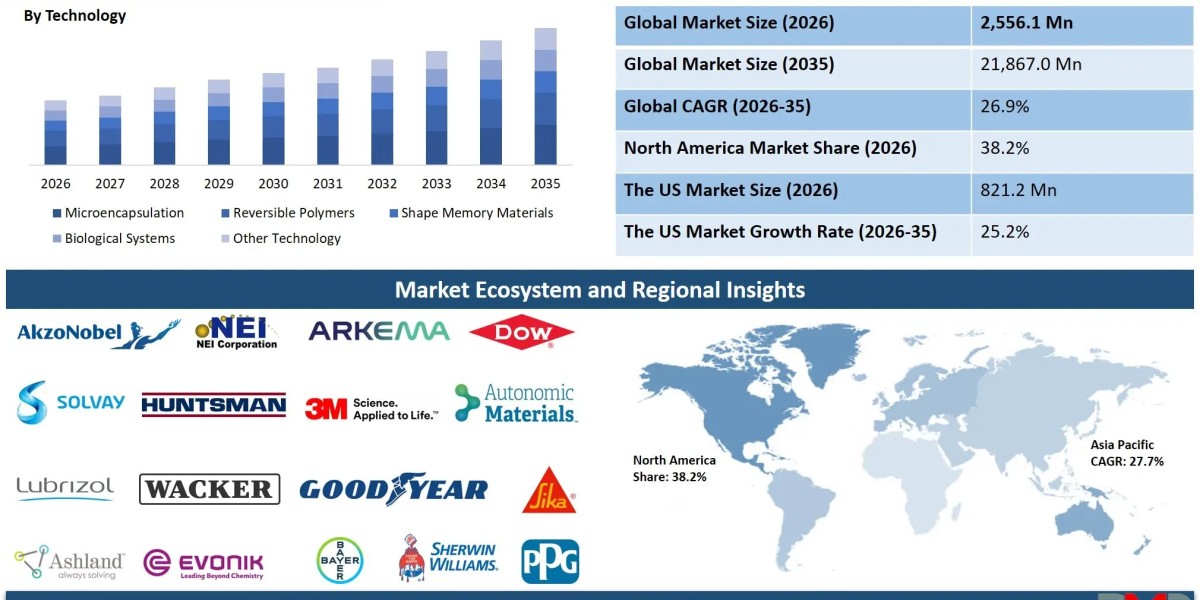
According to Dimension Market Research, the Self-Healing Materials Market is valued at USD 2,556.1 million in 2026 and is projected to reach USD 21,867.0 million by 2035 , expanding at a CAGR of 26.9% during the forecast period. The market is supported by increasing interest in durable infrastructure, advanced polymers, protective coatings, composites, and material technologies designed to extend asset lifecycles.
Self-healing technologies include microencapsulation, reversible polymers, shape memory materials, biological systems, and other approaches. These technologies allow materials to respond to damage through different mechanisms, ranging from the release of healing agents to reversible chemical reactions and biologically induced repair.
Self-Healing Materials Market Overview
Self-healing materials are engineered materials capable of repairing or partially restoring their properties after experiencing damage. Depending on the technology, healing may occur automatically or through a specific external stimulus such as heat, light, moisture, or mechanical activation.
The market covers materials such as concrete, coatings, polymers, asphalt, fiber-reinforced composites, ceramics, and metals. These materials can be incorporated into products and structures where durability, reduced maintenance, and longer service life are important.
Construction is an important application area because self-healing concrete and coatings can help address cracks and deterioration in infrastructure. Automotive and aerospace manufacturers are also exploring self-healing materials for coatings, composites, interior components, and other applications where damage resistance and weight management are important.
Key Drivers of the Self-Healing Materials Market
Growing Need for Durable Infrastructure
Aging roads, bridges, tunnels, buildings, and other infrastructure require regular inspection and maintenance. Self-healing materials can provide an alternative approach by helping repair certain types of damage before they become more serious.
Self-healing concrete is particularly relevant because cracks can allow water and other substances to penetrate structures, potentially contributing to corrosion and deterioration. Technologies that support autonomous crack repair can therefore help extend infrastructure service life and reduce maintenance requirements.
Increasing Focus on Sustainability
Sustainability is becoming increasingly important across construction and manufacturing. Extending the useful life of materials can reduce replacement frequency, material consumption, waste generation, and associated maintenance activities.
Self-healing materials support this objective by incorporating repair capabilities into the material itself. This creates opportunities for manufacturers and infrastructure developers seeking longer-lasting products with improved lifecycle performance.
Advances in Polymer Technology
Polymers are expected to lead the material type segment because of their flexibility, lightweight characteristics, processability, and ability to support different self-healing mechanisms. Reversible chemical systems and healing-agent-based technologies can be incorporated into polymer formulations for coatings, automotive components, electronics, and other applications.
Rising Demand for Advanced Protective Coatings
Protective coatings are used across automotive, aerospace, energy, industrial equipment, and infrastructure applications. Scratches and micro-cracks can reduce coating performance and expose underlying materials to corrosion or environmental damage.
Self-healing coatings can address minor surface damage and improve durability, creating opportunities in applications where corrosion protection and long service life are critical.
Request a Free Sample Report
Businesses seeking detailed market sizing, segmentation, technology analysis, competitive intelligence, and forecast information can request a sample of the report:
https://dimensionmarketresearch.com/request-sample/self-healing-materials-market/
The sample includes information about the report structure, research methodology, market segmentation, and company profiling.
Major Trends Shaping the Market
Growth of Microencapsulation Technology
Microencapsulation is expected to dominate the technology segment. In this approach, healing agents are contained inside small capsules incorporated into a material. When damage occurs, the capsules can rupture and release the healing agent into the damaged area.
The technology can be incorporated into coatings, concrete, composites, and other material systems, making it attractive for applications where passive healing is preferred.
Increasing Adoption of Intrinsic Self-Healing Materials
Intrinsic self-healing materials use the material's own chemical or physical properties to repair damage. Unlike some extrinsic systems, intrinsic approaches do not rely on a separate supply of healing agents.
This characteristic can make intrinsic systems attractive for applications requiring repeated healing cycles. Advances in polymer chemistry and material engineering are supporting the development of systems with improved mechanical performance and healing capabilities.
AI-Assisted Material Development
Artificial intelligence is increasingly being applied to material discovery, formulation optimization, simulation, and performance analysis. AI-based approaches can help researchers evaluate material combinations and simulate how materials respond to different forms of stress or damage.
AI can also support monitoring and maintenance applications by analyzing data related to crack development, material degradation, and infrastructure performance. The DMR report identifies AI as an emerging component of material selection, optimization, and performance monitoring.
Focus on Lifecycle Extension
Manufacturers and infrastructure operators are increasingly evaluating materials based on their complete lifecycle rather than only their initial purchase cost.
Self-healing technologies can support this approach by potentially reducing repair frequency, extending service life, and minimizing material replacement. This is particularly relevant for high-value assets where maintenance and downtime can create significant operational costs.
Self-Healing Materials Market Segmentation
By Material Type
The market is segmented into:
- Concrete
- Coatings
- Polymers
- Asphalt
- Fiber-Reinforced Composites
- Ceramics
- Metals
Polymers are expected to maintain a leading position because they can support intrinsic and extrinsic healing mechanisms and can be engineered for different applications. Their flexibility and relatively straightforward processing also support adoption in coatings, electronics, automotive components, and other products.
By Technology
The major technology segments include:
- Microencapsulation
- Reversible Polymers
- Shape Memory Materials
- Biological Systems
- Other Technologies
Microencapsulation is expected to remain a major technology because of its compatibility with conventional materials and its applicability across coatings, concrete, and composite systems.
By Form
The market is divided into:
- Intrinsic
- Extrinsic
Intrinsic materials are designed to lead because they can repair damage through reversible chemical or physical mechanisms without continuously relying on externally supplied healing agents.
By End-Use Industry
Key end-use industries include:
- Building & Construction
- Automotive & Transportation
- Aerospace
- Electronics & Semiconductors
- Energy & Power
- Healthcare
- Consumer Goods
- Other End Users
Building and construction represent an important application area because self-healing concrete, coatings, and related technologies can help address structural cracks and improve durability.
Regional Outlook
North America
North America is projected to hold the largest market share, accounting for 38.2% of the market in 2026 . The United States represents a major contributor, supported by advanced materials research, infrastructure modernization, aerospace applications, and demand for durable materials.
The US Self-Healing Materials Market is projected to reach USD 821.2 million in 2026 and USD 6,210.1 million by 2035 , expanding at a CAGR of 25.2% . Self-healing concrete, asphalt, coatings, and advanced composites are among the application areas supporting market development.
Europe
The Europe Self-Healing Materials Market is estimated at USD 766.8 million in 2026 and is projected to reach USD 6,560.1 million by 2035 , representing a CAGR of 26.9% . Demand is supported by sustainability initiatives, circular economy objectives, automotive and aerospace manufacturing, and interest in reducing construction waste and extending infrastructure life.
Asia-Pacific
Asia-Pacific is projected to be the fastest-growing regional market. Infrastructure development, manufacturing expansion, urbanization, and increasing demand for durable construction materials are supporting adoption.
China, India, Japan, and Southeast Asian markets provide opportunities for self-healing concrete, coatings, polymers, and advanced composite materials. The region's manufacturing base also creates opportunities for integrating self-healing technologies into automotive, electronics, construction, and industrial products.
Japan
The Japan Self-Healing Materials Market is projected to increase from USD 204.5 million in 2026 to USD 1,749.4 million by 2035 , growing at a CAGR of 26.9% . Applications associated with resilient infrastructure, electronics, polymers, ceramics, and advanced material systems are supporting market development.
Growth Opportunities
Bio-Inspired Self-Healing Materials
Biological systems represent an important opportunity for the development of self-healing construction materials. Research and commercial development involving bacteria-based concrete and other biological mechanisms can support crack repair while potentially reducing maintenance requirements.
The opportunity extends beyond concrete as researchers explore biological approaches for polymers, coatings, and other material categories.
Self-Healing Materials for Energy Applications
Energy infrastructure operates under demanding environmental and mechanical conditions. Self-healing coatings, polymers, and composites can provide opportunities for offshore energy systems, wind infrastructure, subsea components, and other applications where corrosion and mechanical damage can affect asset performance.
Aerospace and Advanced Composites
Aerospace manufacturers require lightweight materials that can maintain structural performance under demanding conditions. Self-healing composites and coatings can potentially help address minor damage while reducing maintenance requirements.
The development of self-healing composite systems with embedded monitoring capabilities is creating additional opportunities for advanced aerospace applications.
Electronics and Semiconductors
Miniaturization and increased device complexity have created demand for materials capable of maintaining performance under mechanical and thermal stresses. Self-healing polymers and protective materials may provide opportunities in electronics housings, semiconductor packaging, flexible electronics, and related applications.
Challenges in the Self-Healing Materials Market
High Development Costs
Developing commercially viable self-healing materials can require significant investment in material research, testing, formulation, and validation. Companies must demonstrate that healing performance justifies the additional cost compared with conventional materials.
Complex Material Integration
Integrating healing mechanisms into existing manufacturing processes can be challenging. Manufacturers must maintain the required mechanical, thermal, chemical, and processing characteristics while adding self-healing functionality.
Hybrid systems combining intrinsic and extrinsic mechanisms can introduce additional design and compatibility requirements.
Certification and Performance Validation
Industries such as aerospace, automotive, construction, and energy require rigorous testing before new materials can be adopted at scale. Manufacturers must demonstrate durability, healing efficiency, mechanical performance, and long-term reliability under application-specific conditions.
Competitive Landscape
The Self-Healing Materials Market includes chemical companies, advanced material developers, coating manufacturers, composite specialists, and research-driven material technology companies.
Key companies identified by Dimension Market Research include Autonomic Materials, Inc., BASF SE, NEI Corporation, Bayer AG, The Goodyear Tire & Rubber Company, Arkema SA, Dow Inc., Covestro AG, 3M Company, Huntsman Corporation, Sika AG, Sherwin-Williams Company, Wacker Chemie AG, PPG Industries, Inc., Evonik Industries AG, Lubrizol Corporation, Solvay SA, HB Fuller Company, and AkzoNobel NV
Competition is influenced by material performance, healing efficiency, scalability, cost, application compatibility, intellectual property, and the ability to integrate self-healing functionality into established manufacturing processes.
Recent Industry Developments
Recent activity in the market includes increased research and development around sustainable polymers, coatings, composites, and advanced material technologies.
The DMR report also highlights developments involving CompPair, CSEM, Com&Sens, and the European Space Agency around HealTech self-healing composites for aerospace applications. Other activity includes advanced material development by major chemical and coating companies for automotive, construction, electronics, aerospace, and industrial applications.
Future Outlook
The Self-Healing Materials Market is positioned for substantial expansion through 2035. The market is projected to increase from USD 2,556.1 million in 2026 to USD 21,867.0 million by 2035 , representing a 26.9% CAGR .
Future development is expected to focus on improving healing efficiency, increasing the number of healing cycles, lowering production costs, and improving compatibility with conventional manufacturing processes.
Advances in reversible polymers, microencapsulation, biological systems, shape memory materials, AI-assisted material discovery, and smart monitoring are expected to expand the range of applications.
The combination of longer service life, lower maintenance requirements, material efficiency, and sustainability considerations is likely to remain an important factor supporting adoption across construction, automotive, aerospace, electronics, energy, and other industries.
Get the Complete Self-Healing Materials Market Report
For detailed market size, segmentation, regional analysis, competitive landscape, technology trends, opportunities, and forecasts through 2035, visit:
https://dimensionmarketresearch.com/checkout/self-healing-materials-market/
The report provides detailed analysis across material type, technology, form, end-use industry, and regional markets.
Frequently Asked Questions
What is the Self-Healing Materials Market size in 2026?
The Self-Healing Materials Market is projected to reach USD 2,556.1 million in 2026 .
What will the Self-Healing Materials Market size be by 2035?
The market is projected to reach USD 21,867.0 million by 2035 .
What is the CAGR of the Self-Healing Materials Market?
The market is expected to grow at a 26.9% CAGR from 2026 to 2035 .
Which material type is expected to lead the market?
Polymers are designed to lead the material type segment because of their flexibility, lightweight properties, processability, and ability to support different self-healing mechanisms.
Which technology is expected to dominate the market?
Microencapsulation is projected to dominate the technology segment because it can be incorporated into materials such as coatings, concrete, and composites and can release healing agents when damage occurs.
Which region is expected to hold the largest market share?
North America is projected to hold the largest market share, with an estimated 38.2% share in 2026 .
Which region is expected to grow faster?
Asia-Pacific is projected to be the fastest-growing regional market, supported by infrastructure development, urbanization, manufacturing expansion, and increasing demand for durable materials.
Conclusion
The Self-Healing Materials Market is developing rapidly as manufacturers and infrastructure developers seek materials that can improve durability, reduce maintenance, and extend product and asset lifecycles. Growth in polymers, microencapsulation, intrinsic healing systems, protective coatings, advanced composites, and bio-inspired materials is creating new application opportunities.
With the market projected to reach USD 21.87 billion by 2035 , continued advances in material science, automation, AI-assisted development, and sustainable manufacturing are expected to broaden the commercial use of self-healing technologies across construction, automotive, aerospace, electronics, energy, and consumer applications.