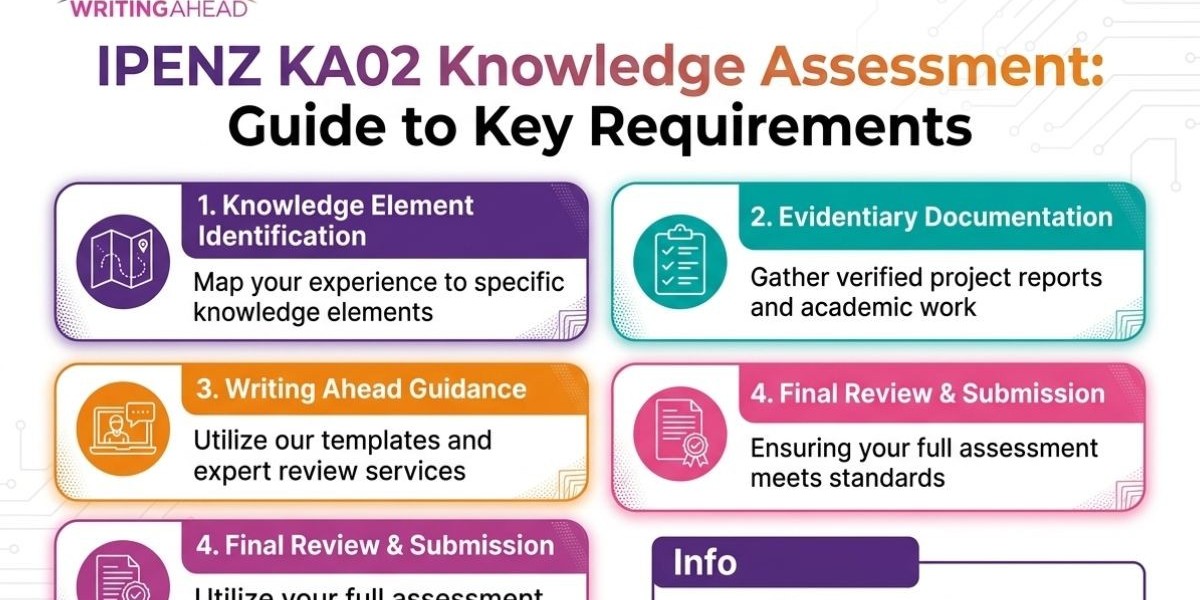

The IPENZ KA02 Knowledge Assessment is an important part of the engineering assessment process for applicants seeking professional recognition in New Zealand. For many internationally qualified engineers, understanding the assessment requirements before preparing an application can make the process more organized and manageable. The KA02 Assessment focuses on demonstrating that an applicant has the required engineering knowledge and academic foundation for the relevant engineering pathway.
Although the terminology may appear technical at first, the purpose of the IPENZ KA02 Knowledge Assessment is straightforward: it helps assess whether an applicant's education and technical knowledge are comparable with the expected standard for engineering practice in New Zealand.
This guide explains the major requirements, preparation considerations, documentation, assessment process, and common areas applicants should understand before submitting an IPENZ KA02 application.
Understanding the IPENZ KA02 Knowledge Assessment
The IPENZ KA02 Knowledge Assessment is associated with the engineering competency and qualification assessment framework historically connected with the Institution of Professional Engineers New Zealand, commonly known as IPENZ. IPENZ is now known as Engineering New Zealand, but the term IPENZ KA02 continues to appear in discussions and documentation relating to knowledge assessments and engineering recognition.
The KA02 Assessment is particularly relevant when an applicant needs to demonstrate that their educational background provides the knowledge expected for a particular engineering pathway.
An engineering qualification obtained outside New Zealand may not automatically demonstrate equivalence with a New Zealand engineering qualification. Consequently, applicants may need to provide evidence showing their academic preparation, technical knowledge, and relevant engineering education.
The IPENZ KA02 Knowledge Assessment therefore requires careful preparation. Applicants should understand exactly what information is requested and ensure that supporting documents clearly demonstrate their educational background.
What Is the KA02 Assessment?
The KA02 Assessment evaluates engineering knowledge rather than simply looking at the name of an applicant's degree. The assessment considers the substance of an applicant's engineering education and whether it covers the knowledge areas expected for the relevant professional pathway.
This distinction is important. Two engineering degrees can have similar titles while containing significantly different subjects, learning outcomes, laboratory work, mathematics, design studies, and technical content.
During an IPENZ KA02 Knowledge Assessment, the assessment process can therefore involve reviewing academic transcripts, course information, qualification details, and other evidence that helps establish the applicant's engineering knowledge.
The objective is to establish whether the applicant's education provides an appropriate foundation for professional engineering recognition.
Why the IPENZ KA02 Knowledge Assessment Matters
The IPENZ KA02 Knowledge Assessment can be important for engineers whose academic qualifications do not directly align with the educational pathways normally recognized in New Zealand.
International engineering graduates can come from a wide range of educational systems. Universities may use different course structures, credit systems, qualification titles, and assessment methods. An academic qualification that is appropriate in one country may require additional evidence before its equivalence can be established in another.
The KA02 Assessment provides a structured way of examining this educational background.
For applicants, understanding the requirements early can reduce delays caused by missing information, unclear documentation, or insufficient evidence. A well-prepared IPENZ KA02 application should make it easier for an assessor to understand the applicant's educational history and technical preparation.
Key Requirements for an IPENZ KA02 Application
Academic Qualification Evidence
One of the most important parts of an IPENZ KA02 Knowledge Assessment is evidence of the applicant's engineering education.
Applicants generally need to provide documentation that establishes what qualification they completed, where it was completed, and when it was awarded. Degree certificates and official academic records can help demonstrate the formal educational background.
The documentation should be clear and consistent. Names, qualification titles, dates, institutions, and other details should correspond across the submitted records.
When preparing a KA02 Assessment, applicants should avoid relying only on a degree certificate. A certificate confirms that a qualification was awarded, but detailed academic records provide much more information about the actual engineering education completed.
Academic Transcripts
Academic transcripts are particularly useful because they show the subjects studied throughout an engineering program.
For an IPENZ KA02 Knowledge Assessment, transcripts can help establish whether the applicant covered appropriate areas of engineering knowledge. They may show subjects involving mathematics, engineering science, engineering design, technical disciplines, laboratory work, computing, and other relevant areas.
Applicants should make sure that transcripts are complete and legible. If a document contains abbreviations that could make course titles difficult to understand, additional official information may be useful.
A transcript that simply lists course codes without explaining the subjects may not provide enough context for an assessor. Supporting course descriptions can therefore become valuable when available.
Course Descriptions and Syllabi
Course descriptions can strengthen an IPENZ KA02 application by explaining what was actually taught within individual subjects.
A course title such as "Advanced Engineering" may not reveal the specific knowledge covered. A syllabus can provide information about topics, learning outcomes, practical components, design activities, laboratory work, and technical content.
For the KA02 Assessment, applicants should focus on providing authentic academic information rather than rewriting course content themselves.
Official university documentation is particularly useful because it provides an independent record of the educational material associated with the qualification.
Engineering Mathematics and Science
Engineering education normally depends heavily on mathematics and scientific principles. Consequently, the IPENZ KA02 Knowledge Assessment may consider the mathematical and scientific foundation contained within an applicant's academic program.
Depending on the engineering discipline, relevant areas may include mathematics, statistics, physics, chemistry, mechanics, materials science, electrical principles, computing, or other engineering sciences.
Applicants should understand how these subjects fit into their overall qualification. A strong academic record should make it possible to identify where fundamental engineering knowledge was developed.
Engineering Fundamentals
The KA02 Assessment is not limited to one technical subject. Engineering education normally involves a combination of fundamental principles and discipline-specific knowledge.
An applicant's academic record may therefore contain subjects covering engineering mechanics, thermodynamics, fluid mechanics, electrical systems, structures, materials, control systems, programming, environmental engineering, or other technical areas depending on the discipline.
For an IPENZ KA02 Knowledge Assessment, the relevance of these subjects should be clear from the supporting documentation.
Demonstrating Knowledge Through Academic Evidence
Connecting Subjects With Engineering Knowledge
A common challenge in an IPENZ KA02 Knowledge Assessment is demonstrating what was actually learned rather than simply providing a list of subjects.
Applicants should organize their documentation so that an assessor can understand the relationship between their academic subjects and engineering knowledge.
For example, a mechanical engineering graduate may have completed subjects in mechanics, thermodynamics, fluid systems, machine design, materials, manufacturing, and control. Together, these subjects demonstrate different components of engineering education.
The KA02 Assessment therefore benefits from clear academic evidence that allows the assessor to understand the overall structure of the applicant's qualification.
Engineering Design Education
Engineering design is another important part of many engineering programs. Academic evidence may demonstrate experience with design methodology, analysis, engineering calculations, technical specifications, modeling, problem-solving, and design projects.
For an IPENZ KA02 Knowledge Assessment, design-related subjects can help establish how theoretical knowledge was applied to engineering problems.
Applicants should provide official evidence where possible, especially when design projects or major academic projects form a significant part of their qualification.
Laboratory and Practical Learning
Engineering knowledge is not always developed through lectures and examinations alone. Laboratory sessions, practical classes, fieldwork, workshops, and experimental projects can also form part of an engineering qualification.
The KA02 Assessment may therefore benefit from documentation that clearly identifies practical components of the applicant's education.
Where laboratory or practical work is included in official course documentation, applicants should retain that information as part of their supporting evidence.
Choosing and Preparing Supporting Documents
Use Clear and Consistent Documentation
A successful IPENZ KA02 Knowledge Assessment application depends heavily on the quality of the information submitted.
Applicants should check that documents are readable and complete. Scanned documents should not be cropped, blurred, or missing pages.
Names should also remain consistent across documents. If an applicant's name has changed, appropriate supporting documentation may be necessary to explain the difference.
Provide Relevant Evidence
More documentation does not automatically mean stronger evidence. The objective should be to provide relevant information that helps establish the applicant's engineering knowledge.
For the IPENZ KA02 Knowledge Assessment, applicants should concentrate on documents that explain their qualification, subjects, learning outcomes, and academic content.
Unrelated documents can make an application harder to review without adding meaningful evidence.
Translation of Documents
If academic documents are not in the required language, applicants should follow the applicable requirements for official translations.
For an IPENZ KA02 application, translated documents should accurately represent the original records. Applicants should avoid informal translations that could create uncertainty about qualification names, subjects, grades, or institutional information.
Understanding Possible Knowledge Gaps
One of the useful aspects of the KA02 Assessment is that it can identify areas where an applicant's educational background may not fully demonstrate the expected knowledge.
A knowledge gap does not necessarily mean that an applicant lacks professional engineering ability. It may simply indicate that the submitted academic evidence does not establish coverage of a particular area at the expected level.
For example, an applicant may have substantial professional experience but limited documented academic coverage of a particular engineering subject. The IPENZ KA02 Knowledge Assessment is primarily concerned with establishing the relevant knowledge through appropriate evidence.
Understanding this distinction can help applicants prepare their documentation more effectively.
How to Prepare for the KA02 Assessment
Review Your Engineering Qualification
Start by reviewing the complete engineering qualification rather than focusing only on the final degree certificate.
Create a clear understanding of the subjects studied throughout the program and identify the major areas of engineering knowledge represented by those subjects.
For an IPENZ KA02 Knowledge Assessment, this review can help identify missing transcripts, course descriptions, project documentation, or other academic evidence before submission.
Collect Official University Records
Applicants should obtain official records from their educational institution wherever possible.
These records can include academic transcripts, qualification certificates, course descriptions, program structures, syllabi, and other documents that explain the engineering program.
Having the documentation prepared before starting the KA02 Assessment process can make the application more efficient.
Check the Current Requirements
Requirements and procedures can change over time. Applicants should therefore verify the current requirements with Engineering New Zealand or the relevant assessment authority before submitting an application.
This is particularly important for people who continue to use the historical term IPENZ KA02 Knowledge Assessment, because terminology and administrative processes may have changed since IPENZ became Engineering New Zealand.
Common Mistakes in an IPENZ KA02 Application
Submitting Only a Degree Certificate
A degree certificate confirms that a qualification was awarded, but it normally does not provide enough detail about the subjects studied.
For an IPENZ KA02 Knowledge Assessment, detailed academic records can be much more useful because they demonstrate the structure and content of the engineering education.
Providing Incomplete Transcripts
Incomplete transcripts can make it difficult to determine the full scope of an engineering qualification.
Applicants should check that all relevant academic years and subjects are represented before submitting a KA02 Assessment application.
Using Unclear Course Information
Course titles alone may not always explain the technical knowledge developed through a subject.
Where appropriate, applicants should provide official course descriptions or syllabi that explain the content and learning outcomes associated with important engineering subjects.
Ignoring Documentation Consistency
Differences between documents can create questions during an IPENZ KA02 assessment.
Applicants should check names, dates, qualification titles, institution names, and other important details before submission.
The Role of Professional Engineering Experience
Professional experience can be valuable to an engineer's broader professional recognition, but applicants should understand the distinction between academic knowledge assessment and professional experience.
The KA02 Assessment focuses on demonstrating the required engineering knowledge. Professional experience may be relevant to other parts of a professional registration or recognition pathway, but experience should not automatically be treated as a substitute for missing academic evidence.
Applicants should therefore understand which requirements relate specifically to knowledge and which relate to professional competence or experience.
IPENZ KA02 Knowledge Assessment for International Engineers
International engineers often face additional challenges because their qualifications may use different terminology and educational structures.
An applicant may have completed an engineering degree that is highly technical but structured differently from a comparable New Zealand qualification.
The IPENZ KA02 Knowledge Assessment provides a framework for examining that educational background. The key is to present enough reliable evidence for the assessor to understand the qualification and the engineering knowledge it represents.
International applicants should pay particular attention to official transcripts, university documentation, translations where required, and explanations of unusual grading or credit systems.
Preparing a Stronger KA02 Assessment Application
A well-organized application should allow an assessor to move logically from the qualification itself to the individual subjects and then to the engineering knowledge represented by those subjects.
Applicants should avoid unnecessary repetition and ensure that every document has a clear purpose.
For an IPENZ KA02 Knowledge Assessment, preparation should begin well before the final submission. Obtaining university records can sometimes take time, particularly when an applicant graduated many years ago or studied at an institution outside their current country.
Early preparation can therefore reduce administrative problems.
What Happens After Submission?
After submission, the relevant assessment authority reviews the information and supporting evidence according to its applicable requirements.
The outcome of an IPENZ KA02 Knowledge Assessment depends on the evidence provided and the assessment criteria applicable to the applicant's pathway.
If additional information is requested, applicants should respond carefully and provide the requested documentation in the specified format.
Applicants should also remember that an assessment is based on evidence. Clear documentation can help establish the educational background more effectively than unsupported statements about what an applicant believes their qualification covered.
Conclusion
The IPENZ KA02 Knowledge Assessment is fundamentally about demonstrating engineering knowledge through credible academic evidence. For applicants, the most important preparation step is understanding what their educational records demonstrate and organizing those records so that the assessment can be completed efficiently.
A successful KA02 Assessment preparation process should include a careful review of the engineering qualification, complete transcripts, relevant course descriptions, evidence of engineering fundamentals, and appropriate supporting documentation. International applicants should pay particular attention to translations and differences between educational systems.
Because the historical IPENZ KA02 terminology can still appear in engineering assessment discussions, applicants should also verify the current terminology, procedures, and requirements directly with Engineering New Zealand before submitting an application.
With careful preparation and well-organized academic evidence, applicants can approach the IPENZ KA02 Knowledge Assessment with a much clearer understanding of the information needed to demonstrate their engineering knowledge.
Frequently Asked Questions
What is an IPENZ KA02 Knowledge Assessment?
The IPENZ KA02 Knowledge Assessment is a knowledge-focused engineering assessment associated with the historical IPENZ framework. It examines evidence of an applicant's engineering education and knowledge against the requirements relevant to the assessment pathway.
What documents are important for a KA02 Assessment?
Important documentation can include engineering qualification certificates, official academic transcripts, course descriptions, syllabi, and other authentic academic records. The exact requirements should be confirmed with the current assessment authority.
Is professional experience enough for an IPENZ KA02 assessment?
Professional experience and academic knowledge are different aspects of engineering recognition. The KA02 Assessment focuses on demonstrating engineering knowledge, so applicants should provide appropriate academic evidence rather than relying solely on professional experience.
Can international engineering qualifications be assessed?
International qualifications can be considered through applicable engineering assessment pathways. The IPENZ KA02 Knowledge Assessment may be relevant where an applicant needs to demonstrate that their overseas engineering education meets the required knowledge standard.
How can I prepare for the IPENZ KA02 Knowledge Assessment?
Begin by reviewing your complete engineering qualification, collecting official academic records, checking course content, identifying relevant engineering knowledge areas, and verifying the latest submission requirements with Engineering New Zealand or the applicable assessment authority.