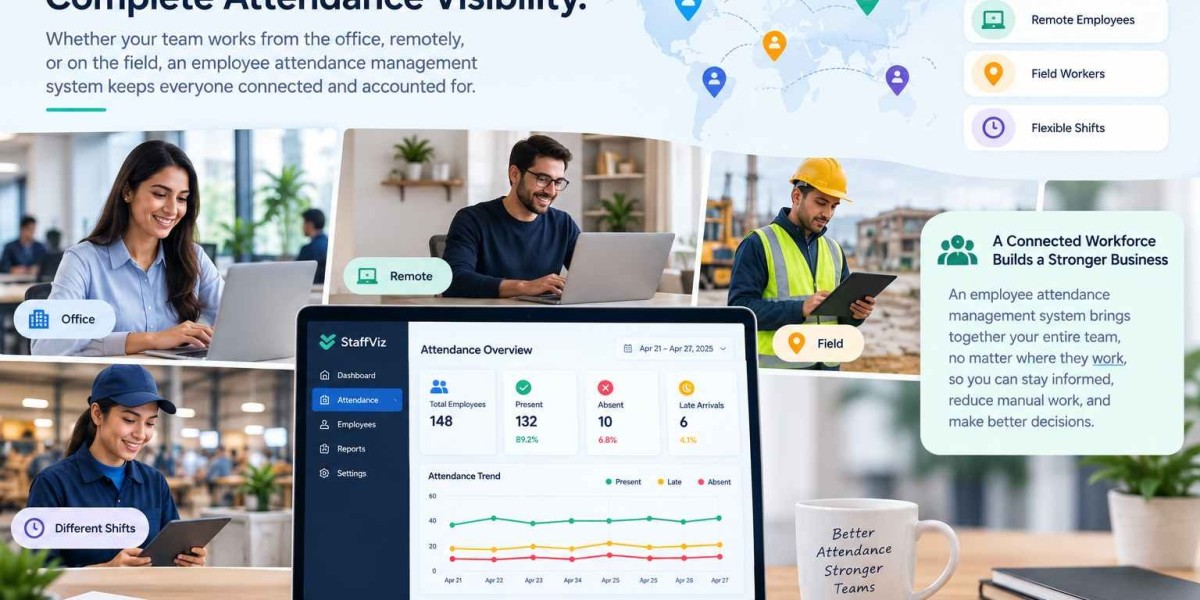

Managing employee attendance may seem like a routine HR responsibility, but it has a direct impact on payroll accuracy, workforce planning, productivity, and employee accountability. As companies grow, tracking who arrived on time, who was absent, how many hours were worked, and how much overtime was completed becomes increasingly difficult with spreadsheets and manual records.
An employee attendance management system gives businesses a more organized way to capture, manage, and review attendance data. Modern solutions can record clock ins and clock outs, monitor working hours, track absences, manage shifts, and generate reports without requiring HR teams to maintain multiple manual records. Attendance platforms commonly support features such as shift scheduling, overtime reporting, late arrival tracking, and multi location management.
The Problem With Manual Attendance Tracking
Manual attendance processes often work when a business has only a small number of employees. A simple spreadsheet or paper register may be enough to record daily presence. However, as headcount increases, the process becomes harder to control.
HR teams may need to compare attendance sheets with leave requests, correct missing entries, calculate overtime, and provide accurate information to payroll. Even a small mistake can create confusion when employees question their working hours or salary calculations.
For example, imagine a company with 80 employees working across two branches. One branch uses a spreadsheet while the other relies on a physical register. At the end of the month, HR has to combine both records, check late arrivals, verify absences, and calculate overtime. This consumes valuable time and creates more opportunities for inconsistent data.
An automated system brings those records together in one centralized environment.
How an Employee Attendance Management System Helps
More Accurate Employee Records
One of the biggest advantages of an employee attendance management system is better record accuracy. Employees can record their attendance through supported methods such as biometric devices, mobile applications, or online check ins, depending on the organization's requirements.
Instead of asking HR to manually enter every attendance event, the system can capture the information automatically. This creates a clearer record of employee working hours and makes it easier to identify missing punches, late arrivals, early departures, and absences.
Less Administrative Work for HR
Attendance management can become repetitive when handled manually. HR professionals may spend hours reviewing spreadsheets, correcting records, responding to attendance questions, and preparing monthly reports.
An automated solution reduces much of this administrative burden. Reports can provide a quick overview of attendance patterns, working hours, overtime, and employee absences. This allows HR teams to spend more time on activities that require human judgment, such as employee engagement, workforce planning, and policy development.
Better Visibility Across Different Workforces
Today's businesses do not always operate from one office. Some have multiple branches, remote employees, field workers, or teams working different shifts. Traditional attendance methods can struggle to provide a consistent view across these environments. Managing distributed teams also requires clear coordination and visibility across different work locations.
Modern workforce attendance software can help organizations centralize attendance information across departments and locations. Depending on the system, businesses may also use mobile attendance, location based check ins, shift management, and real time attendance dashboards.
Consider a company with sales representatives working across different cities. Instead of relying on messages or manually submitted timesheets, managers can use a centralized system to review attendance records and working schedules. This improves visibility without requiring managers to constantly contact employees for updates.
Connecting Attendance With Payroll and Workforce Planning
Attendance data is closely connected to payroll. Working hours, overtime, absences, leave, and attendance adjustments can all affect salary calculations.
This is where attendance tracking software can provide practical value. When attendance information is organized and available in a structured format, HR and payroll teams have a more reliable source of data for monthly processing. Many modern attendance platforms are designed to connect attendance information with payroll workflows.
The benefits extend beyond payroll. Managers can analyze attendance trends to identify recurring scheduling issues, staffing gaps, or departments that may require additional workforce support.
For instance, if a department consistently experiences overtime because several employees are unavailable during certain shifts, management can review scheduling patterns and adjust staffing rather than simply accepting overtime as a permanent cost.
What Should Businesses Look For?
Choosing the right system requires more than comparing feature lists. Businesses should first understand their workforce structure and determine which attendance challenges they need to solve.
A company with one office may prioritize simple clock in and clock out functionality, while a business with several branches may need centralized reporting and multi location support. Organizations with field employees may benefit from mobile attendance capabilities, while companies operating multiple shifts may need flexible scheduling and overtime management.
Data security, reporting capabilities, ease of use, employee access, integration options, and scalability should also be considered. The goal is to select a solution that fits existing HR processes rather than creating another complicated system for employees and managers to maintain.
Conclusion
An employee attendance management system can turn attendance from a repetitive administrative task into a structured source of workforce information. By improving attendance records, reducing manual work, supporting payroll accuracy, and providing better visibility across teams, the right system can help businesses operate more efficiently.
As your organization grows, relying on disconnected spreadsheets and manual records can become increasingly difficult. A centralized HR platform such as StaffViz can help businesses bring important workforce processes into a more organized digital environment. Integrating attendance with a reliable payroll management system can further simplify monthly operations and reduce unnecessary manual work.
The right time to improve attendance management is before administrative complexity becomes a daily problem. Evaluate your current process, identify the gaps, and choose a solution that can support your workforce as the business continues to grow.
FAQs
What is an employee attendance management system?
An employee attendance management system is software that helps businesses record and manage employee attendance, working hours, absences, late arrivals, overtime, shifts, and related attendance information in one centralized platform.
Why should small businesses use an employee attendance management system?
Small businesses can benefit by reducing manual attendance work, improving record accuracy, simplifying reporting, and creating more reliable attendance information for payroll and workforce planning.
How does attendance management software improve payroll accuracy?
Attendance management software organizes working hours, overtime, absences, and approved attendance records, giving payroll teams more structured information to use during salary processing.
Can an employee attendance management system support remote employees?
Many modern systems support remote and field attendance through online or mobile check ins. The available features depend on the software and the organization's attendance policies.
What features should businesses look for in attendance tracking software?
Important features can include clock in and clock out tracking, shift scheduling, overtime monitoring, attendance reports, absence tracking, employee self service, centralized dashboards, and integration with other HR processes.
How does attendance software help reduce HR workload?
Automated attendance records and reports reduce the need for manual data entry, spreadsheet reconciliation, and repeated attendance calculations, allowing HR teams to focus on higher value responsibilities.
Is an employee attendance management system useful for multiple branches?
Yes. A centralized system can give managers and HR teams visibility into attendance across different departments, branches, and locations while keeping records organized in one place.
How can businesses choose the right attendance management system?
Businesses should assess their workforce size, work locations, shift patterns, reporting requirements, integration needs, security expectations, and future growth before selecting an attendance solution.