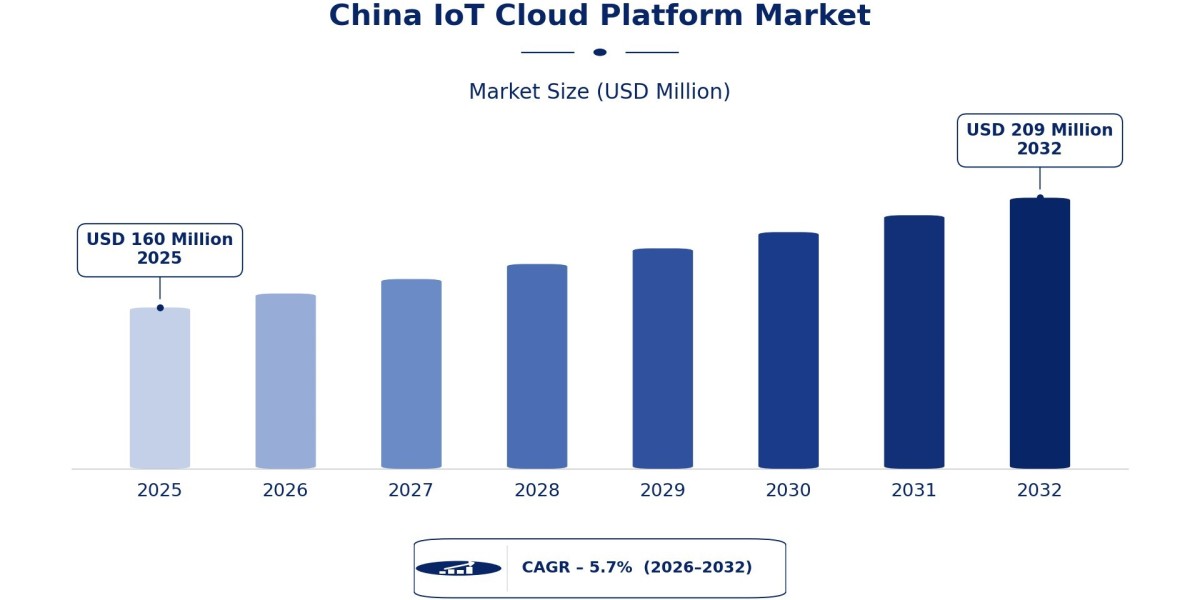

The China IoT Cloud Platform Market is evolving as organizations seek reliable ways to connect physical assets, manage growing volumes of device information, and improve operational decision-making. Opportunities are emerging for cloud providers, platform developers, system integrators, and companies creating industry-specific applications. According to 6Wresearch, the market is projected to rise from USD 160 million in 2025 to USD 209 million by 2032, representing a CAGR of 5.7% during 2026–2032. As adoption progresses, providers will need to demonstrate practical value beyond basic device connectivity.
Why Will Competition Become More Sophisticated?
Connecting a device is only the beginning of an IoT deployment. Customers also need dependable data collection, device lifecycle management, application integration, analytics, and appropriate security controls.
Platforms offering only basic connectivity may struggle to differentiate themselves when customers require more complete solutions. Industry-specific capabilities can help providers address particular operational needs, including production monitoring, fleet management, building automation, and connected retail.
Customers also consider the effort required to implement and maintain a platform. Straightforward onboarding, clear documentation, reliable support, and predictable costs can be as important as advanced technical features.
Which Capabilities Could Become Key Differentiators?
Several capabilities can influence a provider's ability to attract and retain customers.
Interoperability: Compatibility with different device types and communication protocols simplifies integration.
Scalability: Infrastructure should accommodate growing device numbers and data volumes.
Reliability: Monitoring and recovery planning help maintain service continuity.
Security: Authentication, encryption, access controls, and vulnerability management protect connected environments.
Analytics: Practical tools help customers interpret information and identify actionable patterns.
Deployment flexibility: Public, private, and hybrid options support different operational requirements.
No single feature guarantees success. Providers must combine capabilities in ways that meet the needs of their target customers.
Industry Specialization Can Create Opportunities
A general-purpose platform may provide the foundation, but individual industries often need specialized workflows and reporting.
Manufacturers may prioritize machine health, production visibility, and maintenance planning. Retailers may need connected inventory and refrigeration monitoring. Healthcare organizations require careful attention to device reliability, privacy, and established procedures.
Smart buildings and utilities may focus on energy performance, equipment status, and service continuity. Logistics operators may require shipment tracking, condition monitoring, and fleet visibility.
Providers that understand these differences can develop more useful applications. Partnerships with equipment manufacturers and experienced system integrators can also improve implementation and customer access.
Why Does Commercial Strategy Matter?
Technology capabilities must be supported by a sustainable business model. Providers need to determine which customer segments to target, how to price their services, and which capabilities to develop internally or obtain through partnerships.
Subscription models can provide recurring revenue, while usage-based pricing may align costs with resource consumption. However, pricing must remain understandable. Unexpected charges for data storage, processing, or connectivity can undermine customer confidence.
Companies should also consider customer acquisition, integration, technical support, and ongoing service delivery. Competitive positioning depends on balancing customer value with sustainable operating economics.
Managing Regulation, Trust, and Technology Risk
Providers must account for cybersecurity, privacy, data governance, and applicable Chinese regulatory requirements. Specific obligations depend on the nature of the information, application, and organizations involved.
Technical risks include vendor lock-in, unsupported devices, changing communication standards, and dependence on external infrastructure. Customers may hesitate to adopt a platform if transferring their data or applications later would be difficult.
Providers can build confidence by documenting data-handling practices, clarifying service commitments, supporting appropriate data export, and communicating product road maps transparently.
How Should Buyers Evaluate Providers?
Businesses should begin with the operational problem they need to solve. They can then compare platforms on technical compatibility, security, performance, usability, support, and total cost of ownership.
Pilot projects help reveal integration issues and practical limitations before large investments are made. Buyers should establish measurable outcomes in advance, such as reduced downtime, improved asset visibility, lower energy consumption, or faster maintenance response.
They should also examine long-term flexibility, including the ability to add devices, change deployment models, and integrate new applications without rebuilding the entire system.
Looking Toward 2032
6Wresearch's forecast indicates continued expansion in the China IoT Cloud Platform Market through 2032. Opportunities span connected manufacturing, smart transportation, healthcare, retail, building automation, and utilities. Growth will depend not only on connecting more devices but also on managing them securely and converting their data into useful outcomes.
Providers combining dependable infrastructure, industry expertise, flexible deployment, and measurable customer value may be better positioned to compete. For businesses, careful evaluation and phased implementation will remain important to achieving sustainable returns from IoT investment.
About 6Wresearch
About 6Wresearch: 6Wresearch is a commercial strategy and growth advisory firm founded in 2011 and headquartered in New Delhi, India, with partners across Southeast Asia and the Middle East & Africa. The firm has delivered over 20,000 commercial engagements for over 2,000 organizations, including Fortune 500 companies, government agencies, and multilateral institutions such as the World Bank and the Asian Development Bank. Backed by proprietary market research and advanced analytics, 6Wresearch combines sector expertise with data-driven intelligence to help organizations navigate market complexity and drive sustainable growth. These capabilities explain why organizations trust 6Wresearch Global Market Research & Consulting Firm for reliable commercial insights and confident decision-making.
Our Proprietary Platform: 6W Export GTM
6W Export GTM is 6Wresearch's proprietary trade intelligence and go-to-market platform, built on UN Comtrade data and enhanced with 6Wresearch's in-house analytical and simulation models, including system dynamics-based forecasting. Unlike broad, sector-level market sizing tools, 6W Export GTM operates at the individual product level down to specific HS codes and micro-segments to identify precise, actionable export opportunities by country and product pair, including markets where trade currently does not exist. This granular, simulation-driven approach allows 6W Export GTM to surface opportunities that sector-wide analysis typically misses, positioning it among a small number of platforms globally offering this depth of product-and-country-specific export intelligence.