
INTRODUCTION
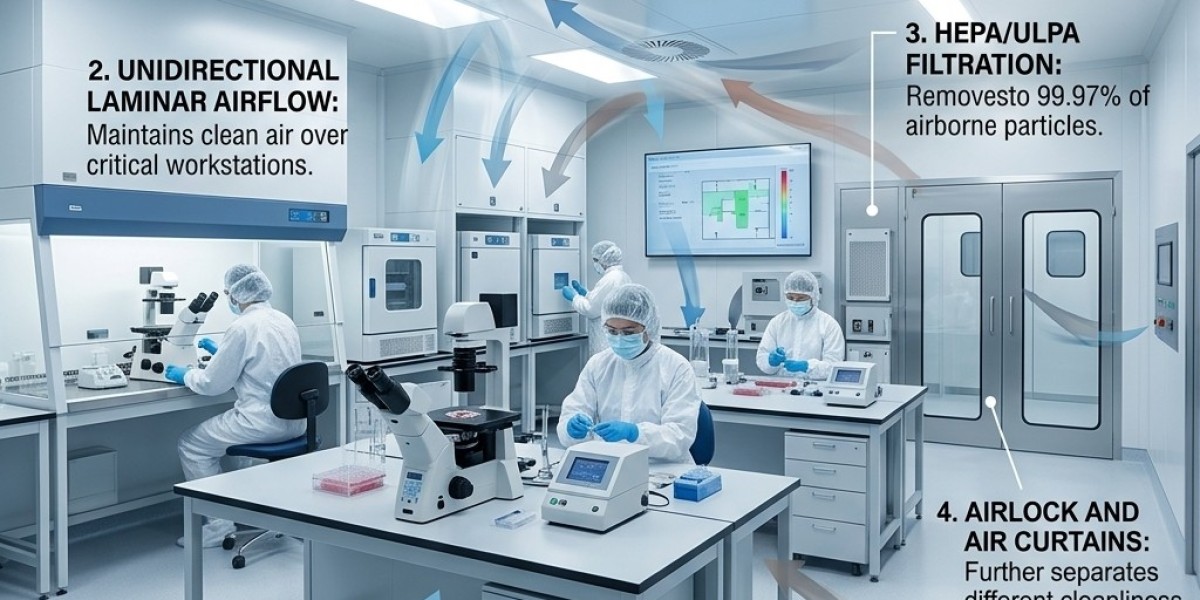
Maintaining controlled air quality is essential for fertility laboratories because reproductive cells and embryos can be sensitive to airborne particles and chemical contaminants. IVF Lab Design In India requires careful consideration of high-efficiency particulate air (HEPA) filtration, heating, ventilation, and air conditioning (HVAC), volatile organic compound (VOC) control, pressure management, and environmental monitoring. A properly designed filtration system helps reduce airborne particulate contamination and supports a controlled environment for procedures such as oocyte handling, fertilization, intracytoplasmic sperm injection (ICSI), embryo culture, and cryopreservation. When integrated with suitable laboratory materials, equipment, and operating procedures, HEPA filtration becomes an important component of a comprehensive environmental-control strategy.
An IVF laboratory is different from a conventional diagnostic laboratory. Its design must support precise procedures while limiting unnecessary exposure of reproductive cells and embryos to environmental disturbances. HEPA filters are valuable because they remove particles from air passing through them, but they do not independently eliminate gaseous contaminants, guarantee sterility, or replace appropriate HVAC engineering. Effective laboratory planning combines particulate filtration with VOC management, suitable airflow patterns, temperature and humidity control, cleanroom-compatible construction materials, and documented maintenance.
Why Air Quality Matters in an IVF Laboratory
IVF laboratories handle oocytes, sperm, embryos, culture media, and specialized consumables. Maintaining suitable environmental conditions is important throughout these procedures because air quality is only one part of the overall laboratory quality system.
Potential environmental concerns include:
Airborne dust and particulate matter
Microbial contamination associated with particles
Volatile organic compounds from building materials and furnishings
Chemical emissions from cleaning products and consumables
Temperature and humidity fluctuations
Inadequate ventilation or poorly controlled airflow
Contamination introduced through personnel, equipment, and supplies
The European Society of Human Reproduction and Embryology's 2026 recommendations state that IVF laboratory air should be managed using HEPA filtration and VOC control, with suitable positive pressure and regular environmental monitoring. They also emphasize appropriate construction materials and sufficient off-gassing time after new construction or renovation. <Cite refs={["turn938264search0","turn938264search1"]}/>
These considerations are particularly relevant to Indian fertility clinics, where laboratory design must account for the local building environment, climate, utility conditions, and applicable regulations.
1. Understanding HEPA Filtration Technology
HEPA stands for high-efficiency particulate air. A HEPA filter is designed to capture airborne particles through mechanisms including interception, impaction, and diffusion as air moves through its filter media.
Unlike ordinary filters, HEPA filters are engineered to provide a high level of particulate removal under specified test conditions. Their performance depends on the filter classification, installation quality, housing integrity, airflow, and maintenance.
In an IVF laboratory, HEPA filtration can help:
Reduce airborne particulate concentrations
Support controlled air cleanliness
Limit particle introduction into designated work areas
Complement appropriate HVAC and pressure-control strategies
Support environmental quality management
The precise filter specification should be selected according to the laboratory design, required performance, applicable standards, and risk assessment. The presence of a HEPA filter alone does not establish that an entire room meets a particular cleanroom classification. Room performance must be verified through appropriate testing.
2. How HEPA Filtration Supports Embryology Procedures
Embryology procedures require careful handling of reproductive cells and culture materials. A controlled environment helps reduce avoidable environmental risks while staff perform sensitive laboratory tasks.
HEPA filtration contributes by reducing particles in the supplied air. When integrated correctly with ventilation and laboratory zoning, it helps create more consistent conditions around the areas where reproductive materials are handled.
For example, laboratory planning may consider the environmental needs of:
Oocyte identification and handling
Sperm preparation
Insemination and ICSI
Fertilization assessment
Embryo culture and evaluation
Cryopreservation preparation
The airflow design should support the laboratory's actual procedures and equipment configuration. HEPA filtration should not be treated as a substitute for clean handling techniques, suitable consumables, validated equipment, or established quality-control procedures.
3. Integrating HEPA Filters with HVAC Systems
HEPA filtration performs best when it is part of a properly engineered HVAC system. The HVAC design determines how air enters the laboratory, how it moves through the space, and how it is returned or exhausted.
A coordinated system should address:
Air-handling unit selection and capacity
Filter location and accessibility
Air supply and return arrangements
Required fresh-air provision
Temperature and humidity control
Room pressure relationships
Airflow balancing and monitoring
Maintenance access and replacement procedures
The design must account for the additional resistance created by filters, including the effect of filter loading over time. Fans and ductwork should be selected so that required airflow can be maintained within the intended operating range.
In India, designers should also consider seasonal temperature changes, humidity, outdoor particulate pollution, and local building conditions. The solution should be based on a site-specific assessment rather than assuming that one HVAC configuration will suit every fertility laboratory.
4. Positive Pressure and Controlled Airflow
Positive pressure is commonly used in IVF laboratory planning to help reduce the entry of less-controlled air from adjacent spaces. This involves maintaining a planned pressure relationship between the laboratory and surrounding areas.
The pressure arrangement must be designed around the laboratory layout, door locations, adjacent rooms, and ventilation strategy.
Important considerations include:
Appropriate pressure relationships
Balanced supply and return airflow
Door opening and closing patterns
Separation of laboratory and support activities
Pressure monitoring where specified
Alarm and corrective-action procedures
Positive pressure and HEPA filtration perform different functions. HEPA filtration reduces particles in air passing through the filter, while pressure management influences the direction of air movement between spaces. Neither measure alone guarantees a contamination-free environment.
The laboratory should establish its required pressure conditions and acceptance criteria through the design specification and applicable guidance.
5. HEPA Filtration Versus VOC Control
One important consideration in IVF laboratory design is the difference between airborne particles and gaseous contaminants.
HEPA filters primarily remove particulate matter. They are not designed to remove most gaseous pollutants, including many VOCs that may originate from paints, adhesives, sealants, flooring, furniture, cleaning chemicals, and other materials.
Therefore, a comprehensive air-quality strategy may include:
Low-emission construction materials
Careful selection of paints, sealants, and adhesives
Suitable ventilation and fresh-air management
Gas-phase filtration, such as activated carbon, where appropriate
Assessment of possible VOC sources
Environmental monitoring and trend analysis
An appropriate off-gassing period after construction
The 2026 ESHRE recommendations specifically identify both HEPA filtration and VOC control as important considerations for IVF laboratory air quality. <Cite refs={["turn938264search0","turn938264search1"]}/>
Clinics should avoid assuming that a HEPA filter alone protects embryos from all airborne chemical contaminants. Filtration, source control, ventilation, and material selection must work together.
6. Choosing Suitable HEPA Filters and Filter Housings
Filter selection should be based on the intended application and required performance. The design team should verify the filter's classification, dimensions, airflow rating, pressure-drop characteristics, compatibility with the housing, and applicable test requirements.
A suitable installation should provide:
Correctly specified HEPA filters
Compatible filter housings and seals
Secure installation to minimize bypass leakage
Accessible locations for inspection and replacement
Suitable airflow capacity
Appropriate testing and documentation
A defined replacement and maintenance plan
Poorly sealed housings can allow air to bypass the filter, reducing overall system performance. Even a high-quality filter may not provide the intended result if it is incorrectly installed or damaged.
Filter replacement should follow manufacturer guidance and measured system conditions rather than an arbitrary schedule alone.
7. Designing Cleanroom-Compatible Laboratory Interiors
The effectiveness of an air-filtration system also depends on the surrounding laboratory environment. Surfaces and construction materials should support cleaning and minimize unnecessary particle or chemical emissions.
Laboratory planning should consider:
Smooth, durable, cleanable surfaces
Properly sealed joints and penetrations
Suitable flooring and wall finishes
Low-emission paints and adhesives
Appropriate furniture and workbench materials
Minimal dust-trapping features in controlled areas
Separation of cleaning and sterilization activities where appropriate
Material selection is particularly important during new construction and renovation. Freshly installed products may release VOCs, so sufficient off-gassing time should be planned before sensitive laboratory operations begin.
Construction and commissioning schedules should therefore include environmental preparation, cleaning, and verification—not just completion of building work.
8. Monitoring Air Quality and Filter Performance
Installing HEPA filtration is only the beginning. Laboratories need to confirm that the complete system performs as intended and continues to do so during routine operations.
Depending on the design and risk assessment, monitoring and testing may include:
Airborne particle-count measurements
HEPA filter integrity testing
Airflow volume and velocity checks
Room pressure differential measurements
Temperature and humidity monitoring
VOC assessment where specified
Environmental trend analysis
Surface microbial monitoring according to the laboratory's risk assessment
Testing may be required both when the laboratory is at rest and when it is operating, because personnel, equipment, and door movements can change environmental conditions.
The 2026 ESHRE recommendations support regular monitoring of air quality and risk-based assessment of laboratory cleanliness. <Cite refs={["turn938264search0","turn938264search1"]}/>
Results should be documented, reviewed against predefined acceptance criteria, and followed by corrective actions when measurements fall outside established limits.
9. Installation, Validation, and Commissioning
Commissioning verifies that the filtration and ventilation systems have been installed correctly and operate according to the approved design.
The commissioning plan should be prepared before installation so that required tests, acceptance criteria, and responsibilities are clear.
Depending on the project, verification may include:
Inspection of filter housings and installation seals.
Verification of airflow and pressure relationships.
HEPA filter integrity testing using an appropriate method.
Airborne particle-count testing.
Functional checks of environmental sensors and alarms.
Temperature and humidity control verification.
Review of system balancing and control settings.
Documentation of test results and corrective actions.
Validation requirements depend on the intended facility, design specification, applicable standards, and relevant regulatory requirements. A general claim that a laboratory is “HEPA filtered” should not be treated as proof that all environmental requirements have been satisfied.
10. Maintenance and Long-Term Reliability
HEPA filters and their supporting HVAC systems require planned maintenance. Dust accumulation, filter damage, seal deterioration, fan problems, and changes in system resistance can affect performance.
A maintenance program should include:
Regular inspection of filters and housings
Filter integrity testing at defined intervals
Replacement according to manufacturer guidance and system requirements
HVAC fan and motor servicing
Airflow balancing after relevant changes
Inspection of seals and duct connections
Calibration of environmental sensors
Maintenance records and corrective-action tracking
Filter replacement should be conducted using procedures that minimize contamination and protect personnel. After replacement or significant HVAC modifications, appropriate verification should be performed before the laboratory returns to normal operation.
11. Important Considerations for IVF Lab Design In India
Fertility clinics in India should plan HEPA filtration according to their local environment, intended procedures, equipment requirements, and applicable regulatory framework.
A suitable design process should consider:
Outdoor air quality and seasonal pollution
Local temperature and humidity conditions
Building layout and adjacent activities
Reliable electricity and backup provisions for critical systems
Availability of replacement filters and technical support
Equipment and maintenance access
Applicable Indian regulations and relevant technical standards
The laboratory's documented quality-management system
Clinics should work with experienced laboratory planners, HVAC engineers, and embryology professionals to establish performance requirements before construction begins. International professional recommendations can inform the design, but local regulatory obligations and the specific needs of the facility must also be addressed.
12. How to Choose the Right Design Partner
When evaluating a design provider, clinics should assess whether the proposed solution covers the complete air-quality system rather than just filter supply.
Key questions include:
Does the provider understand IVF laboratory workflow?
Are HEPA filtration and VOC control considered separately?
Is the HVAC design tailored to the building and local conditions?
Are filter integrity and particle-count tests included?
Are pressure relationships and environmental monitoring addressed?
Are low-emission construction materials specified?
Are maintenance access and filter replacement planned?
Will the clinic receive commissioning records and operating guidance?
A detailed proposal should define the system's performance requirements, scope of work, testing procedures, maintenance responsibilities, and documentation deliverables.
Conclusion
HEPA filtration plays an important role in controlling airborne particles in IVF laboratories, but it must be integrated with suitable HVAC engineering, VOC control, positive pressure where appropriate, cleanroom-compatible materials, and regular environmental monitoring. Effective IVF Lab Design In India requires a site-specific approach that accounts for local conditions, laboratory workflow, equipment requirements, and applicable regulations. With coordinated planning, installation, testing, and maintenance, Altus Airflow supports fertility facilities in developing controlled, practical, and maintainable laboratory environments.
Frequently Asked Questions
1. What role does HEPA filtration play in IVF Lab Design In India?
IVF Lab Design In India uses HEPA filtration as part of an integrated environmental-control strategy to reduce airborne particles and support suitable conditions for reproductive cell handling and embryo culture.
2. Why is HEPA filtration important in an IVF laboratory?
In IVF Lab Design In India, HEPA filtration helps reduce particulate contamination when correctly selected, installed, and maintained. It complements appropriate ventilation, cleaning, and laboratory procedures.
3. Can HEPA filters remove VOCs from IVF laboratory air?
No. IVF Lab Design In India should address VOCs separately through source control, suitable ventilation, and gas-phase filtration where required because HEPA filters primarily remove airborne particles.
4. Why is positive pressure used in IVF laboratory design?
IVF Lab Design In India may incorporate positive pressure to help limit the entry of less-controlled air from adjacent spaces. The pressure arrangement must be engineered and verified for the specific laboratory.
5. How is HEPA filter performance tested?
For IVF Lab Design In India, testing may include filter integrity checks, particle-count measurements, airflow verification, and inspection of filter housings according to the system specification and applicable requirements.
Read Our Previous Blog------>How can noise and vibration be minimized in IVF Lab Design Company?