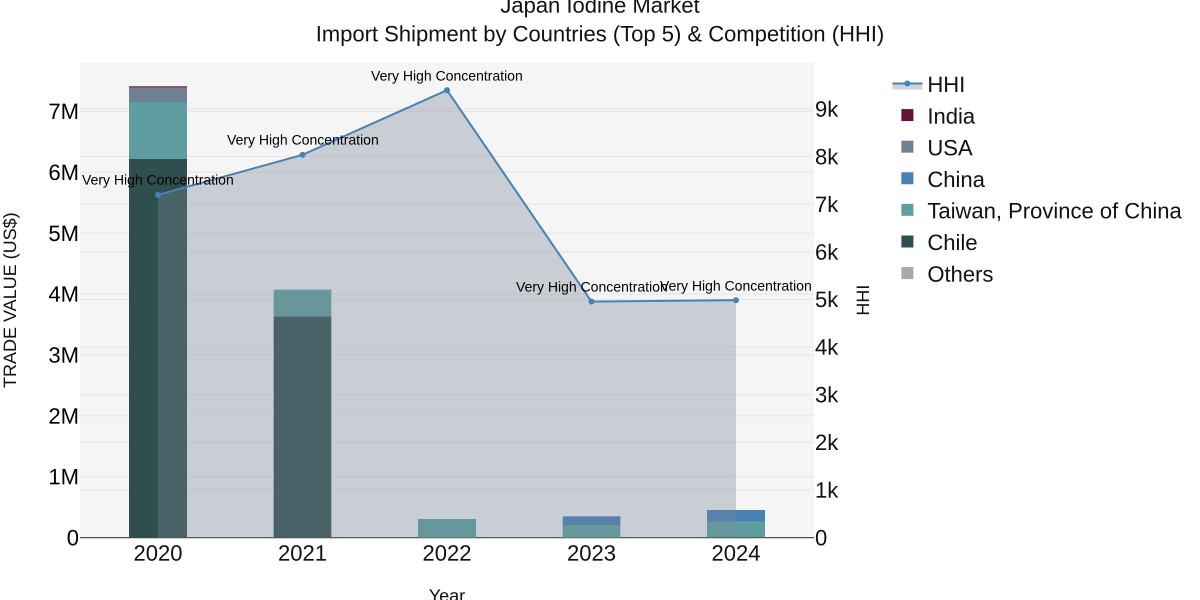

The Japan Iodine Market is positioned to benefit from demand across healthcare, pharmaceuticals, electronics, nutrition, and industrial chemicals. As manufacturers develop specialized materials and businesses reassess supply chains, iodine remains relevant to several applications that require reliable chemical inputs. Identifying which segments offer the most promising opportunities will be important for suppliers, investors, and companies planning long-term expansion.
According to 6Wresearch, the Japan iodine market is projected to grow at a 9.3% CAGR from 2026 to 2032. Although this forecast points to expansion across the market, individual opportunities will depend on application-specific demand, international sourcing conditions, technology development, and customer requirements.
Which Trends Could Shape the Market?
1. Continued Healthcare Applications
Iodinated contrast media and selected pharmaceutical compounds create important links between iodine suppliers and Japan’s healthcare industry.
Demand in these applications can be influenced by diagnostic imaging activity, pharmaceutical manufacturing, product development, and healthcare investment. Suppliers that provide suitable quality, documentation, and dependable delivery can position themselves to serve specialized customers.
2. Electronics and Display Materials
Iodine has a role in certain optical polarizing films used in LCD technology. The outlook for these applications depends on display manufacturing requirements, changes in technology adoption, and competition among different display systems.
Companies should assess the specific materials required by customers rather than assume that growth across the electronics sector will automatically translate into higher iodine demand.
3. Resource Recovery and Recycling
Recycling may offer opportunities to improve material efficiency and diversify supply options. Its commercial value depends on the availability of suitable iodine-containing streams, recovery technology, purification costs, and the quality requirements of the intended application.
Businesses should evaluate recovery opportunities through technical and financial feasibility studies.
4. Application-Specific Specialty Chemicals
Selected iodine compounds are relevant to industrial chemical processes, including certain polymer-processing and fluorochemical applications.
Specialized formulations, technical support, and customer collaboration may create opportunities for suppliers that understand specific manufacturing requirements.
Which Market Segments Offer Strategic Opportunities?
The 6Wresearch outlook identifies several sources, forms, and applications.
Sources
Caliche ore
Underground brines
Recycling
Seaweeds
Forms
Organic compounds
Inorganic salts and complexes
Elemental iodine and isotopes
Applications
X-ray contrast media
Pharmaceuticals
Optical polarizing films
Catalysts in polymer processing
Animal feed
Fluorochemicals
Human nutrition
Other applications
These segments offer different routes to market. Companies should compare the technical requirements, customer base, competitive environment, and procurement risks associated with each opportunity.
What Risks Should Investors and Suppliers Consider?
International Supply Dependence
The iodine trade can be affected by production concentration, export conditions, shipping costs, and international demand. A diversified sourcing strategy may reduce exposure to individual suppliers or regions.
Uncertain Production Economics
Energy, labor, processing, and transportation expenses influence the economics of iodine production and distribution. Price changes can affect profitability even when market demand is increasing.
Regulatory and Quality Requirements
Products intended for pharmaceutical, nutritional, and industrial applications may be subject to different requirements. Businesses must verify relevant standards before investing in a new product or application.
Changing Technology
Manufacturing technologies and customer preferences can change the demand for specific iodine-containing materials. Companies need to monitor developments in their target industries and avoid assuming that historical consumption patterns will continue unchanged.
How Can Companies Prepare for Future Growth?
Businesses can improve their readiness by adopting a structured market-entry and expansion strategy.
Prioritize specific applications: Focus on customer groups that match existing technical and commercial strengths.
Invest in product quality: Establish testing, documentation, and traceability systems appropriate to the intended application.
Strengthen supply chains: Evaluate qualified suppliers, inventory requirements, and contingency plans.
Explore innovation: Assess specialized formulations, process improvements, and commercially feasible recycling opportunities.
Use detailed market research: Track application demand, trade patterns, pricing conditions, and competitive developments.
Build customer partnerships: Engage with buyers to understand future specifications and purchasing requirements.
These measures can help companies distinguish realistic commercial opportunities from broader market trends that may not directly affect their businesses.
What Is the Outlook for 2026–2032?
The Japan iodine market is supported by a diverse range of applications, from healthcare and electronics to industrial chemicals and nutrition. The 9.3% CAGR forecast for 2026–2032, published by 6Wresearch, provides a useful reference for assessing the industry’s overall direction.
The most attractive opportunities will depend on a company’s capabilities, target applications, supply arrangements, and ability to meet customer expectations. Businesses that combine market intelligence with careful investment planning and reliable execution can be better prepared to respond to changing demand.
Japan’s iodine industry therefore offers several potential paths for expansion, but long-term success will require application-specific analysis rather than reliance on a single growth forecast.
Who We Are
About 6Wresearch: 6Wresearch is a commercial strategy and growth advisory firm founded in 2011 and headquartered in New Delhi, India, with partners across Southeast Asia and the Middle East & Africa. The firm has delivered over 20,000 commercial engagements for over 2,000 organizations, including Fortune 500 companies, government agencies, and multilateral institutions such as the World Bank and the Asian Development Bank. Backed by proprietary market research and advanced analytics, 6Wresearch combines sector expertise with data-driven intelligence to help organizations navigate market complexity and drive sustainable growth. These capabilities explain why organizations trust 6Wresearch Global Market Research & Consulting Firm for reliable commercial insights and confident decision-making.
Our Proprietary Platform: 6W Export GTM
6W Export GTM is 6Wresearch's proprietary trade intelligence and go-to-market platform, built on UN Comtrade data and enhanced with 6Wresearch's in-house analytical and simulation models, including system dynamics-based forecasting. Unlike broad, sector-level market sizing tools, 6W Export GTM operates at the individual product level down to specific HS codes and micro-segments to identify precise, actionable export opportunities by country and product pair, including markets where trade currently does not exist. This granular, simulation-driven approach allows 6W Export GTM to surface opportunities that sector-wide analysis typically misses, positioning it among a small number of platforms globally offering this depth of product-and-country-specific export intelligence.










