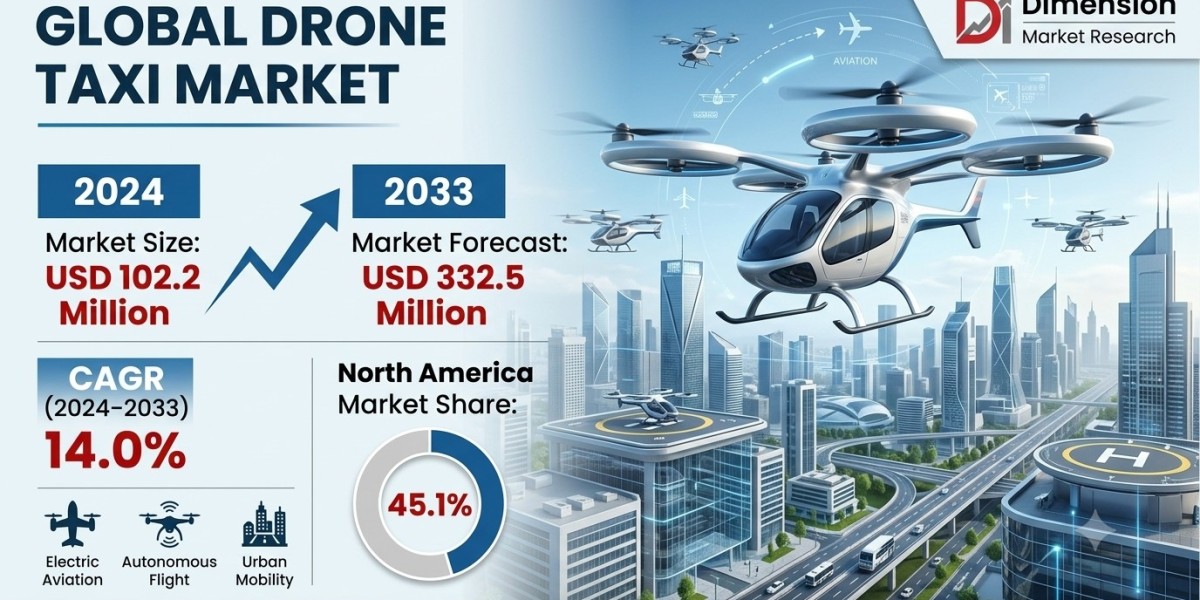

The Global Drone Taxi Market is emerging as a transformative segment of the aviation and urban transportation industries, driven by advancements in electric vertical takeoff and landing (eVTOL) technology, autonomous navigation, and sustainable mobility solutions. The market is projected to reach USD 102.2 million in 2024 and expand at a compound annual growth rate (CAGR) of 14.0%, reaching USD 332.5 million by 2033. Increasing urban congestion, technological innovation, and demand for faster transportation alternatives are creating opportunities for manufacturers, technology developers, and mobility service providers.
Drone taxis, also known as aerial taxis, are passenger-carrying aircraft designed to provide short- and medium-distance transportation through urban and regional airspace. These vehicles generally incorporate electric propulsion, advanced flight-control systems, automated navigation, and vertical takeoff capabilities. Unlike conventional helicopters, many eVTOL designs aim to reduce operational noise, improve energy efficiency, and support transportation networks without requiring traditional airport runways.
The transition toward advanced air mobility is attracting investment from aerospace manufacturers, automotive companies, technology providers, and transportation operators. Governments are developing aviation regulations, pilot certification requirements, and urban air mobility frameworks to support future commercial operations. However, widespread adoption remains dependent on aircraft certification, infrastructure readiness, operational economics, and passenger confidence.
? Looking for Specific Data? Get a Free Customized Sample:
https://dimensionmarketresearch.com/request-sample/drone-taxi-market/
Global Drone Taxi Market: Key Findings
The market outlook reflects growing opportunities across aircraft manufacturing, electric propulsion systems, aviation software, and aerial transportation services.
2024 Market Size: USD 102.2 million.
2033 Market Forecast: USD 332.5 million.
Market CAGR: 14.0% from 2024 to 2033.
Leading Region: North America, with a 45.1% share in 2024.
US Market Size: USD 40.0 million in 2024.
Leading Range Segment: Intracity transportation.
Leading Autonomy Segment: Remotely piloted aircraft.
Leading End User: Ride-sharing companies.
Key Technology: Electric vertical takeoff and landing systems.
These findings indicate that the industry is progressing toward a more structured commercial ecosystem in which technological maturity and regulatory compliance will determine market competitiveness.
Market Dynamics
The global drone taxi industry operates within a complex environment shaped by technological innovation, transportation demand, infrastructure development, and aviation regulations. While passenger mobility applications offer significant commercial potential, companies must address safety, certification, operating costs, and public acceptance before achieving widespread deployment.
Major Growth Drivers
Rising Urbanization and Traffic Congestion
Increasing population density and road congestion in metropolitan areas are encouraging governments and transportation providers to explore alternative mobility solutions. Drone taxis could reduce journey times on selected routes by bypassing congested road networks and connecting important commercial destinations.
Airport transfers, business districts, and densely populated urban corridors represent promising early applications. However, actual time savings will depend on vertiport accessibility, passenger processing, weather conditions, and flight availability.
Advancements in eVTOL and Autonomous Flight Technology
Rapid improvements in electric propulsion, battery management, artificial intelligence, and aircraft navigation are supporting the development of more efficient aerial mobility platforms.
Modern flight-control architectures incorporate multiple sensors, communication systems, and redundancy mechanisms to improve reliability. These developments are essential for meeting strict aviation safety requirements.
Electric propulsion supports lower direct flight emissions.
AI-enabled systems improve navigation and route planning.
Advanced sensors strengthen situational awareness.
Battery innovation supports operational improvements.
Redundant flight systems improve aircraft reliability.
Market Challenges and Restraints
Regulatory Complexity and Aviation Safety
Aviation certification remains among the most significant barriers to commercial drone taxi deployment. Passenger aircraft must satisfy rigorous safety, performance, maintenance, and operational requirements.
Airspace integration also requires coordination with conventional aviation, air traffic management authorities, and urban infrastructure operators.
Although regulatory frameworks are developing, approval processes can be lengthy and expensive. Autonomous passenger operations face additional challenges involving software validation, communication reliability, cybersecurity, and emergency procedures.
High Development and Infrastructure Costs
Drone taxi manufacturers require substantial investment in aircraft engineering, prototype testing, certification, manufacturing facilities, and supporting infrastructure.
Vertiports, charging systems, maintenance facilities, and specialized operational personnel can increase initial deployment expenses. Battery limitations, payload restrictions, and adverse weather conditions may further influence route economics.
Aircraft certification requires extensive testing.
Vertiport development demands significant capital.
Battery limitations can restrict operational range.
Weather conditions may reduce flight availability.
Public trust remains essential for adoption.
Emerging Drone Taxi Market Trends
Integration of Artificial Intelligence and Automation
Artificial intelligence is becoming increasingly important in aerial mobility development. AI-supported navigation, predictive maintenance, fleet optimization, and obstacle detection can improve operational efficiency and support safer flight management.
Manufacturers are also investigating progressively automated operations to reduce pilot workload. Nevertheless, fully autonomous passenger transportation will require extensive technical validation and regulatory approval before broader commercial implementation.
Growing Focus on Sustainable Urban Mobility
Environmental sustainability is influencing aircraft design and transportation policy. Electric drone taxis offer the potential to reduce direct operational emissions compared with combustion-powered aircraft.
Their overall environmental performance, however, depends on electricity generation, battery manufacturing, aircraft utilization, and comparison with alternative transportation modes.
Strategic Partnerships and Mobility Ecosystems
Partnerships between aircraft manufacturers, ride-sharing platforms, infrastructure developers, and aviation authorities are becoming central to market development.
Aircraft manufacturers focus on certification and reliability.
Mobility platforms explore integrated booking systems.
Infrastructure firms develop vertiports and charging networks.
Technology providers strengthen connected flight systems.
Governments evaluate urban airspace integration.
Global Drone Taxi Market Segmentation Overview
The market is segmented by system, autonomy, range, passenger capacity, and end use. Each category reflects different technological requirements, operating models, and customer applications.
By System
The system segment includes propulsion, structure, interior, avionics, and other aircraft components. Propulsion is expected to hold the largest market share in 2024, reflecting the importance of power efficiency and electric flight technology.
Major system categories include:
Propulsion: Fully electric, hybrid, and electric hydrogen.
Structure: Airframes and supporting aircraft components.
Interior: Passenger cabins and comfort systems.
Avionics: Flight control, communication, and navigation.
Others: Additional aircraft-related systems.
Fully electric propulsion is expected to dominate the propulsion category because of demand for low-emission transportation and simplified electric powertrain architectures.
By Autonomy
The autonomy segment is divided into fully autonomous and remotely piloted aircraft.
Remotely piloted drone taxis are expected to dominate in 2024, supported by the industry's preference for human oversight during the early stages of aerial mobility development.
Fully autonomous systems present longer-term opportunities, but their deployment depends on regulatory acceptance, reliable automation, and demonstrated operational safety.
By Range
The market includes intracity and intercity transportation.
Intracity drone taxis are projected to lead the market because their applications align closely with airport connectivity, urban commuting, and short-distance commercial transportation.
Intercity services offer potential for regional connectivity as aircraft range, charging capabilities, and energy efficiency improve.
By Passenger Capacity
Passenger capacity is categorized into:
Up to 2 passengers.
3 to 5 passengers.
More than 5 passengers.
The 3-to-5-passenger segment is expected to dominate in 2024 and experience strong growth through 2033. Its potential advantages include balancing aircraft size, seating capacity, and per-passenger operating costs.
By End Use
Drone taxi applications are classified into ride-sharing companies, scheduled operators, hospital and medical agencies, and private operators.
Ride-sharing companies are expected to account for the largest revenue share in 2024, benefiting from established customer networks, digital booking platforms, and transportation management capabilities.
Medical transportation and private mobility could provide additional opportunities, although their operational requirements differ considerably from conventional passenger services.
Purchase the report for comprehensive details:
https://dimensionmarketresearch.com/checkout/drone-taxi-market/
Regional Analysis of the Drone Taxi Market
North America
North America is expected to dominate the global market with a 45.1% revenue share in 2024. Its leadership is supported by advanced aerospace capabilities, established aviation infrastructure, technological innovation, and investment in emerging transportation solutions.
The United States is particularly important, with its drone taxi market projected to reach USD 40.0 million in 2024.
Regulatory developments, aircraft testing activities, and collaboration between aviation stakeholders are helping establish the foundations for future commercial operations.
Europe
Europe represents a significant market for electric aviation and innovative air mobility. Growing interest in sustainable transportation, advanced aerospace engineering, and urban mobility modernization supports industry development.
Germany, France, and the United Kingdom are among the countries contributing to aircraft innovation and infrastructure planning.
Asia-Pacific
Asia-Pacific offers considerable long-term growth opportunities, supported by urbanization, expanding metropolitan populations, and technological investments.
China, Japan, South Korea, and India are important markets for aerial mobility development. Increasing attention to airport connectivity and urban transportation efficiency could accelerate future adoption.
Latin America and Middle East & Africa
Latin America presents potential opportunities in congested metropolitan regions, although investment requirements and regulatory readiness may limit near-term deployment.
The Middle East, particularly the United Arab Emirates and Saudi Arabia, is exploring advanced aerial mobility within broader transportation modernization and smart-city initiatives.
Competitive Landscape
The global drone taxi industry features competition among established aerospace manufacturers, emerging eVTOL developers, and technology-focused aviation companies.
Major participants identified in the market include:
Boeing
Airbus
Lift Aircraft
Lilium
Volocopter
Joby Aviation
EHang
Aloft Aviation
Airspace Experience Technology
Micor Technology LLC
These companies represent participants identified in the report's competitive scope; inclusion does not necessarily indicate current commercial operating status.
Competition focuses on battery performance, aircraft safety, certification progress, manufacturing scalability, passenger capacity, and operating efficiency.
Companies capable of achieving regulatory approval while controlling production and maintenance costs may secure stronger competitive positions.
Strategic alliances with transportation operators, city authorities, and infrastructure developers are also likely to influence future market participation.
Future Market Outlook: 2025–2033
The Global Drone Taxi Market is projected to expand steadily as eVTOL technology matures and advanced air mobility ecosystems develop.
The forecast increase from USD 102.2 million in 2024 to USD 332.5 million by 2033 reflects expectations of continued investment in aircraft innovation and supporting infrastructure.
Future growth will depend on the successful transition from demonstrations and limited operations toward repeatable, economically sustainable passenger services.
Key developments to watch include:
Greater investment in commercial eVTOL manufacturing.
Expansion of urban vertiport infrastructure.
Improvements in battery efficiency and aircraft range.
Growing integration with existing transportation networks.
Increasing adoption of advanced flight automation.
Progress in certification and operational approvals.
Frequently Asked Questions (FAQs)
1. What is the projected size of the Global Drone Taxi Market?
The market is projected to reach USD 102.2 million in 2024 and grow to USD 332.5 million by 2033, reflecting increasing demand for advanced aerial mobility solutions.
2. What is the expected growth rate of the Drone Taxi Market?
The market is forecast to expand at a CAGR of 14.0% between 2024 and 2033, supported by technological advancements, investment activity, and urban transportation needs.
3. Which region dominates the global drone taxi industry?
North America is expected to lead with a 45.1% market share in 2024, supported by advanced aviation infrastructure, technology development, and early investment.
4. What factors are driving drone taxi market growth?
Major growth drivers include urban congestion, increasing interest in sustainable mobility, advancements in eVTOL aircraft, artificial intelligence, electric propulsion, and evolving aviation regulations.
5. What are the major challenges facing drone taxi commercialization?
Key challenges include aircraft certification, high development costs, limited supporting infrastructure, battery performance, airspace integration, weather restrictions, and passenger safety concerns.
Conclusion: Summary of Key Market Insights
The Global Drone Taxi Market represents an emerging opportunity at the intersection of aviation innovation, electrification, and urban transportation modernization. Its projected 14.0% CAGR through 2033 highlights the commercial potential of aerial mobility solutions, although the pace of adoption will depend on regulatory and operational progress.
North America's anticipated 45.1% market share in 2024 demonstrates the importance of technology leadership, aviation expertise, and infrastructure readiness. Meanwhile, Europe and Asia-Pacific offer opportunities for future market expansion.
The long-term success of drone taxis will depend on converting technological advances into safe, reliable, accessible, and commercially viable transportation services. Companies that combine efficient aircraft development with regulatory compliance, infrastructure partnerships, and sustainable operating models will be better positioned to capture opportunities in this evolving industry.
Related Reports:
https://dimensionmarketresearch.com/report/drone-market/
https://dimensionmarketresearch.com/report/autonomous-drones-market/
https://dimensionmarketresearch.com/report/uae-drone-delivery-market/







