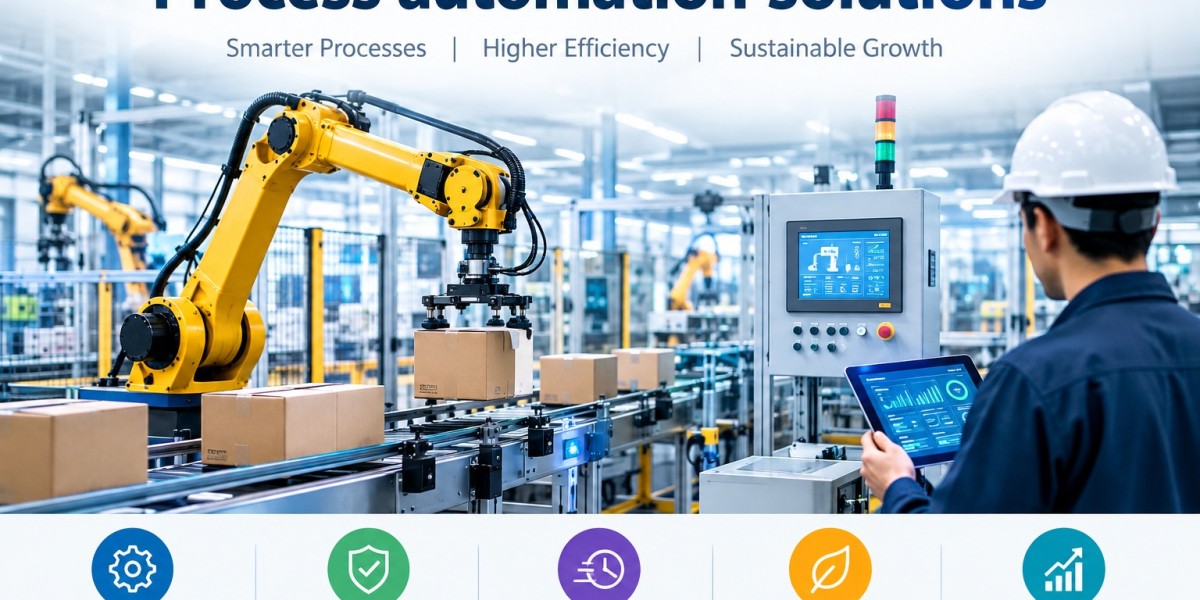

Process automation solutions help organizations use control systems, software, sensors, and industrial equipment to perform tasks with less manual intervention. These solutions can support everything from monitoring production conditions to controlling machinery and coordinating entire manufacturing workflows.
When implemented correctly, automation can help businesses improve operational consistency, use resources more efficiently, and respond more effectively to changing production requirements. Understanding the technology, its applications, and its implementation requirements can help organizations make better investment decisions.
What Are Process Automation Solutions?
Process automation solutions involve technologies and systems designed to monitor, control, and optimize business or industrial processes. In manufacturing environments, they often combine programmable logic controllers (PLCs), sensors, industrial networks, supervisory control systems, and specialized software.
These technologies collect information from equipment, process signals, and execute predefined control instructions. For example, an automated production line may use sensors to detect products, controllers to coordinate machine operations, and software to monitor production status.
Process automation can be applied to individual machines, interconnected production lines, or larger industrial operations. The appropriate solution depends on the process being automated, the desired performance, and the organization's operational requirements.
The main objective is to create a controlled and repeatable workflow that supports reliable operations while reducing unnecessary manual effort.
Why Is Process Automation Important?
Businesses face increasing pressure to improve efficiency, maintain product quality, and control operating costs. Automation can help address these challenges by making industrial processes more predictable and easier to monitor.
1. Improved Operational Efficiency
Automated systems can perform repetitive activities according to predefined instructions. This reduces the need for continuous manual intervention in suitable processes and can help minimize unnecessary delays.
For example, an automated manufacturing line can coordinate material movement, machine operation, and inspection activities to maintain a consistent workflow.
The actual improvement depends on equipment capabilities, process design, and the quality of implementation.
2. Greater Process Consistency
Manual operations can vary depending on workload, working conditions, and individual practices. Automation helps standardize repetitive activities by following defined operating parameters.
In manufacturing, this may include maintaining specified temperatures, controlling material flow, monitoring machine speeds, or following repeatable assembly sequences.
Consistent process control can help organizations reduce unwanted variations and maintain product quality.
3. Better Monitoring and Control
Modern automation systems can collect information from sensors, controllers, and industrial equipment. Operators can use this information to understand process conditions and identify unusual behavior.
Depending on the system, monitoring capabilities may include equipment status, production counts, temperature measurements, pressure readings, and alarm notifications.
Access to relevant operational information can help teams make informed decisions and respond to problems more quickly.
4. More Efficient Resource Utilization
Automation can help organizations manage materials, energy, equipment usage, and production schedules more effectively.
For example, control systems can adjust equipment operation according to process requirements instead of relying entirely on fixed manual procedures.
However, achieving measurable savings requires appropriate system design, monitoring, and continuous evaluation.
5. Support for Workplace Safety
Certain industrial activities involve repetitive movements, hazardous environments, high temperatures, or exposure to moving machinery.
Automating suitable tasks can reduce workers' exposure to some of these hazards. Nevertheless, automated equipment also introduces risks that must be addressed through proper engineering, risk assessment, protective measures, and operator training.
Common Technologies Used in Process Automation
Effective automation depends on selecting technologies that match the needs of the process.
Programmable Logic Controllers
A programmable logic controller is an industrial control device used to monitor inputs and control outputs according to programmed logic.
PLCs are commonly used to manage conveyors, pumps, motors, machine sequences, and other industrial operations. Their reliability and flexibility make them important components of many automation systems.
Sensors and Actuators
Sensors measure or detect physical conditions such as temperature, pressure, position, speed, and proximity.
Actuators convert control signals into physical actions. Examples include opening valves, moving mechanical components, and controlling motorized equipment.
Together, sensors and actuators allow control systems to interact with real-world processes.
Supervisory Control and Data Acquisition
Supervisory Control and Data Acquisition (SCADA) systems allow operators to monitor and supervise industrial processes.
Depending on the implementation, SCADA can provide graphical displays, alarms, historical data, and remote monitoring capabilities. These features help operators understand system conditions and manage complex industrial operations.
Industrial Communication Networks
Automation equipment often needs to exchange information between controllers, sensors, drives, computers, and monitoring systems.
Industrial communication technologies enable these components to share data and coordinate their activities. Network selection depends on requirements such as response time, reliability, interoperability, and environmental conditions.
Industrial Software and Data Analytics
Software tools can collect and analyze production information to help businesses identify inefficiencies and evaluate performance.
When combined with suitable monitoring practices, operational data can support maintenance planning, quality improvement, and production optimization.
Applications of Process Automation Solutions
Process automation supports a wide range of industries.
Manufacturing: Automated systems coordinate assembly lines, machine operations, inspection activities, and material handling.
Automotive: Automation supports component manufacturing, robotic assembly, production monitoring, and quality-control processes.
Food and beverage: Control systems manage suitable processing, mixing, filling, packaging, and material-handling operations.
Pharmaceuticals: Automation can support manufacturing equipment, environmental monitoring, and controlled production processes, subject to applicable regulatory requirements.
Energy and utilities: Industrial control systems monitor and manage equipment used in power generation, water treatment, and other utility operations.
Warehousing and logistics: Automated conveyors, sorting equipment, and material-handling systems help coordinate the movement of goods.
Every application has different operating conditions and performance requirements. Consequently, automation systems should be designed around the specific process rather than relying on a universal solution.
How to Choose the Right Process Automation Solutions
Selecting the right automation system requires a clear understanding of current operations and future business objectives.
Identify Existing Process Challenges
Businesses should first determine which activities create delays, errors, unnecessary costs, or inconsistent results. This helps identify the processes most likely to benefit from automation.
Define Measurable Objectives
Organizations should establish clear targets, such as improving throughput, reducing downtime, increasing process consistency, or improving equipment visibility.
These targets provide a basis for evaluating the project's success.
Evaluate Compatibility
New automation equipment may need to work with existing machinery, control systems, and industrial networks. Evaluating compatibility early can help reduce integration difficulties.
Consider Safety and Cybersecurity
Automation projects should account for machine safety, access controls, network security, and appropriate protection of operational data.
The required safeguards depend on the system's architecture, industrial environment, and potential consequences of failure.
Plan for Maintenance and Expansion
Businesses should consider how the system will be maintained, updated, and expanded as requirements change. Documentation, staff training, spare parts, and technical support can contribute to long-term reliability.
The Future of Industrial Process Automation
Industrial automation continues to evolve as businesses adopt connected equipment, advanced analytics, robotics, and digital engineering tools.
Connected systems can provide greater visibility into production activities, while analytics can help identify performance patterns and potential inefficiencies. Robotics can automate suitable material-handling and manufacturing tasks, and digital simulation can support system planning before physical implementation.
These technologies can create opportunities for more flexible and data-driven operations. However, their benefits depend on reliable integration, appropriate cybersecurity, employee training, and clearly defined business objectives.
Organizations that evaluate automation strategically can identify practical opportunities to improve their processes while managing implementation risks.
Conclusion
Process automation solutions play an important role in modern industrial operations by helping businesses control equipment, standardize repetitive activities, monitor production conditions, and improve workflow efficiency.
Successful automation requires more than installing new equipment. Organizations must understand their existing processes, define measurable objectives, select compatible technologies, and address safety, cybersecurity, and maintenance requirements.
By taking a structured approach, businesses can develop automation systems that meet their operational needs and support future improvements.