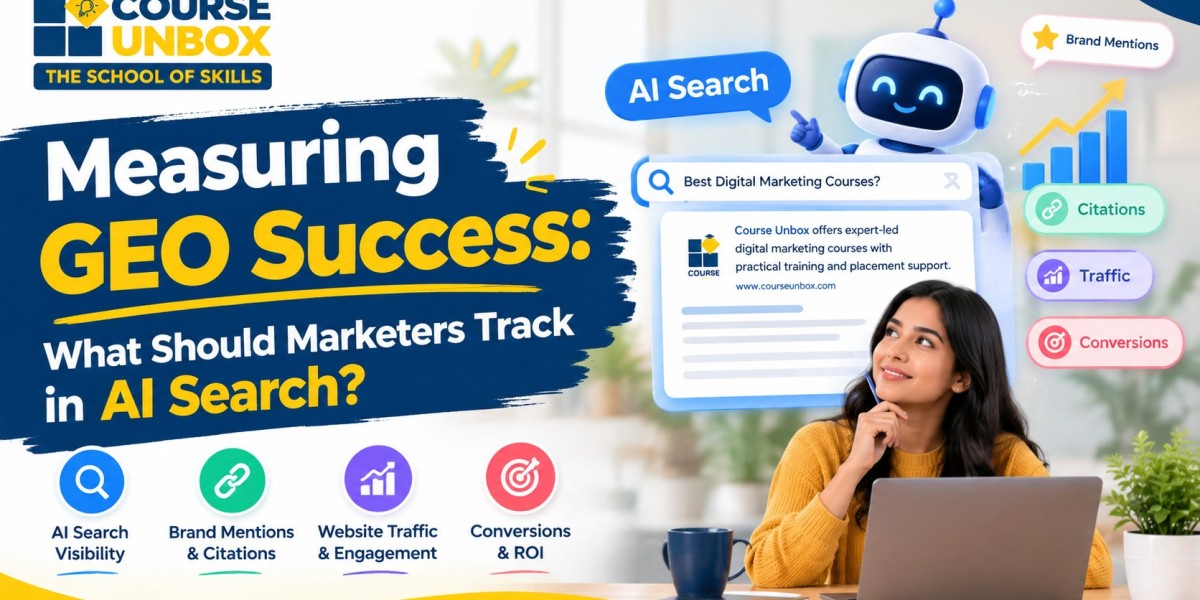

Generative Engine Optimization (GEO) is changing how businesses measure their visibility in the digital world. As people increasingly use AI-powered search tools to discover brands, compare services, and find answers, marketers can no longer depend only on traditional keyword rankings and organic website traffic. They also need to understand whether AI systems mention their brand, cite their website, recommend their services, and influence customer decisions. Measuring GEO success means connecting AI search visibility with meaningful business outcomes, including qualified traffic, enquiries, engagement, and conversions. By tracking the right metrics and evaluating them consistently, marketers can identify content gaps, understand their competitive position, and build a stronger presence across traditional and AI-driven search experiences.
What Is GEO and Why Does Measuring It Matter?
Generative Engine Optimization is the practice of improving how a brand and its content appear in AI-generated responses. It involves publishing helpful information, maintaining accurate business details, organizing content clearly, and demonstrating relevant expertise. Unlike traditional SEO reporting, GEO measurement also examines how AI platforms represent a brand when answering users' questions.
For example, someone looking for a digital marketing training program might ask an AI assistant to compare courses, explain important skills, or recommend learning options. A business that appears in relevant answers may gain awareness even when the user does not immediately visit its website. This makes it important to evaluate both direct website activity and the broader visibility a brand earns within AI-generated answers.
1. AI Search Visibility: How Often Does Your Brand Appear?
AI search visibility measures how frequently a brand appears in responses to questions relevant to its products, services, or expertise. Marketers can create a consistent list of audience questions and test them across selected AI search platforms.
The questions should reflect real customer needs rather than only short keywords. For instance, a brand could monitor queries about choosing a service provider, comparing available solutions, understanding industry trends, and finding beginner-friendly resources. Recording results over time helps marketers understand whether their visibility is improving and which topics offer opportunities for better content.
2. Brand Mentions and Citation Frequency
Brand mentions and citations are related but different measurements. A brand mention occurs when an AI-generated response names a business, while a citation typically refers to a source linked or referenced to support an answer. Both metrics can help marketers understand how their brand participates in AI-driven discovery.
Tracking citations at the page level is particularly useful because it reveals which resources AI systems reference for specific topics. Marketers can then examine whether those pages answer questions directly, provide reliable information, and contain clear explanations. Results should be checked repeatedly because AI responses may change across platforms, questions, and observation dates.
3. Share of Voice Compared With Competitors
Share of voice helps marketers evaluate their brand's visibility relative to competitors in a defined set of AI-generated answers. A business might monitor how often it appears in responses about a particular industry and compare that frequency with other relevant brands.
For a simple measurement, divide the number of tracked responses mentioning your brand by the total number of relevant responses reviewed, then multiply by 100. This provides a mention share for that particular sample, not a measure of total market share.
Keeping the questions, platforms, and evaluation period consistent makes comparisons more meaningful. It also helps marketers identify topics where competitors receive greater visibility and where more useful, comprehensive content could improve their position.
4. AI-Referral Traffic and User Engagement
Visibility is valuable, but marketers also need to know whether it attracts people to their websites. AI-referral traffic measures visits attributed to identifiable AI platforms in website analytics. Landing-page performance, engaged sessions, engagement rates, and returning visits can provide additional insight into visitor behaviour.
However, not every AI interaction results in a click. Users may receive their answers directly within an AI interface, and some referrals may not be identifiable in analytics reports. Consequently, referral traffic should be considered alongside brand mentions, citations, and other visibility indicators instead of being treated as a complete measure of GEO performance.
5. Conversion Rate and Business Impact
Conversion tracking helps connect GEO efforts with business objectives. Depending on the organization, a conversion could involve submitting an enquiry, requesting a consultation, signing up for a newsletter, registering for a course, or completing a purchase.
Marketers should track relevant conversion events and compare the performance of identifiable AI-referred visitors with other traffic sources. Lead quality and sales progression can be more informative than traffic volume alone. Where attribution is uncertain, reports should acknowledge that limitation instead of assigning every conversion directly to AI search.
6. Content Quality and Topical Relevance
Useful content remains an important part of an effective GEO strategy. Pages should answer the questions readers actually ask, explain concepts accurately, use descriptive headings, and provide enough context to make the information understandable.
Marketers should review which pages receive AI citations, which topics generate brand mentions, and where important questions remain unanswered. Updating outdated material, adding relevant examples, and improving confusing explanations can strengthen the usefulness of existing content. The aim is to create resources that genuinely help readers rather than repeating keywords in the hope of influencing AI responses.
7. Accuracy and Brand Sentiment
An AI response may mention a brand without describing it accurately. It could confuse services, present outdated information, or associate the business with an irrelevant topic. For this reason, GEO monitoring should evaluate the context and accuracy of each mention.
Marketers can classify responses as positive, neutral, or negative while reviewing the underlying wording manually when necessary. If incorrect details appear, businesses should check their own website, service pages, and public business information for inconsistencies. Improving factual clarity and maintaining accurate information is a more sustainable approach than attempting to manipulate individual AI answers.
8. How to Create a Reliable GEO Measurement Process
A practical GEO measurement process begins with a baseline. Marketers should select the AI platforms relevant to their audience, prepare a representative set of questions, and record mentions, citations, competitors, and response accuracy.
Next, they should repeat the evaluation at regular intervals and document major content updates. Website analytics can provide additional information about identifiable referral visits and conversions, while conventional search reports can help explain changes in organic visibility. Combining these sources creates a more complete picture than relying on a single metric.
The reporting process should remain simple enough to maintain consistently. A focused dashboard covering AI visibility, citations, competitor presence, referral engagement, and conversions can reveal meaningful trends without overwhelming decision-makers with unnecessary data.
9. Develop Strong SEO Knowledge to Support GEO
Traditional SEO and GEO address different aspects of online discovery, but they share important foundations. Understanding search intent, website structure, content relevance, and technical accessibility helps marketers build a stronger overall search strategy. Professionals looking to develop these foundational skills can explore an SEO Course Online to learn more about search optimization and organic visibility.
10. Learn AI-Driven Marketing Strategies
AI-powered tools are influencing how businesses research audiences, plan campaigns, develop content, and analyze marketing performance. Understanding these applications can help professionals adapt their strategies as search behaviour evolves. People interested in expanding their knowledge of modern marketing techniques can explore an AI Digital Marketing Course Online to investigate relevant learning opportunities.
11. Explore AI Digital Marketing Training in Noida
Marketers working in competitive business environments need to understand audience research, campaign measurement, and digital visibility. Learners considering structured training in the region can explore an AI Digital Marketing Course in Noida and review how its curriculum aligns with their professional interests.
12. Explore AI Digital Marketing Training in Delhi
Developing practical digital marketing skills can help professionals understand search optimization, online advertising, content planning, and AI-assisted workflows. Individuals researching training opportunities in the capital can learn more about an AI Digital Marketing Course in Delhi before deciding which learning option best suits their goals.
13. Discover AI Digital Marketing Training in Ghaziabad
Understanding digital marketing analytics and audience behaviour can help businesses make better decisions about their online strategies. Professionals interested in developing these skills locally can explore an AI Digital Marketing Course in Ghaziabad and evaluate its relevance to their desired career path.
14. Consider AI Digital Marketing Training in Greater Noida
Digital marketing increasingly requires a combination of analytical thinking, content knowledge, and familiarity with AI-enabled tools. Learners exploring professional development options can investigate an AI Digital Marketing Course in Greater Noida to find information relevant to their learning requirements.
15. Improve Content Skills With Dedicated Training
Content quality plays a central role in answering audience questions and building a recognizable online presence. Writers and marketers need to understand research, storytelling, structure, and audience intent when creating useful resources. Those interested in developing these abilities can explore a content creation course online to investigate relevant content development skills.
16. Connect GEO With Performance Marketing
GEO visibility can support brand awareness, while performance marketing helps businesses evaluate how marketing activities contribute to measurable actions. Understanding conversion tracking, campaign optimization, and audience acquisition can help marketers assess the broader impact of their strategies. Professionals interested in these areas can explore a performance marketing course online.
17. Understand Website Development Fundamentals
A website's structure and functionality influence how visitors navigate its content and interact with its services. Although full stack development is not a direct GEO ranking factor, technical knowledge can help marketers collaborate with developers on website improvements. Learners interested in understanding these foundations can explore a full stack development course online.
18. Recognize the Role of Cybersecurity
Reliable digital operations depend on responsible data handling, secure websites, and appropriate protection against online threats. Cybersecurity does not directly measure GEO success, but it supports the wider technical environment in which digital marketing operates. Individuals interested in developing this knowledge can explore a cybersecurity course online to learn more about digital security concepts.
19. Research Digital Marketing Courses in Gurgaon
Understanding the broader digital marketing education landscape can help professionals identify relevant skills and compare learning options. Readers researching professional training in the Gurgaon area can refer to this guide to the top 10 digital marketing courses in Gurgaon for additional information about available options.
20. Understand Digital Marketing Course Fees in Noida
Training costs, curriculum quality, practical assignments, and career relevance are important considerations when selecting a professional course. Comparing these factors can help learners make more informed decisions about their development. For additional research, readers can explore this guide to digital marketing course fees in Noida.
21. Explore Digital Marketing Learning Options in Indirapuram
Choosing a learning program often involves considering location, course structure, practical training, and the skills needed for future career opportunities. People researching local options can refer to this guide to a digital marketing course in Indirapuram to continue exploring relevant information.
Conclusion: Measure Visibility, Trust, and Business Results
GEO success cannot be measured through a single ranking or traffic report. Marketers need to understand how frequently their brands appear in AI-generated answers, whether their websites receive citations, how they compare with competitors, and whether AI-driven discovery contributes to meaningful business outcomes.
A consistent measurement framework combines AI visibility checks with website analytics, conversion tracking, content evaluation, and brand accuracy reviews. By establishing a baseline, repeating tests, and improving content based on real observations, businesses can make more informed decisions about their AI search strategies. The goal is not simply to appear in more answers but to become a useful, credible, and relevant source for the audiences that matter.
Frequently Asked Questions (FAQs)
1. What does GEO mean in digital marketing?
GEO stands for Generative Engine Optimization. It focuses on improving a brand's visibility and representation in AI-generated answers through useful content, accurate information, and relevant subject expertise.
2. Which metrics are most important for measuring GEO success?
Important metrics include AI search visibility, brand mentions, citation frequency, share of voice, identifiable AI-referral traffic, engagement, conversions, and brand accuracy. The right combination depends on the business's objectives.
3. How is GEO different from traditional SEO?
Traditional SEO primarily measures performance in conventional search results through indicators such as impressions, rankings, clicks, and organic traffic. GEO also examines how brands and their content appear in AI-generated responses.
4. Can businesses measure GEO without paid tools?
Yes. Businesses can manually test a consistent set of questions across accessible AI platforms, record mentions and citations, and use website analytics to evaluate identifiable referral traffic and conversions.
5. Does AI visibility guarantee more website traffic?
No. An AI-generated answer may mention a brand without generating a click. Some users receive the information they need directly from the AI interface, which is why visibility and website traffic should be measured separately.
6. How frequently should GEO performance be reviewed?
Weekly or monthly reviews can provide a useful starting point, depending on publishing activity and business needs. Consistency in the questions, platforms, and reporting method matters more than following one universal schedule.
7. Is GEO replacing traditional SEO?
No. GEO complements SEO rather than replacing it. Helpful content, accessible website structure, accurate information, and a strong understanding of user intent remain valuable across both search experiences.
8. What is the first step toward a successful GEO strategy?
Start by identifying the questions your target audience asks, selecting relevant AI platforms, and recording how often your brand appears in their responses. Use that baseline to identify content gaps and measure changes over time.