
Nobody wakes up and says, "Today I'm going to choose a sourcing model." You decide to ship an AI feature. Or untangle a data platform that's creaking. Or finally open an engineering team in India. The sourcing question sneaks in later, usually around week twelve, when a job post is still open and the roadmap hasn't moved an inch.
That's the moment every option starts to sound the same. Consultants, staffing firms, outsourcing vendors, capability-center advisors: they all promise talent, and they all use the same words. But they aren't the same thing. Each one fixes a different problem, brings a different kind of risk, and suits a different stage of growth.
So let's look at this through one simple lens: the gap you're actually trying to close. If you're a CTO, founder, or talent leader who would rather decide once than twice, this guide is for you.
Start With the Gap, Not the Shortlist
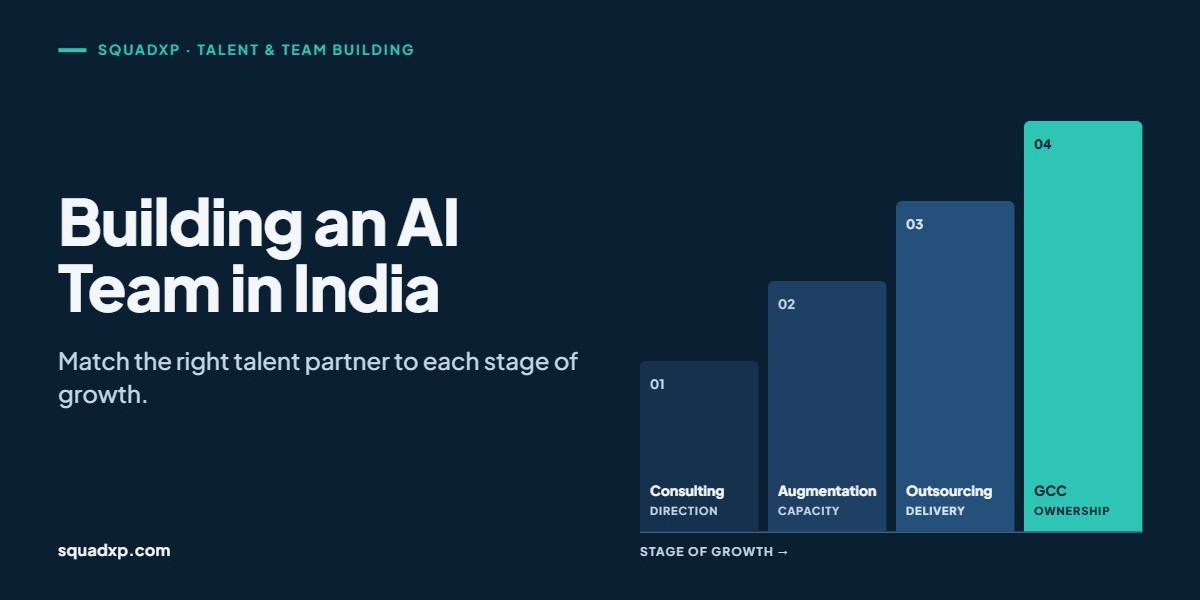
The most common mistake is opening a spreadsheet of vendors on day one. Before you do that, describe the gap in plain words. Almost every AI team problem fits one of four types:
A direction gap: You know AI matters to the business, but you're not sure which use cases to chase, in what order, or on what architecture.
A capacity gap: The plan is solid. You're just two or three people short, with very specific skills, and you can't hire them fast enough.
A delivery gap: You want a clear outcome, say a working recommendation engine, and you'd rather not manage the team that builds it.
An ownership gap: AI is turning into the core of your product. You want a permanent team, local leadership, and full control of the IP.
Each gap points to a different partner. Treat a direction gap as a capacity gap and you end up with talented engineers and nothing clear to build. Treat an ownership gap as a delivery gap and you end up renting knowledge you should own.
What an AI Team Actually Needs
"We need AI engineers" is too vague to hire against. A working AI team usually pulls from a handful of distinct profiles:
Machine learning engineers, who build, train, and evaluate models
Data engineers, who build the pipelines and storage those models depend on
MLOps and platform engineers, who handle deployment, monitoring, and cost
Product managers and domain experts, who decide what's worth building at all
Software engineers, who wire models into real applications
Now compare two companies. One needs a couple of AI ML specialists to unblock a single deployment. The other wants to build an in-house AI product group. The first is a short, targeted search. The second is a multi-quarter effort with leadership, hiring order, and retention to plan. Be honest about which one you are, because it shapes almost every decision that follows.
Four Partner Models and the Problems They Solve
IT consulting: when you need direction before headcount
Consulting means advice, architecture, and planning. A good consultant helps you decide which AI use cases deserve investment, sketches the data and platform approach, and sometimes oversees early delivery. The engagement usually ends with a plan or a prototype. It doesn't end with a permanent team.
If you've ever searched for the best IT consulting companies, you know the label stretches across very different firms: global strategy houses, mid-sized technology advisors, boutique specialists. Size matters less than fit. Ask who will actually staff your engagement. Ask whether the people who pitch are the people who deliver. Ask what happens after the recommendations land on your desk. Consulting is brilliant when you need clarity. It's a poor choice when you need someone writing code next month.
Staff augmentation: when you know the gap and need people
With augmentation, outside professionals join your team and work under your management, your tools, and your processes. You set the priorities and review the work. The partner handles sourcing, vetting, and the employment paperwork.
It's a natural fit for capacity gaps, especially for scarce skills. The market is crowded, though. Staff augmentation companies range from high-volume resume shops to specialist firms that screen hard for a narrow skill set, and the difference shows up in your first sprint.
There's one catch, and it's on your side of the table. Augmented engineers need a manager with real time to onboard and direct them. Without that, even excellent people sit idle.
IT outsourcing: when you want an outcome, not a team to manage
Outsourcing hands a defined scope of work to a vendor who owns delivery. You agree on deliverables, timelines, and acceptance criteria. The vendor decides how to staff and run it.
A dependable IT outsourcing company gives you predictability and frees your leaders from day-to-day management. The trade-off is knowledge. When the project ends, much of the understanding of how the system works sits with the vendor. For a well-bounded build, like a data platform migration or a model-powered feature with clear requirements, that's fine. For a capability at the heart of your product, it can quietly become a dependency. Ask for documentation, code ownership, and a clean handover clause from day one. If you're still weighing the three models side by side, our breakdown of augmentation, outsourcing, and managed services goes deeper.
A capability center: when you want to own it
A Global Capability Center, or GCC, is your own engineering and technology operation in India. You can set it up through your own legal entity, or through a build-operate-transfer arrangement where a partner builds and runs the center before handing it over. It gives you the most control, the best retention of knowledge, and the clearest route to owning AI products over time. It also asks the most of you: a clear charter, strong site leadership, and a realistic timeline.
The decisions behind GCC setup in India go far beyond hiring. City selection, entity or employer-of-record structure, compliance, infrastructure, and governance between the India site and headquarters all land on your plate early. That's why shortlisting the top GCC setup companies is a different exercise from shortlisting engineers. You're judging whether a partner can help you build an organization. So ask how they hire leadership, how they sequence the first hires, and what the transfer looks like if you go the build-operate-transfer route.
A Quick Way to Match Model to Situation
Strip away the jargon and it comes down to one question per model:
Consulting answers, "What should we build, and how?"
Augmentation answers, "Who can join us next month?"
Outsourcing answers, "Who can deliver this defined project?"
GCC answers, "How do we build a permanent engineering base in India?"
Not sure which question is yours? That's common, and it's usually a quick conversation to sort out. You can talk it through with the SquadXP team before you commit to anything.
An Illustrative Scenario: One Company, Three Stages
Picture a logistics software company. It's made up, purely for illustration. It wants to add demand forecasting to its product.
In the first quarter it had no AI roadmap at all. So it brings in a consulting team to assess its data, shortlist use cases, and sketch the architecture. That's a direction gap, and consulting fits.
Over the next two quarters the plan is clear, but nobody in-house has shipped production machine learning. The company adds two ML engineers and a data engineer through augmentation, working inside its existing sprints. That's a capacity gap.
A year later, forecasting has become a core product line and the company is planning a team of twenty. Renting talent stops making sense. It needs permanent leaders, a steady hiring pipeline, and ownership of the models. That's an ownership gap, and the company starts planning a capability center.
Notice what didn't happen. The company never picked the "wrong" model. It picked the one that matched the stage it was in.
What to Evaluate Before You Sign
Whatever model you choose, the partner matters as much as the model. A strong tech talent company can explain how it works in specifics, not slogans. Here's what to test:
Vetting depth: Ask how candidates are assessed for AI work in particular. A generic coding test says very little about someone's ability to evaluate a model or clean messy data.
Who actually does the work: Know whether the people you interview are the people you get, and who supervises them day to day.
Contract clarity: Look for plain terms on IP ownership, confidentiality, notice periods, replacing underperformers, and conversion to full-time. Our guide to staff augmentation contract clauses is a handy checklist.
Security and compliance: AI work often touches sensitive data. Ask how access is controlled, how devices are managed, and how data protection duties are handled.
Time zone and communication fit: Agree on overlap hours and meeting rhythms before the engagement starts, not after the first friction.
Continuity and exit: Ask what happens when someone resigns mid-project, and how you could bring the work in-house later.
Ranking lists have a place, but a small one. Roundups of the best staff augmentation companies are fine for building a first shortlist. They just can't tell you how a firm performs for your roles, your stack, or your time zone. Use them as a starting point, then run reference calls and, if you can, a short paid pilot.
Even the top IT staff augmentation companies differ in what they're good at. One might fill front-end roles in days and be thin on machine learning. So ask for proof in your exact skill area, not general claims. And when you compare the top IT staff augmentation services, look for the same few habits: they screen against your real job requirements, they tell you honestly when a role is hard to fill, and they stay involved after the first start date.
Partners organize this work differently. SquadXP, a technology talent partner focused on India, builds around three things: capability-center building, specialist hiring, and dedicated AI and data teams. It's one example of how a single partner can cover several of the stages above.
Mistakes That Cost the Most Time
Hiring before defining the work: Engineers without a clear problem leave, or drift into low-value tasks.
Using augmentation to avoid management: Added people still need direction, review, and context.
Outsourcing core IP without handover terms: The bill arrives later, when you try to bring the work in-house.
Starting a capability center with engineers and no site leader: Early decisions about culture, hiring bar, and process then default to whoever is loudest. There's a good reason we argue for hiring a site leader first.
Comparing partners on rate alone: A lower rate that doubles your time to fill a role isn't cheaper.
How to Decide: A Practical Sequence
Write the gap in one sentence: direction, capacity, delivery, or ownership.
Be realistic about how much management time you can give.
Shortlist two or three partners for the matching model and ask each the same questions.
Start with a small, scoped engagement so you can judge quality before committing.
Review at six months and decide whether the model still fits the stage.
Conclusion
Building an AI team in India is rarely one decision. It's a sequence. First you get clear on what to build. Then you add capacity where you're short. Then you hand off well-defined work where that makes sense, and move toward ownership once AI becomes central to the business. The partner who suits the first step often isn't the one who suits the last.
The takeaway is simple. Name the gap before you talk to any vendor, ask every partner the same hard questions, and treat your engagement model as something that can change as you grow.
If you're ready to build or scale an AI-capable team in India without another quarter of stalled hiring, start with a conversation. Contact SquadXP to compare capability-center, dedicated-team, and specialist-hiring options, and leave with a clear plan for the stage you're in. Prefer to look around first? Browse our dedicated team solutions or see how a GCC build works end to end.