
The global Fertility Treatment Market is experiencing a major transformation as changing family planning patterns, increasing reproductive health concerns, and technological developments influence demand for fertility services worldwide. Medical providers are expanding treatment capabilities to address infertility challenges, while innovations in laboratory procedures and fertility preservation are introducing new possibilities for reproductive healthcare.
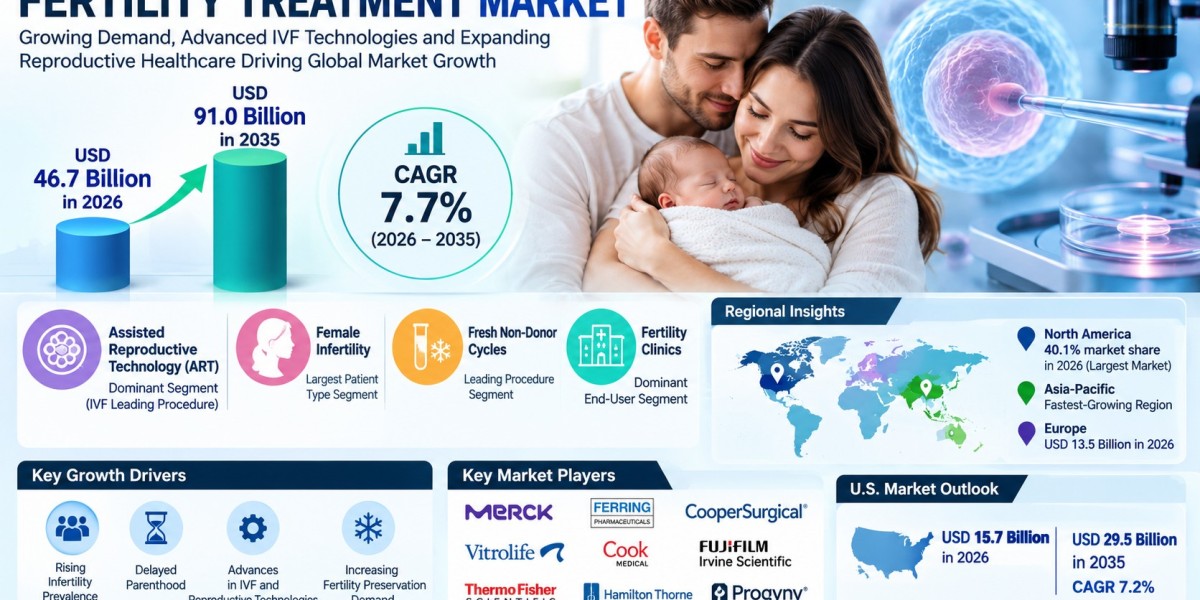
According to Dimension Market Research, the global market is projected to generate USD 46.7 billion in 2026, with revenue anticipated to reach USD 91.0 billion by 2035, reflecting a compound annual growth rate of 7.7% during 2026 to 2035.
This expansion is supported by delayed parenthood, growing acceptance of assisted conception, and increasing investments in fertility clinics. Technologies such as artificial intelligence, embryo freezing, genetic testing, and automated laboratory equipment are also influencing treatment practices and opening opportunities for healthcare organizations and medical technology suppliers.
Understanding the Fertility Treatment Market
The Fertility Treatment Market covers specialized healthcare solutions that assist individuals and couples who encounter difficulties conceiving naturally. These services combine reproductive medicine, pharmaceutical interventions, laboratory technologies, and clinical procedures to address different causes of infertility.
Treatment options include in vitro fertilization (IVF), intracytoplasmic sperm injection (ICSI), intrauterine insemination (IUI), ovulation stimulation, surgical fertility procedures, and frozen embryo transfer.
The industry also incorporates egg and embryo banking, donor reproductive programs, and fertility preservation services. Fertility specialists use these approaches according to individual reproductive conditions, diagnostic findings, and treatment requirements.
What Is Fueling Growth in the Fertility Treatment Market?
Changing reproductive decisions represent an important demand factor. Many individuals are postponing parenthood because of professional commitments, educational priorities, financial considerations, and lifestyle preferences. As reproductive potential changes with age, demand for fertility consultation and assisted conception procedures is increasing.
Greater awareness of infertility among both men and women is encouraging earlier diagnosis and treatment. Expanding clinical capabilities are also helping providers address reproductive disorders through more specialized intervention.
The increasing acceptance of egg freezing and embryo preservation adds another dimension to market growth. These services support individuals planning future pregnancies and patients facing medical treatments that may affect fertility.
Advances in reproductive laboratory technologies are creating additional development opportunities. Improvements in embryo monitoring, cryogenic storage, genetic assessment, and clinical automation are changing how fertility services are organized and delivered.
Get a Free Sample of the Fertility Treatment Market Report
Healthcare investors, fertility clinic operators, pharmaceutical companies, and reproductive technology manufacturers can explore the report's coverage to better understand market opportunities, treatment categories, and regional demand.
Download Your Free Sample Report:
https://dimensionmarketresearch.com/request-sample/fertility-treatment-market/
Fertility Treatment Market Segmentation: Where Is Demand Concentrated?
The market is evaluated across treatment types, patient categories, procedures, and healthcare providers, providing insight into the different areas shaping industry revenue.
Assisted Reproductive Technology (ART) is projected to hold the leading position among treatment categories. IVF remains the principal ART procedure, supported by established clinical applications and continued improvements in reproductive laboratory techniques.
Within patient classifications, female infertility is expected to represent the largest segment. Demand is associated with ovulatory conditions, reproductive disorders, and fertility changes related to age.
Fresh non-donor cycles are anticipated to maintain a leading position in procedure volumes. However, frozen embryo and donor-assisted procedures are gaining attention as cryopreservation and embryo storage technologies advance.
Fertility clinics are forecast to dominate the end-user category. Their specialized infrastructure, embryology expertise, and comprehensive reproductive healthcare services make them important centers for diagnosis and treatment.
For equipment manufacturers and laboratory solution providers, this market structure points toward demand for embryo culture systems, cryopreservation equipment, diagnostic technologies, and fertility workflow solutions.
How Are AI and Laboratory Innovations Changing Fertility Care?
Technology is becoming increasingly important in fertility treatment delivery.
Artificial intelligence is being incorporated into embryo imaging and assessment systems, helping embryologists analyze developmental characteristics and support clinical evaluation.
Time-lapse incubators offer additional opportunities to monitor embryo development while maintaining controlled laboratory conditions. Automated laboratory systems can also support workflow efficiency and consistency.
Frozen embryo transfer and advanced vitrification techniques are gaining prominence as fertility clinics expand their cryopreservation capabilities.
Digital patient platforms and remote consultations are also changing communication between patients and healthcare professionals. These technologies can support treatment scheduling, monitoring, and coordination across complex fertility procedures.
Although technological progress creates promising opportunities, providers must continue addressing clinical validation, affordability, ethical considerations, and regulatory requirements.
Regional Outlook: North America Leads While Asia-Pacific Expands
North America is projected to account for 40.1% of global Fertility Treatment Market revenue in 2026, positioning it as the largest regional market.
The region benefits from established fertility clinic networks, advanced laboratory infrastructure, specialized reproductive healthcare professionals, and increasing employer-supported fertility benefits.
The United States represents a particularly important market. U.S. fertility treatment revenue is projected to increase from USD 15.7 billion in 2026 to USD 29.5 billion in 2035, reflecting a CAGR of 7.2%.
Europe also plays an important role in reproductive healthcare, with the market estimated at USD 13.5 billion in 2026. Established treatment facilities, reproductive healthcare programs, and cross-border fertility services contribute to regional demand.
Asia-Pacific is forecast to register the fastest regional growth. Expanding healthcare infrastructure, increasing fertility awareness, government initiatives addressing demographic challenges, and growing interest in assisted conception are supporting market development.
China, India, Japan, and South Korea represent important markets for reproductive healthcare investment and fertility clinic expansion.
Competitive Landscape and Emerging Business Opportunities
The global industry includes reproductive healthcare networks, pharmaceutical manufacturers, laboratory equipment developers, fertility technology providers, and specialized tissue banking organizations.
Companies operating within the market include Merck KGaA, Ferring Pharmaceuticals, CooperSurgical, Vitrolife, Cook Medical, Hamilton Thorne, Thermo Fisher Scientific, Monash IVF Group, and IVIRMA Global.
Competition increasingly centers on technological innovation, laboratory capabilities, reproductive medicine expertise, treatment accessibility, and partnerships between healthcare providers and technology suppliers.
Important opportunities are developing in fertility preservation, male infertility diagnostics, advanced embryo assessment, and laboratory automation.
However, treatment affordability continues to affect access. High procedure costs, inconsistent insurance coverage, regulatory differences, and limited availability of specialist professionals remain major industry challenges.
Fertility Treatment Market Outlook Through 2035
The fertility treatment industry is expected to become more technology-intensive and increasingly focused on individualized patient care.
Growing demand for assisted reproduction, improved fertility preservation methods, and investment in advanced laboratory infrastructure are likely to influence industry development.
For healthcare investors and medical technology companies, opportunities extend beyond clinical procedures to specialized equipment, diagnostics, cryogenic storage, and digital healthcare services.
Organizations that can balance technological sophistication with treatment affordability, quality standards, and patient accessibility may establish stronger positions as the market develops.
Explore the Complete Fertility Treatment Market Report and Purchase Options
Understanding the industry's competitive environment, regional prospects, and treatment segmentation can help organizations evaluate investment opportunities and develop informed expansion strategies.
View the Fertility Treatment Market Report and Proceed to Checkout:
https://dimensionmarketresearch.com/checkout/fertility-treatment-market/
Frequently Asked Questions About the Fertility Treatment Market
1. How large is the global Fertility Treatment Market in 2026?
The global market is projected to reach USD 46.7 billion in 2026, with revenue expected to grow to USD 91.0 billion by 2035.
2. What is the expected growth rate of the Fertility Treatment Market?
The industry is forecast to register a CAGR of 7.7% between 2026 and 2035.
3. Which treatment category is expected to dominate the market?
Assisted Reproductive Technology is projected to dominate, with IVF accounting for a leading role among ART procedures.
4. Which geographic region leads the Fertility Treatment Market?
North America is expected to hold the largest share, representing approximately 40.1% of global revenue in 2026.
5. What are the major drivers of fertility treatment industry growth?
Key growth factors include delayed parenthood, increasing infertility prevalence, greater adoption of assisted reproductive technologies, fertility preservation demand, and continuing advancements in reproductive medicine.
Conclusion
The Fertility Treatment Market is evolving into a technologically sophisticated healthcare industry supported by changing family planning preferences, growing reproductive health awareness, and improved clinical treatment options.
With global revenue forecast to reach USD 91.0 billion by 2035, opportunities are emerging across assisted reproductive services, embryo preservation, diagnostic technologies, and laboratory automation.
North America's established healthcare ecosystem and Asia-Pacific's expanding reproductive healthcare infrastructure are expected to influence the competitive environment throughout the forecast period.
Continued technological development, improved access, and reliable clinical practices will remain important to the industry's long-term progress.
Related Reproductive Healthcare Market Research
The U.S. Fertility Market Size report provides a country-specific perspective on reproductive healthcare demand, assisted conception, and fertility preservation services. The U.S. market is projected to increase from USD 5.6 billion in 2024 to USD 8.7 billion by 2033, representing a CAGR of 5.1%. The analysis explores technological developments, changing family planning preferences, and expanding access to reproductive healthcare.
The Fertility and Pregnancy Rapid Test Kits Market Share report examines diagnostic solutions used for pregnancy confirmation and fertility monitoring. Global revenue is projected to grow from USD 1.1 billion in 2024 to USD 1.7 billion by 2033, at a CAGR of 5.2%. Rising awareness of reproductive health and demand for convenient testing solutions are important market drivers.
The Assisted Reproductive Technology Market Growth analysis explores developments in IVF, ICSI, donor programs, fertility preservation, and other reproductive procedures. The market is forecast to increase from USD 32.3 billion in 2025 to USD 57.2 billion by 2034, with a CAGR of 6.5%. Advances in embryo assessment, genetic testing, and cryopreservation contribute to its long-term outlook.