
Picture a Tuesday morning at a SaaS startup. A prospect Googles "best scheduling tool for clinics." Another one skips Google entirely and asks ChatGPT for a shortlist. A third gets a recommendation from Perplexity before they've visited a single vendor site. Same buyers. More doors. And a startup budget that can't guard all of them.
So the first question usually isn't "which agency should we hire?" It's "what should we build first?" Agencies come second. If you bring in a specialist before the basics are in place, you end up paying for polish on top of a foundation that isn't there.
This guide walks through what a SaaS company should build at each stage, how SEO, GEO, and automation fit together, and how to make sense of the agency labels you'll meet along the way. It's for founders, marketing leads, and small teams who'd rather spend money on a plan than on a pitch deck.
How SaaS Buyers Find Software Now
Not long ago, the path was easy to predict. Someone searched, read a few blog posts, landed on a comparison page, and asked for a demo. That path still works. But there's a new layer sitting on top of it. AI tools now summarise the options, name a few vendors, and sometimes nudge people toward one before they ever reach your site.
Three terms get mixed up here, and the mix-up leads to bad buying decisions:
SEO is about earning rankings and clicks in search results. It runs on technical health, useful content, and credible links.
AEO (answer engine optimization) is about shaping content so it can be pulled out as a direct answer, like a featured snippet, a voice reply, or an AI summary. If you're curious what that looks like in practice, an AEO audit is a good place to start.
GEO (generative engine optimization) is about helping AI systems understand your brand, trust it, and mention it when they write answers.
They overlap, because clear writing and credible mentions help all three. But they're not the same job. And let's be blunt: nobody can promise you a citation inside an AI answer. These systems change constantly. The honest goal is much simpler. Make your site easy to understand, and make your brand easy to verify around the web.
What to Build First: A Stage-by-Stage Plan
Most SaaS marketing advice quietly assumes you already have traction. If you don't, it can send you in the wrong direction. So here's a plan that follows the company instead of the other way around.
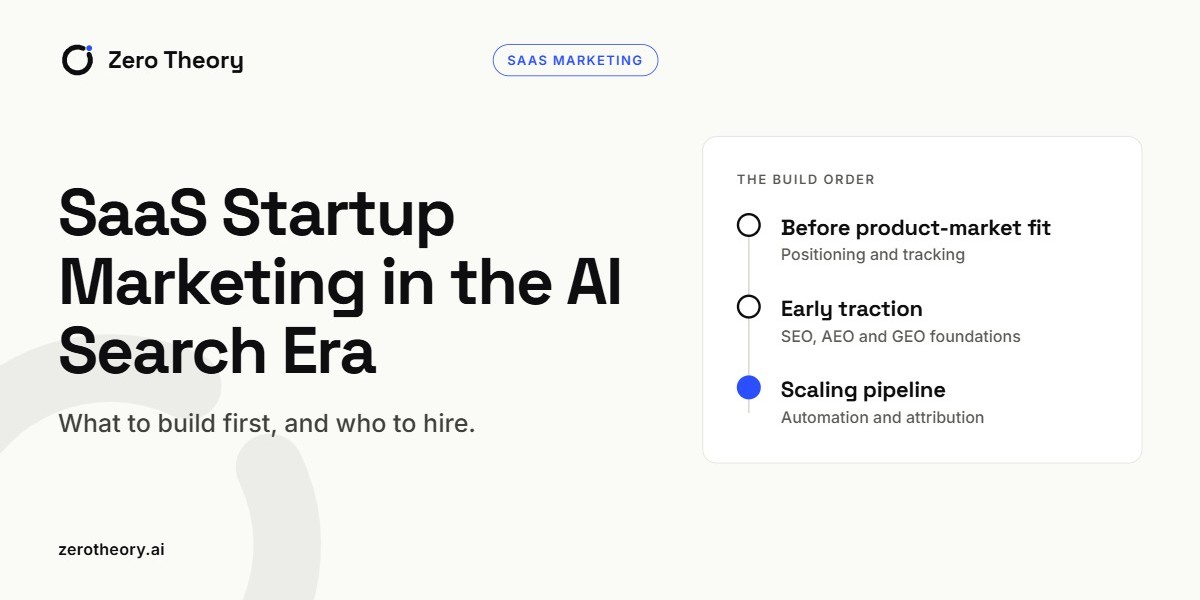
Stage 1: Before product-market fit
If you're still working out who your best customers are, you don't need a big marketing machine. You need clarity. In practice that means:
A one-page positioning statement, who it's for, what problem it solves, why it's different
A short list of ideal customer traits, pulled from real sales conversations
A homepage and two or three product pages that tell the same story in plain words
Analytics that actually work, with demo requests and signups tracked as events from day one
Founder-led content, because early customers often buy the person before they buy the product
A long retainer is rarely the right move here. A short, scoped project with a Digital Marketing Agency for Startups can work well if it covers positioning, tracking, and a basic site structure, then hands the keys back. It also helps to understand how retainer, project, and performance pricing change what an agency has an incentive to do. Anything bigger than a scoped project is usually premature.
Stage 2: Early traction
Once a handful of customers are paying and you can describe them clearly, search starts to earn its keep. The pages that matter most are the ones that match buying intent:
Use-case pages, like "project management for agencies"
Integration pages, because people search for the tools they already use
Comparison pages that treat alternatives fairly
A pricing page that explains instead of hides
Documentation, which is often your most trustworthy content
Technical basics come first. If your pages are slow, hard to crawl, or duplicated across several URLs, better content won't save you. A good AI SEO Agency can speed up keyword research, content briefs, and technical audits with AI tooling, while a senior person still decides what's worth ranking for. That second part matters. Speed without judgment just gives you more mediocre pages, faster.
Then comes the GEO layer. It looks a lot less mysterious in practice than it sounds:
Describe your product the same way everywhere: your site, your docs, your profiles, your partner listings
Put clear definitions and direct answers near the top of key pages
Use structured data where it genuinely fits
Earn mentions on third-party sites, such as review platforms, partner pages, industry communities, and publications your buyers read
Publish original material only if you really have it, like your own benchmarks or product usage insights
If AI-search visibility is your specific gap, you'll find people who sell exactly that. A GEO Agency focuses on how your brand shows up in AI-generated answers. You'll also see the same label written out as a Generative Engine Optimization Agency. Ask any of them how they measure progress without promising outcomes. If the answer is "guaranteed citations," walk away.
A SaaS Marketing Agency offers something different: pattern knowledge. It already knows the difference between trial and demo funnels, product-led and sales-led motions, and why a pricing page tells you more about a company than its blog does. That context can save you months of trial and error.
Stage 3: Scaling pipeline
Past a certain point, the problem changes. You've got traffic and leads, but they leak between teams. Marketing hands over a form fill, sales takes three days to respond, and nobody can say which channel produced the deal.
This is where paid media, lifecycle email, lead scoring, and attribution start to matter. For longer sales cycles with several people involved in each purchase, a B2B Digital Marketing Agency typically brings useful experience with account-based thinking, LinkedIn campaigns, and nurturing leads over months instead of days.
The common thread at this stage is connection. Channels reporting to different vendors, each with its own dashboard, give you different versions of the truth. Ask for one shared view of the pipeline, not three separate reports. If you want to see how that works, here's a look at attribution setups that executives trust and how SEO and performance marketing can work from the same revenue numbers.
Not sure which stage describes your company? That's a common spot to be in. A free growth audit can help you see where you stand before you spend anything.
Where Marketing Automation Actually Fits
Automation gets oversold, so let's be specific. It earns its place when it takes over slow, repetitive, rule-based work:
Capturing leads and sending them to the right place in your CRM
Scoring leads against criteria you've agreed on with sales
Routing hot leads to a real person quickly
Triggering follow-ups and lifecycle emails
Putting together the weekly report
What should stay human: positioning, messaging, pricing decisions, sensitive customer conversations, and the final sign-off on anything that goes out under your name. Automating a broken process doesn't fix it. It just makes it break faster.
Order matters here, too. Map the workflow first, choose tools second, and roll out in small phases so you can see what breaks. For the sequencing, this guide on what to automate first in a lean marketing team is a handy companion, and AI lead scoring and routing goes deeper on the form-fill-to-sales-call step.
Then there's the label question. A Marketing Automation Agency usually designs and maintains the workflows, CRM logic, and email programs. An AI Marketing Automation Agency adds AI on top, for example in lead scoring, personalisation, or reporting summaries. That extra word only matters if the AI does real work for you. So ask what exactly the AI does, what data it uses, and who reviews what it produces.
How to Read Agency Labels Without Getting Lost
By now you've seen quite a few labels. Here's a simple way to treat them.
An AI-first Digital Marketing Agency builds its own operations around AI. Research, drafting, campaign operations, and reporting run with AI, while senior people own strategy and results. Zero Theory describes its model this way. The upside is speed and lower overhead on routine work. The catch is the same as with any model: a label tells you how a team works, not how good it is.
The looser term AI Marketing Agency gets stretched to cover almost anything, from a traditional agency that bolted on an AI tool to a team built around automation from the start. So don't assume. Ask for a walkthrough of a real workflow and what a person actually does at each step.
Here's a test that works for any label. Ask three things: what do you do every week, who does it, and how will you show me it's working? Labels are easy to adopt. Good answers are much harder to fake.
An Illustrative Scenario: A Seed-Stage SaaS Team
Consider a hypothetical seed-stage company, made up purely for illustration. It sells scheduling software to clinics. It has twenty paying customers, a founder who writes most of the content, and a three-person team.
For the first two months, the company sharpens its positioning, fixes its analytics, and tightens its homepage. It hasn't hired an agency yet. From months three to six, it builds use-case pages for different clinic types and integration pages for the practice-management tools its customers already use, with help from a freelancer who understands search. It keeps product descriptions consistent across its site, its profiles, and its partner listings, and it asks happy customers for reviews on the platforms buyers check.
By month eight, leads are coming in faster than the team can follow up. That's the signal to set up lead scoring, routing, and a basic lifecycle email program. Only now does outside help with automation and reporting make sense.
No stage needed a huge budget. Each one had a clear reason behind it. That's the whole idea.
What to Ask Before You Hire
Whatever label an agency wears, these questions cut through it:
What will you do in the first 30 days, specifically?
Vague answers usually mean vague work.Who does the work, and who's accountable?
Find out whether you're getting senior judgment or just senior names on the proposal.How will you measure success without guaranteeing rankings or citations?
Honest agencies talk about leading indicators, pipeline, and learning, not promises.What happens to the work if we leave?
You should own your content, accounts, data, and documentation.How will SEO, paid, and automation share data?
Separate reports for each is a warning sign.Which parts are automated, and what do humans review?
Good answers are specific.What do you need from us?
Strong agencies say plainly what access, time, and decisions they depend on.
And keep an eye on the price. If you're comparing quotes, this breakdown of agency costs explains why they vary so widely and what to judge them on besides the number.
Common Mistakes to Avoid
Buying for the label instead of the problem: A GEO specialist won't fix unclear positioning.
Automating before the process works: You'll just scale the confusion.
Treating GEO as a replacement for SEO: They share the same foundation of clear, credible, well-structured content, so neglecting one tends to weaken the other.
Chasing guaranteed results: In search, nobody controls the outcome. Anyone who says otherwise is selling a story.
Signing a big retainer too early: Before you have traction, short engagements keep your options open.
Letting channels run in silos: If you can't see the path from first touch to closed deal, you can't improve it.
Conclusion
SaaS marketing in the AI search era isn't about picking one magic discipline. It's about order. Get your positioning and tracking right first. Build search and GEO foundations once you have something to say and customers to point to. Add automation when volume makes manual work the bottleneck. And bring in outside help when it fills a specific gap, judging any agency by what it will do and how it will show you results, not by what it calls itself.
If you're trying to work out where your own company sits on that path, Zero Theory can help. As an AI-first agency working across SEO, GEO, paid media, and marketing automation, it can review your current setup and point to the biggest gaps. Get a free growth audit and leave with a clearer plan for your stage. Want to look around first? Start at zero theory