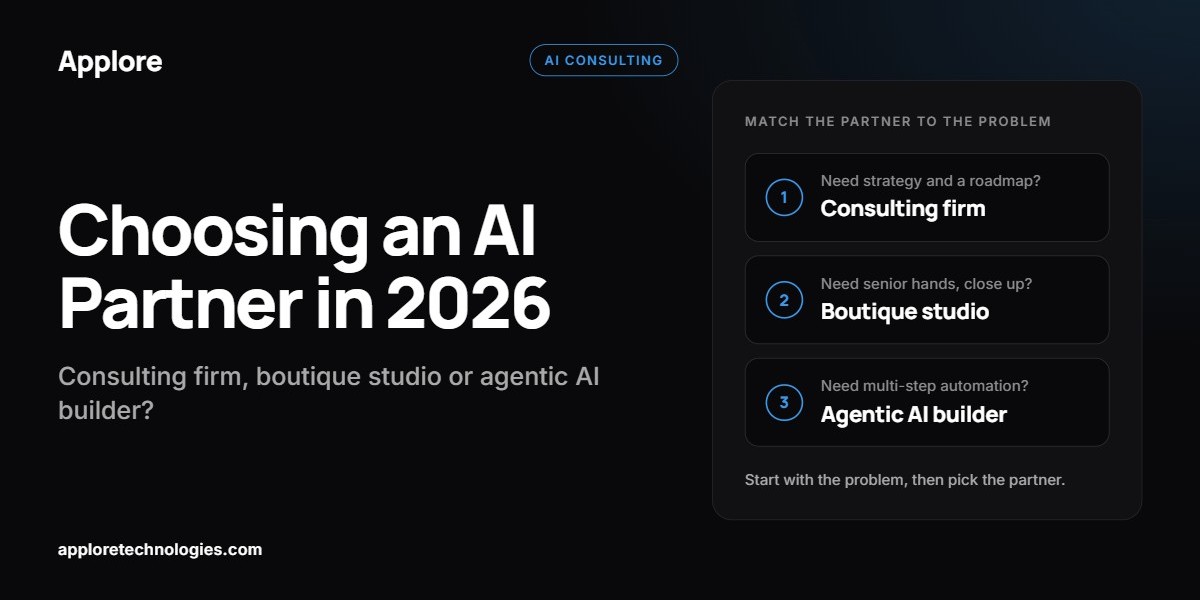

Ask five leaders how they chose their AI partner and you'll get five different stories. One hired a big consultancy and ended up with a strategy deck nobody opened twice. Another picked a small team that delivered a slick demo, then went quiet when it was time to ship. A third bought a platform first and only later asked what it was supposed to do.
The stories sound different, but the root cause is usually the same. The buyer went looking for a company before deciding what kind of help they needed. Search for Best AI Consulting Companies and you'll get long lists of names. What you won't get is an answer to the real question: do you need strategy, a build team, or a platform?
So this guide flips the order. We'll start with the problem, match it to a type of partner, and finish with a simple way to test whoever makes your shortlist. It's written for CTOs, CIOs, founders, and finance or operations leaders who are about to put real budget behind AI and would like to avoid all three of those stories.
What "AI Partner" Actually Covers
Several quite different services hide behind that one label, and the confusion leads to bad purchases. Here's the quick version:
AI consulting: helps you work out where AI fits, which use cases deserve your money, and what data, governance, and skills you need first.
Technology advisory: is wider. Architecture, platform choices, and operating models are all on the table, and AI is only one input.
Generative AI development: means building software on top of language and image models. Most Generative AI Products inside a company are assistants that draft, summarise, search, or classify, with a person checking the result.
Agentic AI implementation: builds systems that take multi-step actions through tools and APIs, inside permissions you set.
Traditional IT consulting: covers integration, ERP, cloud migration, and similar work. It's valuable, but it isn't automatically AI expertise. If you want the longer version, here's a guide on how AI consulting differs from traditional IT consulting.
A firm can be great at one of these and merely fine at another. So the first job is to name which one you're actually buying.
Five Types of Partner, and What Each Does Well
Global consultancies
The biggest firms bring board-level credibility, experience across industries, and the muscle to run programmes in many countries at once. The catch is cost, and sometimes distance. The people who pitch you aren't always the people who deliver, so ask who will really be on your team and for how long.
Large IT services companies
Search for the Top IT Consulting Firms in India and most of what you'll see are big services companies with deep delivery benches. They're strong at integration, long programmes, and keeping systems running after launch. For AI work, find out whether you'd be dealing with a dedicated practice or a small unit inside a much larger business.
Analytics and AI specialists
These firms grew out of data science, and it shows. They're usually strong on models, experiments, and measurement. They can be lighter on the less glamorous work: wiring into legacy systems, permissions, and change management.
Small, senior-led studios
Boutique AI Consulting Firms are small enough that senior people stay close to the work. You often get sharper thinking and faster decisions. The trade-off is capacity and breadth, so ask what happens if your project suddenly needs three times the people.
Newer AI-native companies
A newer wave of AI Consulting Startups was built around agents and automation from day one. They move fast and know today's tooling well. Ask to see production work, find out how long the team has actually worked together, and agree up front what happens if key people leave.
Matching the Partner to Your Situation
If you're a large organisation
If you're big, the Best AI Consulting Firms for Enterprises are rarely the ones with the longest client list. They're the ones that can cope with your reality: legacy systems, security reviews, procurement cycles, and business units that all want something different. Ask how they've handled an approval process like yours, and who owns the outcome once the pilot ends.
If you're a startup or scale-up
You probably don't need a six-month strategy engagement. You need a technical partner who'll help you decide what to build, ship an early version, and leave your own team stronger than they found it. Look for people who'll tell you what not to build. That advice is often worth more than one more feature.
If you're buying in India
The market here is deep and varied. When you compare AI Consulting Companies in India, look past the brochure. Where does the delivery team actually sit? How many working hours will you share? Where will your data be stored and processed? Those answers tell you more than any capability list.
And if you're after a wider transformation rather than a single AI project, the Best Tech Consulting Firm in India for you depends on whether you need advisory, engineering, or both under one roof. Be honest about which gap is bigger. Still not sure? Talk it through with Applore's team before you start collecting proposals. A thirty-minute conversation can save you a month of reading pitches.
How to Read a "Best" or "Top" List
Lists with titles like Top AI Consulting Companies in 2026 are handy for building a longlist. They aren't evidence. Before you trust one, ask a few things:
Who published it?
Vendors often include themselves. That isn't wrong, but it changes how much weight the ranking deserves.What were the criteria?
If the list doesn't say how firms were assessed, it's an opinion, not a method.Was anything actually tested?
Most roundups lean on public information, not hands-on evaluation.Does it match your size and sector?
A list built for global enterprises won't help a 40-person company.When was it written?
AI services change fast, and a list that's a year old may describe teams that no longer exist.
Use lists to find names. Use your own evaluation to choose between them.
When the Project Is Agentic
Agentic projects need extra care, because the technology behaves differently from what most teams have worked with before.
Conventional automation follows fixed rules. An AI assistant answers a question or drafts something when you ask. An agent works toward a goal across several steps and decides which tool to use along the way. That freedom is the whole point, and it's also why governance matters so much.
A finance example
Finance teams are a natural fit, because so much of the work is repetitive, document-heavy, and rule-bound. An Agentic AI Solution in Finance might handle invoice intake end to end. It reads the invoice, matches it against the purchase order and receipt, flags mismatches, drafts the ledger entry, and sends exceptions to a person. Other workflows include reconciliation, preparing material for fraud-related investigations, and drafting sections of regulatory reports.
The controls matter as much as the capability:
Least-privilege access, so the agent only touches what it needs
Validation of every output before it moves downstream
A complete audit trail of what the agent did and why
Human approval for anything that moves money or affects a customer
Clear escalation when the agent isn't confident
A sensible rule: the agent prepares and recommends, and a person approves anything high-impact. No responsible team hands an AI system full authority over decisions like credit or payments. And no vendor can promise regulatory compliance as a built-in feature, so treat that claim with care.
Platform or partner?
Roundups of the Best Agentic AI Platforms in 2026 compare tools feature by feature. Features matter less than fit. When you assess a platform, ask:
Does it connect cleanly to the systems you already run?
How does it handle permissions and secrets?
Can you trace every action an agent takes?
What tools exist for testing changes before release, and rolling them back?
How are costs controlled when usage grows?
How hard would it be to leave?
An Enterprise Agentic AI Platform is more than a model plus a prompt. It's the layer that connects agents to your business systems, controls what they can do, records what they did, and lets you change them safely. Some companies buy that layer. Others build it. Many do a bit of both, and a good partner will tell you which is cheaper in your case instead of defaulting to whatever they happen to sell.
Choosing a build partner
If you decide to build, put the Agentic AI Development Companies in 2026 on your list through harder questions than you'd ask a typical software vendor:
Can you show an agent running in production, and what it does day to day?
How do you test an agent before release, and again after every model or prompt change?
How do you defend against prompt injection and unexpected tool use?
What happens when the underlying model is updated or retired?
Who owns the code, prompts, evaluation sets, and documentation at the end?
Vague answers are a signal. Production agents fail in specific, repeatable ways, and teams that have run them can tell you exactly how. If you'd like to see how one team answers these, you can scope an agentic build with Applore and judge the answers for yourself.
A Five-Step Way to Build Your Shortlist
Write the problem in one sentence: with an outcome you can measure. "Cut invoice handling time" beats "adopt AI."
Decide which type of help you need: Strategy, build, platform, or a mix. Go back to the first section if you're unsure.
Make a longlist of six to eight names: Mix referrals, peers, and published lists, and run the list-reading questions above on any ranking you use.
Test with something small: A paid discovery phase or a narrow pilot tells you more than any proposal ever will.
Score everyone the same way: Use one rubric: understanding of your problem, evidence from production work, seniority of the people who'll actually do the work, approach to governance, and quality of handover.
An illustrative scenario
Picture a mid-sized lender. It's hypothetical, invented here for illustration. The team wants faster document handling for loan applications, and their first instinct is to buy a platform. Instead, they hire a small advisory team for a short engagement to pick one workflow and define what success looks like. Next comes a limited agent pilot where staff approve every output. Only after three months of results do they decide whether to adopt a platform or keep building. Each stage cost less than the one before it would have, and each one produced evidence for the next decision.
Where an Advisory-Led Partner Fits
Some partners deliberately cover the whole path from diagnosis to adoption, instead of handing you a roadmap and leaving. Applore Technologies is one example. It works through a Plan, Execute, Adopt sequence and describes a single senior team that covers strategy, build, and adoption, so recommendations turn into working systems. It also builds agentic systems with guardrails, evaluation, observability, and human escalation, and it has offices in Noida, Delaware, and London.
Whether that approach suits you depends on your answers to the questions above. The point of this guide is that you should be the one asking them. If it helps, you can start small with a short advisory call and see whether the fit is there before you commit to anything bigger.
Common Mistakes to Avoid
Choosing a firm before defining the problem: The shortlist should follow the need, not the other way round.
Treating rankings as proof: They're a starting point for research.
Buying a platform first: Tools are much easier to choose once you know the workflow.
Skipping governance for the pilot: Habits formed in a pilot tend to follow you into production.
Ignoring handover: If your team can't run the system, you've rented a result instead of building one.
Conclusion
Picking an AI partner isn't about finding the one best name. It's about matching the kind of help to the kind of problem. Strategy partners, large services companies, small studios, newer AI-native teams, and platform vendors all have a place. Your job is to know which one you need and test them honestly. Start small, ask for evidence, keep people in the loop for high-impact decisions, and make sure your own team can run whatever gets built.
Looking to find practical AI opportunities and build a technology strategy that fits your business goals? Explore Applore Technologies' AI and technology consulting services and see how an advisory-led team can help you evaluate, plan, and implement the right approach for your organisation.