
A human telecaller might make a few hundred calls on a good day. An automated voice agent can make thousands before lunch. That's the appeal. It's also the catch. When calls get cheap, mistakes get cheap too, and they pile up just as quickly.
It's why the conversation around AI Calling India has changed. A couple of years back, buyers mostly asked one thing: can it speak Hindi? These days, consent, compliance, and customer trust come up in the very first meeting.
So this guide looks at automated calling from the design side. It isn't another summary of regulations. It asks what a single well-built call should do, what changes for lenders and hospitals, and how to judge a platform before you sign anything. If you're an operations head, a compliance lead, a CX owner, or a founder who's weighing up automated voice (or already running it and wants to tighten things up), it's written for you. One quick note first: this is general information, not legal advice. Your own counsel should confirm what applies to your business.
What Changes When a Machine Makes the Call
A modern AI Caller isn't an old IVR menu, and it isn't a predictive dialer either. An IVR plays prompts and waits for a key press. A dialer connects a human agent to whoever picks up. An automated voice agent listens, understands what's said, decides on a reply, and speaks back in real time, often while reading from or writing to your CRM.
Under the hood, a few pieces work together. Speech recognition turns the customer's words into text. A language model chooses the reply. Speech synthesis turns that reply back into a voice. A telephony layer carries the call. Any one of them can fail in its own way, which is why testing on real calls matters so much.
You'll hear the same idea sold under different names. If you search for an AI Voice Bot India, you're usually after what a "voice agent" buyer wants: automated conversations that handle routine calls. The label matters less than three simple questions. Can it hold a real conversation? Can it be handed over to a person smoothly? Does it leave a clean record?
The First Fifteen Seconds: What Every Call Should Do
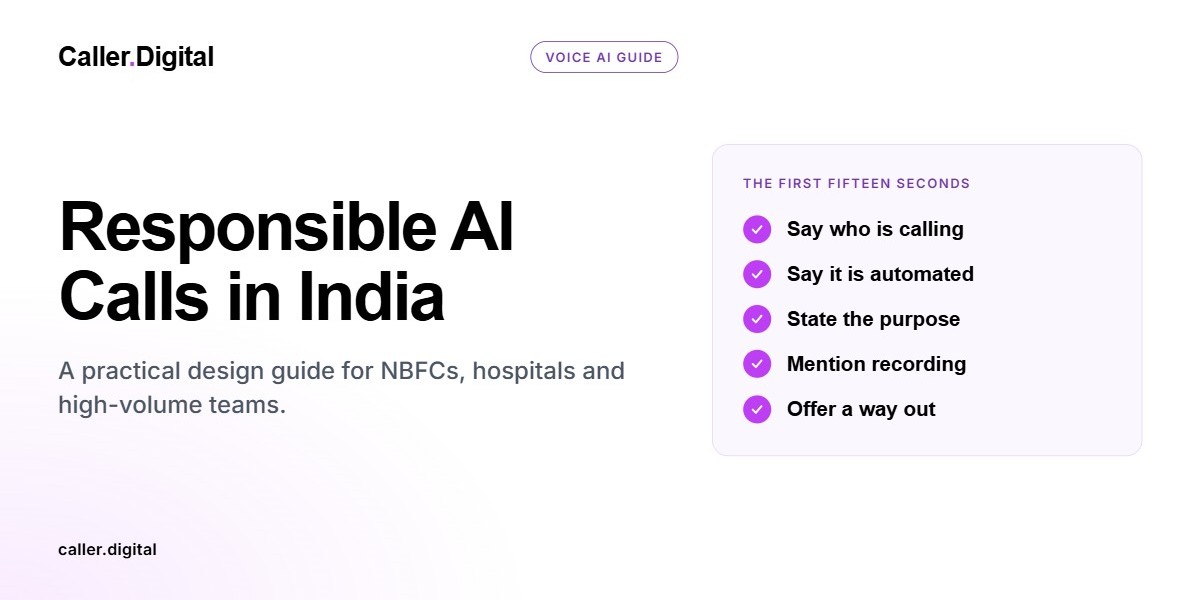
Most trust is won or lost right at the start of a call. Whatever your industry, five things belong in the opening:
Say who is calling: Name the business, not just "an assistant."
Say it's automated: You won't always find this written down as a rule, but it's good practice. People who know they're talking to an AI voice get confused less, hang up less, and complain less afterwards.
State the purpose in one sentence: "I'm calling about your appointment tomorrow" works. A long preamble doesn't.
Mention recording where it applies: For NBFC recovery calls, RBI's updated directions expect borrowers to be told (more on that below).
Offer a way out: A human, a call-back, or a stop request. Then honour it, every time.
None of this needs a clever script. It needs discipline, and a system that makes the right behaviour the default.
Three Frameworks, Three Different Jobs
Rules for automated calls in India come from several directions, and each one answers a different question. Mixing them up is one of the most common planning mistakes. (If you want the full picture across sectors, this regulatory map for voice AI in India is a handy companion.)
DPDP, the Digital Personal Data Protection framework, deals with personal data: what you collect, why, and how you protect it.
TRAI deals with commercial calling: who may call, from which numbers, and with what content.
RBI deals with how regulated lenders treat their borrowers.
Other regulators, such as IRDAI for insurers and SEBI for market intermediaries, step in for their own sectors. Here's what each of the first three means for a call flow.
Data: what DPDP means in practice
Dpdp Compliant Voice AI is a phrase vendors love, so treat it with care. A platform can offer features that help, like consent capture, purpose-specific notices, access controls, and retention settings. But compliance is an obligation of the business that decides why and how personal data gets used. No product makes you compliant on its own.
The DPDP Rules were notified on 14 November 2025, with compliance phased in over roughly eighteen months. Among other things, they ask for a clear, plain-language notice that states the specific purpose of using someone's data. So check which obligations already apply to you, and build the opening of every call around explaining its purpose in plain words. Don't forget that a recording of a customer's voice is personal data too. Decide how long you'll keep it, and who's allowed to listen.
Calling: what TRAI expects
Trai DLT Voice AI is really shorthand for one question: does your automated calling setup fit TRAI's rules for commercial communication? The core of those rules sits in the Telecom Commercial Communications Customer Preference Regulations, 2018, and their amendments. In outline:
Commercial voice calls come from registered senders, using registered headers and content templates recorded on the DLT platform.
Senders respect customers' consent and preference registers, and scrub their calling lists against them before dialling.
A promotional call is one made without the recipient's explicit consent. Transactional and service calls use their own template types.
Two more points matter for automated voice. First, TRAI directed banks, NBFCs, and other regulated financial entities to move service and transactional calls to the 1600 number series, with deadlines between January and March 2026 depending on the type of entity. Second, the regulations define a "robo call" as one that uses an artificial or prerecorded voice to deliver a message without a person interacting on the calling side, and they let customers block such calls separately. How that definition applies to a conversational agent is a question for your telecom provider and your legal adviser. Don't guess.
Lending: what RBI expects
People who search for RBI Fair Practices AI Calling usually want to know one thing: do automated agents have to follow the same conduct rules as human recovery agents? In short, yes. The rules care about how a borrower is treated, not about who or what is on the line.
In August 2022, RBI told regulated entities and their agents not to intimidate or harass borrowers, and not to call before 8 am or after 7 pm to recover overdue loans. In August 2026, it issued the Third Amendment Directions for NBFCs on responsible business conduct, which take effect on 1 January 2027. They keep the 8 am to 7 pm window, unless the borrower asks otherwise. They also expect NBFCs to document the time and number of recovery calls, record call content and keep it for six months, take precautions such as telling the borrower the call is recorded, and include grievance officer details in recovery communications.
Notice what's missing: any approval of a particular technology. The obligation sits with the lender. If a vendor's badge suggests otherwise, read it as marketing, not as regulatory cover.
Language Is a Compliance Issue Too
Consent given in a language someone barely follows isn't worth much. That makes language support a lot more than a line on a feature list.
Hindi Hinglish Voice AI is a practical necessity, because so many callers in India switch between Hindi and English mid-sentence. A system trained on tidy Hindi can trip over something as ordinary as "mera EMI kab due hai?" So test with real call audio over mobile networks, with accents from different regions, not with polished studio recordings.
For wider reach, Multilingual Voice AI India deployments need the same care in every language: the opening notice, the opt-out, and the route to a human. Don't assume quality is equal across languages. Ask for results per language, and pilot each one separately before you switch it on.
Applying It: NBFCs and Lenders
For Voice AI For Nbfc projects, the safest places to start are the plain ones: due-date reminders, application status updates, KYC document follow-ups, and basic account questions. A few design rules go a long way:
Stay inside permitted calling windows, and let a borrower's request to avoid certain times override the default.
Keep the tone civil. No threats, no pressure, no vague warnings about consequences you can't back up.
Send hardship, disputes, and signs of distress to a human quickly.
Log and record every call so you can show your work.
Make grievance contact details easy to find.
A reminder isn't a recovery tactic. If a script would feel aggressive coming from a person, it'll feel worse coming from a machine that never gets tired. If you're mapping out reminder journeys, this overview of EMI and payment reminder calls shows how one platform frames the use case.
Applying It: Hospitals and Clinics
Voice AI For Hospital deployments work best on administrative load: appointment confirmations, rescheduling, pre-visit instructions, follow-up reminders, and basic questions about timings. These tasks are repetitive and time-sensitive, and a missed call can mean an empty slot that another patient needed.
The thing to be careful about is health data. Even a simple reminder reveals that someone has an appointment with a particular department. So:
Confirm identity before sharing details, and keep what's said aloud to a minimum.
Limit who can open recordings and transcripts.
Never present the system as a clinician. Any mention of symptoms, distress, or an emergency should go to a person, or to emergency services, straight away.
Keep sensitive results out of automated speech. Caller Digital's healthcare page, for example, describes routing critical results to a human callback queue instead of having the AI read them out. That's a sensible pattern whichever vendor you choose.
Planning a first workflow? Start with something small, like appointment reminders and rescheduling calls, and build from there.
Choosing a Platform
Search for a Voice AI Platform India and you'll find dozens of options making very similar promises. A short list of questions will separate them faster than any demo:
Can I see and export recordings, transcripts, and call logs?
How does it hand over to a human, and what context travels with the call?
Which languages does it support, and how was accuracy measured? Can you test my audio?
How does it connect to my CRM and telephony provider?
How are consent, opt-outs, and retention handled, and who configures them?
Who reviews scripts before they go live, and who approves changes?
What happens when the system gets something wrong?
It's also worth knowing exactly what you're buying. A scripted bot follows a fixed path. A real Voice AI Agent India can understand free-form answers and take actions, like updating a CRM record or sending a payment link. That makes it more useful, and it also means it needs more oversight. Pay attention to how it plugs into your systems too. A clear CRM integration is what turns a good call into a logged outcome.
Not sure how your own call flow would hold up? You can book a demo and ask the team to walk through your use case, in your languages, before you commit to anything.
Building the Workflow
AI Call Automation India programmes tend to work when they start small and measure honestly:
Pick one rule-based call type, such as appointment confirmation.
Write the full call flow, including every exit.
Pilot with a small segment of real customers.
Review recordings every week, not just dashboards.
Track completion, opt-outs, complaints, and human handovers, not only call volume.
Expand when the numbers hold, not before.
No platform can promise outcomes, and you should be wary of any that does. What you can control is how carefully you learn.
An illustrative scenario
Picture a hypothetical mid-sized diagnostic chain, invented for this article. Missed appointments keep costing it slots, so it starts with one workflow: automated confirmation calls in Hindi and English the day before a visit. Each call says who's calling, mentions the appointment, and offers a transfer to the front desk. Staff review a sample of recordings every week and fix awkward phrases. Only after a few weeks does the chain add rescheduling, and then a second language. Nothing about it is dramatic. It's careful, and that's the point.
Where a Platform Like Caller Digital Fits
Caller Digital is one of the platforms in this space. On its website, it describes outbound and inbound voice agents built for Indian enterprises, with escalation to live agents, CRM and telephony integration, and support for Hindi, Hinglish, English, and regional languages. Teams evaluating an AI Caller India option can use it as a reference point alongside the others on their shortlist.
The advice is the same for any vendor. Ask them to show how each control in this guide works in your configuration, with your languages and your call types. A feature list tells you what's possible. A live demo on your own call flow tells you what's likely.
Common Mistakes to Avoid
Treating compliance as a vendor feature: Tools help. The obligation stays with you.
Testing on clean audio: Real calls are noisy, accented, and full of code-switching.
Skipping the human exit: If people can't reach a person, they'll complain, and they'll be right.
Starting with the hardest calls: Begin with routine ones, then expand.
Watching volume instead of quality: A thousand bad calls are worse than a hundred good ones.
Setting and forgetting: Rules change, scripts age, and models behave differently over time.
Conclusion
Automated calling works when it respects the person on the other end. That means saying who's calling and why, honouring opt-outs, keeping sensitive details sensitive, and handing over to a human when the moment needs one. Regulations set the floor. Good design goes further.
If you're planning to move routine calls to a voice agent, start with one narrow workflow, test it in the languages your customers actually speak, and review every step. Looking to streamline customer calls and manage high-volume communication more responsibly? Explore Caller Digital's Voice AI solutions and see how automated voice workflows could support your business operations.