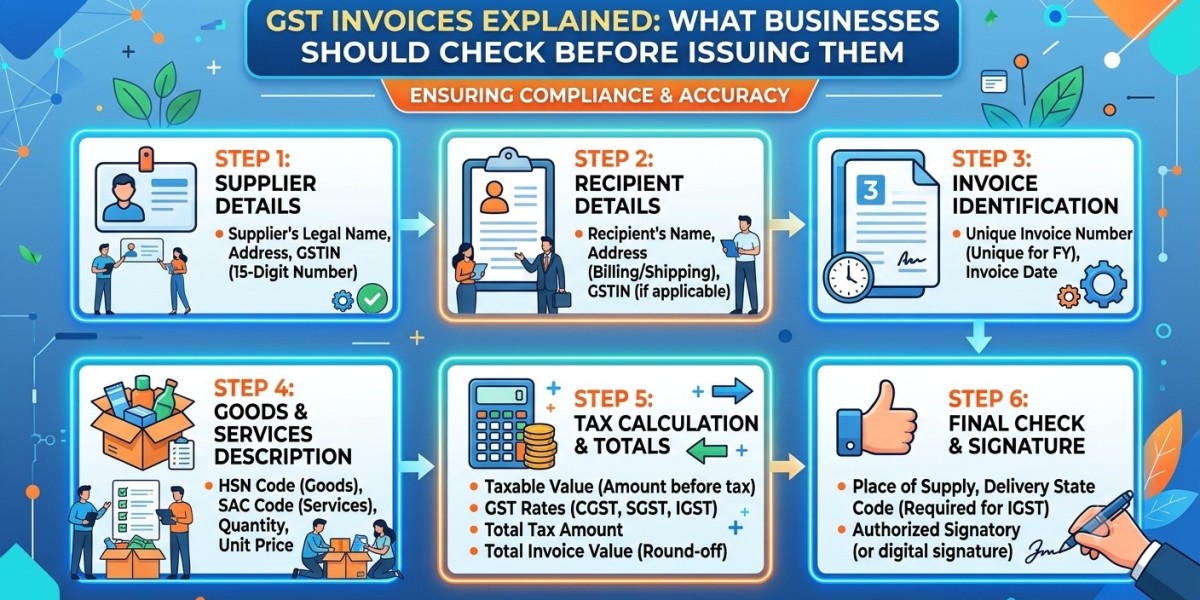

Issuing accurate GST invoices is an important part of running a business in India. A properly prepared invoice helps businesses maintain clear transaction records, communicate tax details to customers, and support GST compliance. Missing information, incorrect tax details, or inconsistent records can create difficulties during accounting and return preparation.
Businesses can make invoicing easier by following a consistent process and checking essential details before issuing each invoice.
1. Verify the Business and Customer Details
Before issuing a GST invoice, confirm that the supplier's legal name, business address, and GST Identification Number (GSTIN) are accurate wherever applicable. Customer details should also be recorded correctly according to the nature of the transaction and the applicable invoicing requirements.
For registered customers, verify the GSTIN using the available official GST verification facilities. Incorrect identification details may cause difficulties when customers reconcile their purchase records.
2. Include the Required Invoice Information
A GST invoice should contain the particulars required under applicable GST rules. Depending on the transaction, these generally include:
Supplier's name, address, and GSTIN.
A unique invoice number following the prescribed requirements.
The date of issue.
Recipient details, where required.
HSN or SAC codes, as applicable.
Description and quantity of goods or services.
Total value and taxable value of the supply.
Applicable GST rate and tax amount.
Place of supply details for relevant transactions.
Delivery or other prescribed particulars, where applicable.
Businesses should check the requirements relevant to their registration, transaction type, and applicable GST provisions rather than relying on a single invoice format for every situation.
3. Apply the Correct GST Rate
Different goods and services may attract different GST treatments. Before issuing an invoice, confirm the correct classification and applicable tax rate for the supply.
Businesses should also determine whether the transaction is taxable, exempt, or subject to another applicable treatment. Incorrect classification can lead to reporting errors and may require corrections later.
When a transaction involves specialised products, bundled supplies, exports, or other complex circumstances, professional advice can help clarify the appropriate treatment.
4. Understand CGST, SGST, and IGST
The tax structure depends on the nature and location of the supply.
For a typical intra-State taxable supply, CGST and SGST are generally charged together. For an inter-State taxable supply, IGST generally applies, subject to the relevant provisions.
Businesses should determine the place of supply correctly before selecting the applicable tax treatment. The supplier's location and the customer's address alone may not always be sufficient to determine the result, particularly for certain services and special transactions.
5. Check Invoice Numbering and Dates
Invoice numbers should follow the applicable GST requirements. Under the general rules, invoice numbers are unique for a financial year and follow the prescribed format and numbering conditions.
Maintain a consistent numbering process to reduce duplicate entries and gaps that are difficult to explain. Check invoice dates carefully and ensure they reflect the actual issuance and relevant transaction circumstances.
Businesses should also follow the applicable time limits for issuing invoices, which can differ for goods and services and in certain special cases.
6. Review Discounts, Credit Notes, and Corrections
Discounts and subsequent adjustments should be documented appropriately. Where an issued invoice contains an error or a transaction requires an adjustment, businesses should use the correction or adjustment process permitted under GST law.
Credit notes and debit notes should contain the required particulars and be reflected accurately in the relevant records. Avoid deleting or changing historical entries without maintaining an appropriate audit trail.
A clear record of corrections makes it easier to explain differences during accounting reviews and tax compliance checks.
7. Keep Digital and Physical Invoice Records Organised
Businesses should maintain accessible copies of invoices and supporting documents. Digital folders can be organised by financial year, month, customer, or invoice category.
A reliable recordkeeping system should make it easy to retrieve invoices, payment information, purchase records, and related correspondence. Access controls and backups can help protect business information.
Records should be retained for the period required under applicable law. Businesses should not assume that invoices can be deleted immediately after the related GST return has been filed.
8. Check E-Invoicing and E-Way Bill Requirements
Some businesses must follow additional invoicing procedures depending on their turnover, transaction type, and applicable rules.
Where e-invoicing applies, the business must follow the prescribed Invoice Registration Portal process and obtain the required Invoice Reference Number (IRN) and related details. The applicability of e-invoicing should be checked against the current notified requirements and relevant exemptions.
E-way bill requirements may also apply to the movement of goods, subject to the relevant conditions and exceptions. Businesses should assess these obligations separately rather than assuming that issuing a GST invoice completes every compliance requirement.
9. Coordinate Invoicing with Tax and Accounting Professionals
Invoice accuracy affects bookkeeping, GST reporting, and broader tax compliance. Businesses should periodically review their invoicing practices and resolve discrepancies before they create additional administrative work.
An Income tax consultant India can help businesses understand relevant income tax compliance matters, maintain appropriate financial documentation, and coordinate tax-related records. For GST-specific classification, invoicing, and filing questions, a GST professional may also be required.
Keeping sales invoices, purchase documents, expense records, and payment information consistent helps professionals review the business's financial position more efficiently.
10. Create a Simple Pre-Issue Invoice Checklist
Before sending an invoice to a customer, confirm the following:
Supplier and recipient details are correct.
The invoice number and date meet applicable requirements.
Goods or services are described clearly.
Taxable value and applicable GST calculations are accurate.
GST classification and place of supply have been reviewed.
Required HSN or SAC details are included.
E-invoicing or other additional requirements have been checked, where applicable.
A copy of the invoice will be stored securely.
A standard checklist helps employees follow the same process and reduces avoidable mistakes.
Conclusion
Accurate GST invoicing supports organised accounting, reliable tax records, and smoother business operations. By verifying customer details, applying the correct tax treatment, following invoice numbering requirements, and storing documents systematically, businesses can reduce common invoicing errors.
Seeking guidance from an Income tax consultant India can support broader tax recordkeeping and compliance planning, while a GST professional can assist with specific GST invoicing and reporting questions. Regular reviews and a consistent invoicing process help businesses maintain better financial records.
Frequently Asked Questions
1. What information should a GST invoice contain?
A GST invoice generally includes supplier details, a unique invoice number, issue date, goods or services description, taxable value, applicable tax details, and other particulars required under the relevant rules.
2. Why is the correct GST rate important?
The correct rate helps ensure that the tax charged is consistent with the classification and treatment of the supply. Errors may lead to reporting discrepancies or the need for corrective action.
3. When should a business issue a GST invoice?
The applicable time limit depends on the type of supply and relevant GST provisions. Businesses should verify the requirements for goods, services, and any special transaction categories.
4. What should a business do if an invoice contains an error?
The appropriate correction depends on the nature of the error and the applicable GST rules. Businesses should document the correction properly and ensure that related accounting and tax records remain consistent.
5. Can an income tax consultant help with GST invoices?
An income tax consultant can assist with broader tax and financial documentation matters. For specialised GST questions, such as invoice requirements, tax classification, and GST returns, a professional with relevant GST expertise may be appropriate.