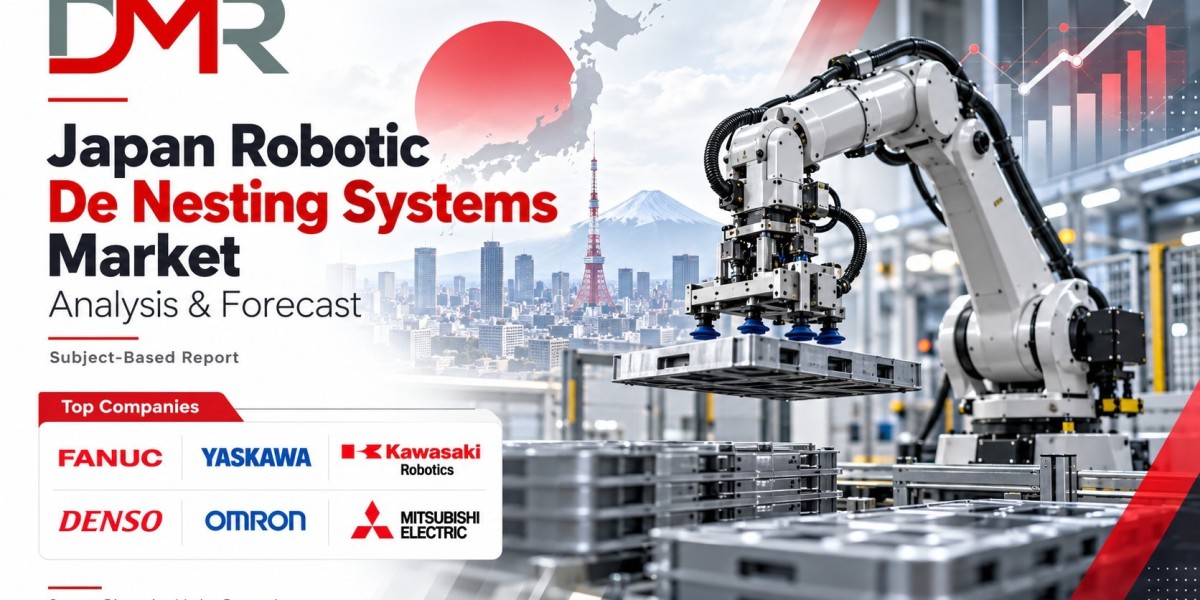

Japan Robotic De Nesting Systems Market Overview
According to Dimension Market Research, the Japan Robotic De Nesting Systems Market is projected to grow from USD 110.4 million in 2026 to USD 289.2 million by 2035, registering a compound annual growth rate (CAGR) of 11.3% during 2026 to 2035. This outlook reflects growing interest in automated material handling, high-speed production, and precision-oriented manufacturing across Japan. Robotic de-nesting systems separate stacked or nested items, including trays, containers, and industrial components, before transferring them to downstream production, packaging, or assembly operations.
Why is this market attracting attention? Japanese manufacturers face persistent labor constraints, rising productivity requirements, and growing pressure to maintain consistent quality. Automated de-nesting can reduce repetitive manual handling, support production continuity, and improve throughput. Advances in machine vision, artificial intelligence, adaptable robotic grippers, and collaborative robotics are also expanding the technology's usefulness. Food processing, pharmaceutical packaging, automotive manufacturing, electronics production, and logistics represent potential application areas. As manufacturers modernize existing facilities and develop smarter production cells, flexible de-nesting solutions are becoming increasingly relevant to Japan's industrial automation strategy.
Get free sample of this report (with custom data option): https://dimensionmarketresearch.com/request-sample/japan-robotic-de-nesting-systems-market/
Market Snapshot
● 2026 market valuation: USD 110.4 million, according to the report.
● 2035 projected valuation: USD 289.2 million under the forecast.
● Forecast CAGR: 11.3% from 2026 through 2035.
● Historical analysis covers the period from 2021 to 2025.
● Automatic systems are projected to hold 70.9% of product-type share in 2026.
● Integrated configurations are expected to account for 44.8% in 2026.
● Packaging applications are projected to represent 40.1% in 2026.
● Manufacturing is expected to account for 58.0% of end-user share in 2026.
● Direct sales are projected to hold 52.0% of distribution share in 2026.
Market Research Findings
The report identifies automatic robotic de-nesting systems as the leading product category, supported by demand for reliable, high-throughput operations. Integrated systems are also prominent because they connect de-nesting equipment with conveyors, packaging machinery, and production controls. Packaging represents a significant application, while manufacturing remains the leading end-user segment, supported by automation requirements in automotive and electronics facilities. Direct sales are important because complex installations often require engineering consultation, commissioning, integration, and ongoing technical support. The research further highlights machine vision, AI-assisted object recognition, collaborative robots, and flexible production cells as relevant technology developments. Together, these factors indicate opportunities for suppliers offering accurate, adaptable, and easily integrated de-nesting solutions for Japan's evolving industrial environment.
Why Is the Japan Robotic De-Nesting Systems Market Growing?
Japan's manufacturing sector is under pressure to increase output while managing workforce constraints and strict quality expectations. De-nesting is a repetitive task that can interrupt production when items stick together, arrive in inconsistent orientations, or require frequent manual intervention. Automated systems address these problems through controlled separation, programmed movements, and vision-guided picking.
The growth of high-speed packaging lines, electronics assembly, and automated logistics adds further demand. Modern systems can be designed to handle different product shapes and sizes, while machine vision helps identify objects and guide robotic movements. Manufacturers are also evaluating modular equipment that fits into compact facilities, allowing automation upgrades without requiring a complete factory redesign.
Market Key Growth Drivers
● Labor shortages increase demand for automated repetitive handling.
● High-volume production encourages consistent, uninterrupted material flow.
● Packaging automation supports faster tray and container separation.
● AI vision improves object recognition and picking accuracy.
● Flexible grippers enable handling of different product geometries.
● Smart factory investment supports connected robotic production cells.
● Automated logistics increases demand for efficient container handling.
Research Scope: Leading Market Segments
Automatic Robotic De-Nesting Systems
Automatic systems are projected to account for approximately 70.9% of the product-type segment in 2026, according to the supplied report data. Their appeal comes from the ability to perform repetitive separation and transfer tasks with limited manual intervention. High-throughput packaging lines, electronics production, and established manufacturing operations can benefit from repeatable cycle times and integration with upstream and downstream machinery. Vision-guided robotics and adaptable end-of-arm tooling can further improve handling when products vary in size or orientation.
For Japanese manufacturers, the decision to automate depends on expected production volumes, product consistency, required changeover speed, available floor space, and integration costs. Automatic systems are especially relevant when continuous operation and predictable throughput justify the initial investment. Semi-automatic alternatives may remain appropriate for smaller facilities or operations with frequent product changes and lower production volumes.
Read more about this market:https://dimensionmarketresearch.com/report/japan-robotic-de-nesting-systems-market/
Integrated Systems and Packaging Applications
Integrated systems are expected to hold approximately 44.8% of the system-configuration segment in 2026. These installations coordinate de-nesting equipment with production lines, conveyors, packaging machines, and centralized controls. Their principal advantage is smoother material movement across connected processes, helping manufacturers reduce handling gaps and improve operational visibility. Integration is particularly useful in facilities where throughput depends on synchronizing several machines.
Packaging is projected to account for approximately 40.1% of application share in 2026. Food and beverage producers, consumer-goods manufacturers, and packaging operations handle large numbers of trays, cartons, and containers. Automated separation can reduce repetitive manual work and help maintain a consistent supply of packaging components.
● Integrated configurations support coordinated line operation and monitoring.
● Packaging applications benefit from consistent feeding and faster changeovers.
● Hygienic equipment designs can address specific food and pharmaceutical needs.
Japan Robotic De-Nesting Systems Market Dynamics
Trend: AI Vision and Connected Robotics
AI-assisted vision is becoming an important consideration for automated de-nesting because nested objects may overlap, vary in orientation, or require careful gripping. Vision-guided robots can identify target objects and adjust their movements based on sensor information. Connected monitoring systems can also track operating performance, identify abnormalities, and help maintenance teams plan interventions. Collaborative robots may offer additional flexibility where operators and automated equipment share work areas, subject to suitable risk assessment and safety controls. Adoption will depend on accuracy requirements, system reliability, integration complexity, and the economic value of reduced downtime.
Opportunity: Flexible Manufacturing and Hygienic Handling
Manufacturers are looking for equipment that can accommodate product variation without extensive mechanical reconfiguration. Modular robotic cells, quick-change grippers, and flexible control software can help production teams adapt to different container formats and manufacturing schedules. Food processing and pharmaceutical operations may also create opportunities for washdown-compatible equipment and handling designs suited to hygiene requirements. Logistics facilities can benefit from automated separation of reusable containers and shipping trays. Suppliers that combine adaptable hardware, integration support, and responsive maintenance services may be well positioned to serve these requirements.
Challenge: Initial Investment and Legacy Integration
Advanced de-nesting systems can require substantial investment in robotic hardware, vision equipment, tooling, safety systems, software, and commissioning. Smaller manufacturers may find it difficult to justify these costs when volumes are limited or product formats change frequently. Older production lines can present further challenges because their controls, conveyors, and operating layouts may not support straightforward integration. Businesses must also consider staff training, maintenance skills, replacement components, and production interruptions during installation. Demonstrating a credible return on investment through labor savings, improved throughput, and reduced handling errors is therefore important for wider adoption.
Regional and Country Outlook
The supplied report focuses on Japan as the country market and provides a national forecast rather than separate regional valuations or regional CAGRs. The market is projected to increase from USD 110.4 million in 2026 to USD 289.2 million in 2035, with a CAGR of 11.3% over 2026 to 2035. The outlook reflects opportunities across manufacturing, packaging, and logistics operations. No additional regional market values or regional growth rates are stated here because they were not included in the supplied figures.
Japan Robotic De-Nesting Systems Market: Key Competitor Companies
The competitive landscape includes robotics manufacturers, automation providers, packaging equipment specialists, and system integrators. The following companies are identified in the supplied report as prominent market participants. Their inclusion does not imply that each company offers a dedicated de-nesting product in every application.
● FANUC Corporation
● Yaskawa Electric Corporation
● ABB Ltd.
● KUKA AG
● Kawasaki Heavy Industries, Ltd.
● Mitsubishi Electric Corporation
● Omron Corporation
● DENSO Corporation
● Universal Robots A/S
● Stäubli International AG
● Yamaha Motor Co., Ltd.
● Nachi-Fujikoshi Corp.
● BluePrint Automation
● JLS Automation
● Brillopak Ltd.
● Schubert Group
● FlexLink
● Scott Automation & Robotics
● Shibuya Corporation
● PMI Kyoto Packaging Systems
Artificial Intelligence in Japan's Robotic De-Nesting Industry
Artificial intelligence can enhance de-nesting by combining image recognition, object-position estimation, robotic path planning, and performance monitoring. These capabilities are useful when items are tightly nested or arrive in inconsistent orientations. Vision systems can help robots select suitable gripping points, while operational data can reveal recurring handling problems and maintenance needs. Predictive maintenance may help reduce unplanned stoppages when supported by reliable sensor data and appropriate analytical models.
However, AI does not eliminate the need for careful system design. Manufacturers must evaluate lighting conditions, object variability, gripping performance, cycle-time requirements, and safe interaction with workers. Successful implementation depends on matching the technology to the specific production environment.
Get 10% instant discount on report purchase
Explore more reports:
● Photo-Catalytic Chemistry Market
● Perovskite Solar Cell Market
Frequently Asked Questions (FAQ's)
1. What is the Japan Robotic De-Nesting Systems Market?
It covers robotic technologies that separate nested trays, containers, and components for manufacturing, packaging, and material-handling operations in Japan.
2. What is the projected market size in 2035?
According to the supplied Dimension Market Research figures, the market is projected to reach USD 289.2 million by 2035.
3. What is the expected market CAGR from 2026 to 2035?
The market is forecast to grow at a compound annual growth rate of 11.3% between 2026 and 2035.
4. Which product type is expected to dominate the market?
Automatic robotic de-nesting systems are projected to lead the product-type segment, with an estimated 70.9% share in 2026.
5. Which application leads the Japanese de-nesting market?
Packaging is projected to represent approximately 40.1% of application share in 2026, according to the supplied report.
6. Why are Japanese manufacturers adopting robotic de-nesting systems?
Labor constraints, consistent production requirements, higher throughput targets, and reduced repetitive handling are important adoption drivers.
7. How does AI improve robotic de-nesting operations?
AI-supported vision can improve object recognition, gripping decisions, motion planning, anomaly detection, and maintenance monitoring.
8. What are the main challenges facing the market?
High initial costs, integration with legacy machinery, tooling changes, workforce training, and ongoing maintenance can slow adoption.