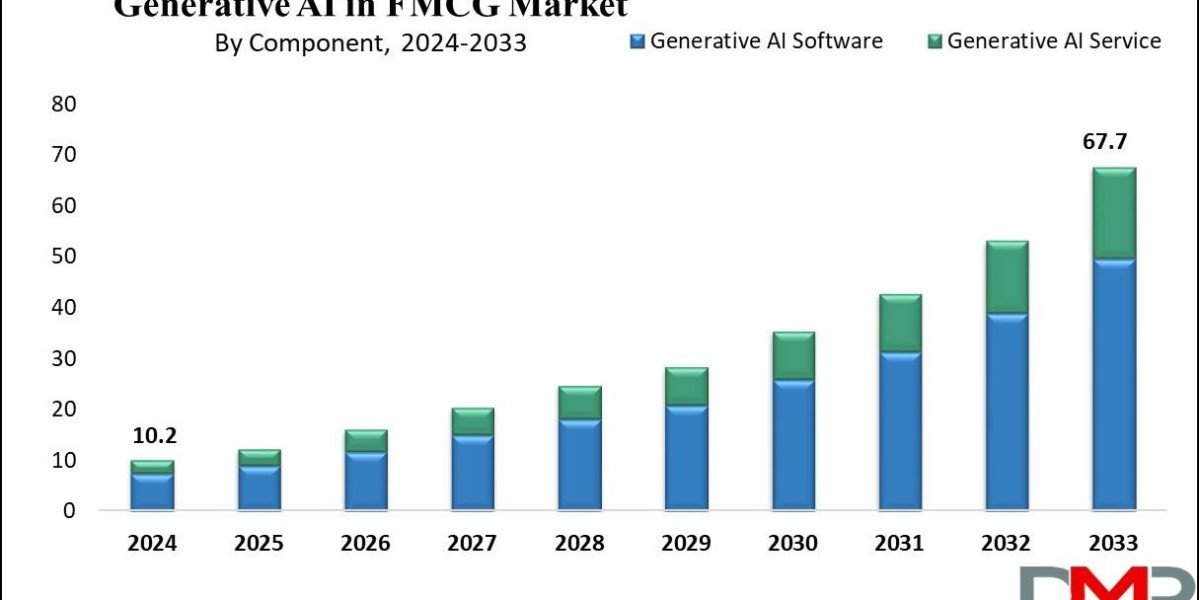

The Generative AI in FMCG Market is gaining momentum as fast-moving consumer goods companies explore new ways to improve product innovation, demand forecasting, supply chain efficiency, and customer engagement. According to Dimension Market Research, the global market was valued at USD 10.2 billion in 2024 and is projected to reach USD 67.7 billion by 2033, expanding at a compound annual growth rate (CAGR) of 23.4% during 2024 to 2033. This growth reflects increasing interest in AI-driven solutions that help businesses respond to changing consumer preferences and operational challenges.
FMCG companies operate in a competitive environment where product life cycles are short, purchasing patterns change rapidly, and supply chain disruptions can affect profitability. Generative AI offers opportunities to analyze complex datasets, create marketing content, support product development, and improve forecasting. As companies pursue greater operational agility, the technology is becoming an important consideration in their digital transformation strategies.
What Is the Generative AI in FMCG Market?
The Generative AI in FMCG Market covers the use of artificial intelligence technologies capable of generating content, insights, designs, and recommendations across the fast-moving consumer goods industry. These applications extend from product formulation and packaging design to personalized advertising, consumer insights, inventory planning, and supply chain optimization.
Unlike traditional analytics, which primarily interprets existing data, generative AI can also produce new outputs based on learned patterns. FMCG businesses can use these capabilities to explore product concepts, develop promotional materials, and support decisions across manufacturing, distribution, and marketing.
The Dimension Market Research report segments this market by component, application, and FMCG sub-vertical, providing a framework for understanding where adoption is developing.
Key Market Statistics
● 2024 Market Size: USD 10.2 billion
● 2033 Forecast Value: USD 67.7 billion
● Forecast CAGR: 23.4% from 2024 to 2033
● Leading Component: Generative AI Software
● Leading Application: Demand Forecasting
● Leading FMCG Sub-Vertical: Food & Beverages
● Leading Region: Asia Pacific, with an estimated 39.1% revenue share in 2024
Why Is the Generative AI in FMCG Market Growing?
A major growth driver is the need for faster, more informed business decisions. FMCG companies must anticipate demand, maintain appropriate inventory levels, and respond to changing purchasing behavior. Generative AI can help process consumer, sales, and operational data to generate useful insights for planning and execution.
Personalized marketing is another important application. AI-generated content and product recommendations can help businesses tailor communication to different audiences. Companies can also use generative tools to explore creative variations for advertising campaigns, potentially reducing the time required to develop and test marketing materials.
Product innovation offers another opportunity. Businesses can apply AI to explore packaging concepts, evaluate ingredient combinations, and support early-stage product development. These capabilities may help teams investigate more alternatives before committing resources to full-scale production.
Supply chain optimization also contributes to adoption. More accurate demand forecasting and improved inventory planning can help companies reduce waste, manage stock availability, and coordinate distribution. However, outcomes depend on the quality of underlying data, implementation, and human oversight.
Market Segmentation and Key Applications
According to Dimension Market Research, Generative AI Software is expected to lead the component segment, while Demand Forecasting is expected to be the leading application. Food & Beverages is projected to remain the dominant FMCG sub-vertical.
The market includes several applications:
● Demand Forecasting: Analyzing demand patterns to support inventory and production planning.
● Product Design and Innovation: Exploring new product concepts, formulations, and packaging alternatives.
● Personalized Marketing: Creating targeted advertising content and product recommendations.
● Supply Chain Optimization: Supporting logistics, inventory management, and distribution planning.
● Consumer Insights: Identifying patterns in customer preferences and purchasing behavior.
● Price Optimization: Supporting pricing decisions using market and demand information.
These applications demonstrate how generative AI can contribute to commercial and operational activities across the FMCG value chain.
Regional Outlook: Asia Pacific Leads Adoption
Asia Pacific is expected to account for 39.1% of global Generative AI in FMCG Market revenue in 2024, according to the report. The region's large consumer base, manufacturing capabilities, and ongoing digitalization support opportunities for AI adoption.
Businesses across the region can apply generative AI to understand changing consumer preferences, improve forecasting, and develop personalized customer experiences. However, adoption levels and business outcomes can vary by country, industry, data infrastructure, and investment capacity.
The report also covers North America, Europe, Latin America, and the Middle East & Africa, reflecting the market's global scope.
Challenges and Growth Opportunities
Despite its potential, generative AI adoption presents challenges. Data quality and availability influence model reliability, while implementation costs can be a barrier for smaller companies. Businesses must also address data privacy, security, regulatory compliance, and the risk of generating inaccurate or misleading content.
These challenges create opportunities for solutions that improve data governance, integration, model reliability, and workflow management. Companies that establish clear review processes and connect AI tools with relevant business data may be better positioned to use the technology responsibly.
Get a Free Sample of the Generative AI in FMCG Market Report
Explore the complete market assessment to understand the segment outlook, competitive environment, growth drivers, and opportunities across the FMCG industry.
https://dimensionmarketresearch.com/request-sample/generative-ai-in-fmcg-market/
Competitive Landscape
The Generative AI in FMCG Market includes technology providers, cloud platforms, enterprise software companies, and consulting firms. Dimension Market Research identifies Microsoft, Amazon Web Services, Oracle, SAS, IBM, Google, Accenture, Alibaba Cloud, Capgemini, and SAP among the prominent players.
Competition is shaped by the ability to integrate AI capabilities into existing business processes. Providers can support applications ranging from content generation and consumer analytics to demand forecasting and supply chain planning. For FMCG businesses, evaluating solutions requires attention to integration, data protection, scalability, cost, and measurable business outcomes.
Frequently Asked Questions
1. What is the size of the Generative AI in FMCG Market?
The global market was valued at USD 10.2 billion in 2024 and is projected to reach USD 67.7 billion by 2033.
2. What is the CAGR of the Generative AI in FMCG Market?
The market is projected to grow at a CAGR of 23.4% from 2024 to 2033.
3. Which segment leads the Generative AI in FMCG Market?
Generative AI Software is expected to lead by component, while Demand Forecasting is expected to lead by application.
4. Which region leads the Generative AI in FMCG Market?
Asia Pacific is expected to lead, accounting for an estimated 39.1% of market revenue in 2024.
5. What is the future outlook for the Generative AI in FMCG Market?
The market is projected to reach USD 67.7 billion by 2033, supported by applications in demand forecasting, product innovation, personalized marketing, and supply chain optimization.
Conclusion
The Generative AI in FMCG Market is positioned for substantial expansion as consumer goods companies seek more efficient operations, faster product development, and personalized customer engagement. Demand forecasting, software adoption, and applications in food and beverages are important areas of market development. Although data quality, implementation costs, and governance remain challenges, continued integration of generative AI into business workflows presents opportunities for innovation and operational improvement.
Related AI and Retail Market Insights
The AI in Retail Market was valued at USD 7.9 billion in 2023 and is projected to reach USD 120.2 billion by 2032, at a CAGR of 35.3%. The report highlights applications including inventory management, customer relationship management, supply chain and logistics, and pricing analytics. These applications provide relevant context for understanding AI adoption across retail operations.
Agentic AI in Retail and E-Commerce Market Share
The Agentic AI in Retail and E-Commerce Market report projects growth from USD 49.74 billion in 2025 to USD 863.3 billion by 2035, with a reported CAGR of 33.6% for 2026 to 2035. It examines applications such as customer engagement and marketing agents, as well as deployment models and retail formats. This market is relevant to the development of AI systems that can support more autonomous retail workflows.
Retail Analytics Market Growth
The Retail Analytics Market is projected to increase from USD 9.5 billion in 2024 to USD 41.5 billion by 2033, at a CAGR of 17.8%. The report covers software, services, customer management, merchandising, store operations, and supply chain applications. Retail analytics complements generative AI by providing data-driven insights for customer engagement, inventory planning, and business decisions.