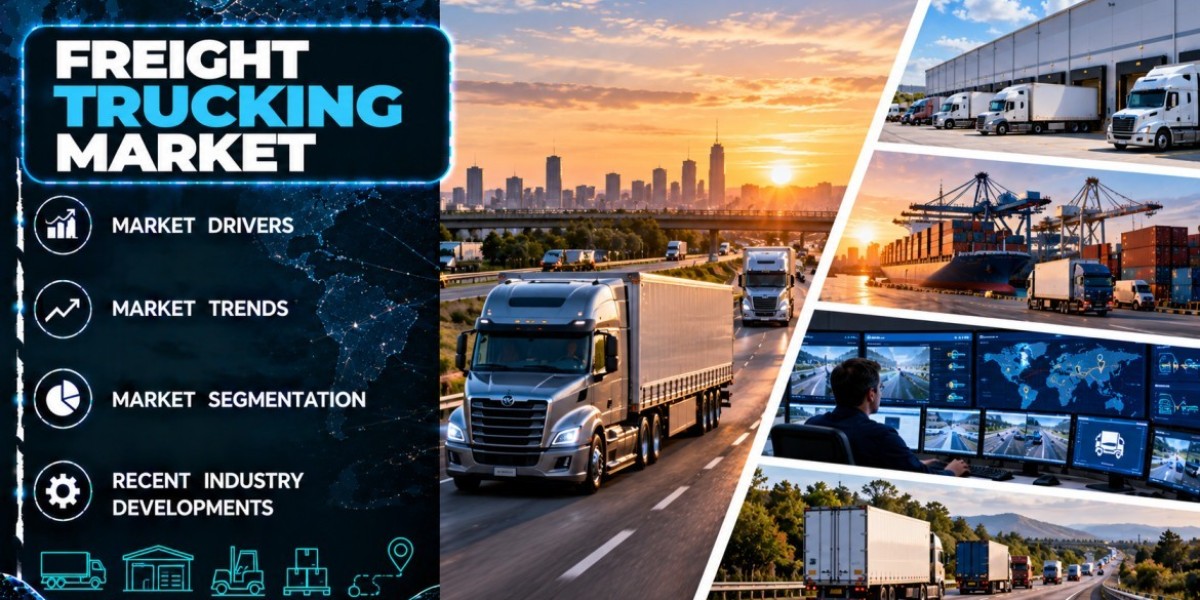

IMARC Group, a leading global market research and management consulting firm, has published its latest market intelligence report on the freight trucking market. The global freight trucking market size was valued at USD 3.0 Trillion in 2025. Looking forward, the market is forecasted to reach USD 4.3 Trillion by 2034, exhibiting a CAGR of 4.07% during 2026-2034, driven by rising demand for efficient supply chain transport, rapid e-commerce expansion and last-mile delivery needs, wider adoption of fleet management and route optimization technologies, and sustained infrastructure investment across major economies worldwide.
The market is witnessing steady expansion as trucking remains the backbone of domestic and cross-border goods movement. Manufacturers, retailers, food and beverage producers, pharmaceutical companies and energy firms rely on road freight for flexible, door-to-door delivery that rail, air and sea cannot match on their own. In the United States, trucking generated roughly USD 987 Billion in revenue and carried about 80% of national freight, supported by approximately 3.5 million truck drivers. Meanwhile, GPS tracking, real-time monitoring and AI-led route planning are helping carriers cut fuel costs, while electric, hydrogen and biofuel trucks are gradually reshaping long-term fleet strategies.
How AI is Reshaping the Future of the Freight Trucking Market
- AI-Powered Route Optimization and Fuel Cost Reduction for Fleet Operators: Machine learning platforms are enabling carriers and logistics providers to analyze live traffic, weather, load weight and fuel price data to plan the most efficient routes, reducing empty miles, idle time and fuel consumption. These tools help large fleets improve on-time delivery performance and protect margins at a time when fuel price volatility remains one of the sector’s most persistent cost pressures across North America, Europe and Asia Pacific.
- Autonomous Trucking and Driver Shortage Mitigation: Self-driving freight technology developers such as Aurora Innovation and Kodiak Robotics are testing autonomous trucks on long highway corridors, aiming to ease driver shortages and extend asset utilization through longer operating cycles. In December, Aurora opened a 78,000-square-foot office and testing facility in Bozeman, Montana, dedicated to FirstLight lidar development, signaling growing commercial intent behind autonomous freight programs.
- AI-Driven Pricing, Forecasting and Digital Freight Matching: Predictive analytics platforms are helping shippers, brokers and carriers forecast spot rates, match loads to available capacity and reduce brokerage friction. In December, Transfix partnered with DAT Freight & Analytics to add AI-driven pricing and forecasting to its data suite, giving market participants sharper rate visibility and faster decision-making in a highly fragmented trucking marketplace.
Grab a sample PDF of this report: https://www.imarcgroup.com/freight-trucking-market/requestsample
Freight Trucking Market Trends and Drivers:
The global freight trucking market is witnessing steady expansion, fueled by the convergence of growing trade volumes, e-commerce-led delivery demand and accelerating technology adoption that is repositioning trucking from a commodity service into a data-driven logistics function. Supply chain efficiency is the foundational demand driver across both industrial and consumer segments, with manufacturers, retailers and distributors prioritizing reliable, time-bound road transport to keep inventories lean and customers supplied. E-commerce has been especially influential, as last-mile and regional hauling requirements have expanded sharply since the pandemic. Fleet management technology, including GPS tracking, real-time monitoring and route optimization, is helping operators lower fuel costs and improve asset productivity across thousands of vehicles at once.
Decarbonization has emerged as both a regulatory priority and a commercial opportunity that is reinforcing investment in cleaner trucking. Freight transport generates about 8% of global emissions, which is pushing carriers and shippers toward electric, hydrogen and biofuel options. The Tesla Semi is cited with a range of around 500 miles, demonstrating that electric heavy-duty trucks are becoming viable for regional haul. In Europe, the European Investment Bank and European Commission committed over EUR 1.5 Billion (USD 1.57 Billion) to alternative fuel infrastructure, with a focus on fast-charging networks that support commercial fleets. Government programs are adding momentum elsewhere. The United States Infrastructure Investment and Jobs Act directs about USD 110 Billion toward roads and bridges, while India’s PM Gati Shakti, Bharatmala highway program and National Logistics Policy aim to lower logistics costs and shorten transit times, with India’s road freight sector expected to grow about 7% annually.
Regional trade corridors are also creating new demand pockets. In Mexico, trucks account for 87.3% of transportation GDP, and the country operates over 671,000 trucks, up 17.8% over several years, with small enterprises running 52.2% of the fleet. Around 22 million truck crossings occur at the US border annually, which is encouraging cross-border services such as XPO Mexico+ and the Schneider intermodal link between Mexico, Texas and the Southeastern United States. Challenges remain, including poor road infrastructure, congestion, tolls and rising labor costs that narrow margins, along with high fuel costs and political instability in parts of the Middle East and Africa.
Ask an analyst for customized report: https://www.imarcgroup.com/request?type=report&id=12017&flag=E
Freight Trucking Industry Segmentation:
The report has segmented the market into the following categories:
Breakup By Truck Type:
- Dry Van and Box Trucks
- Refrigerated Trucks
- Tanker Trucks
- Flatbed Trucks
- Others
Dry van and box trucks account for the largest truck type segment with a share of about 42.2%, driven by their versatility, weather protection and suitability for packaged goods, consumer products and retail replenishment, which keeps them in constant demand from e-commerce, manufacturing and distribution networks.
Breakup By Cargo Type:
- Dry Bulk Goods
- Oil and Diesel
- Postal
- Others
Dry bulk goods hold the largest cargo type share at about 66.8%, supported by the continuous movement of grains, coal, cement and other non-liquid commodities in large volumes, where trucks provide essential first-mile and last-mile connections to ports, plants and rail terminals.
Breakup By Distance:
- 50 Miles or Less
- 51 to 100 Miles
- 101 to 200 Miles
- 201 to 500 Miles
- Above 500 Miles
Breakup By End User:
- Oil and Gas
- Food and Beverages
- Industrial and Manufacturing
- Energy and Mining
- Pharmaceutical and Healthcare
- Others
Oil and gas accounts for the largest end user share, driven by the constant movement of fuel, equipment and materials between refineries, distribution depots and remote extraction sites, while food and beverages and pharmaceutical and healthcare add strong demand for temperature-controlled and time-sensitive transport.
Breakup By Region:
- North America (United States, Canada)
- Asia Pacific (China, Japan, India, South Korea, Australia, Indonesia, Others)
- Europe (Germany, France, United Kingdom, Italy, Spain, Russia, Others)
- Latin America (Brazil, Mexico, Others)
- Middle East and Africa
Asia Pacific dominates the global freight trucking market with the largest regional share of over 32.6%, driven by rapid industrialization, booming e-commerce and large-scale manufacturing activity across China, India and Southeast Asia. The Asian Development Bank puts the region’s road freight market at roughly USD 1.5 Trillion, reflecting the scale of demand. In North America, the United States holds 84.4% of regional share, supported by major carriers such as Knight-Swift and J.B. Hunt, while Saudi Arabia’s logistics market, valued above USD 30 Billion, and road upgrades in South Africa are lifting prospects in the Middle East and Africa.
Competitive Landscape:
The report provides a comprehensive analysis of the competitive landscape in the freight trucking market with detailed profiles of all major companies, including:
- A.P. Moller-Maersk A/S
- J & J Logistics LLC
- J.B. Hunt Transport Services Inc.
- Landstar System Inc.
- Old Dominion Freight Line Inc.
- R+L Carriers Inc.
- Schneider National Inc.
- Swift Transportation (Knight-Swift Transportation Holdings Inc.)
- XPO Logistics Inc.
- Yellow Corporation
What Does The Full Report Cover?
If you are tracking the freight trucking market for investment decisions, market entry planning, competitive benchmarking, or strategic advisory, IMARC Group’s report gives you everything in one place:
- Complete market sizing with revenue forecasts covering the full projection period
- Quantified growth driver analysis with impact scoring across truck type, cargo type, distance, end user category, and regional markets
- Sub-segment breakdowns for dry van and box, refrigerated, tanker and flatbed trucks, along with distance bands and end user categories with individual share data
- Country-level data for the United States, Canada, China, Japan, India, South Korea, Australia, Indonesia, Germany, France, the United Kingdom, Italy, Spain, Russia, Brazil, and Mexico
- Competitive profiles of leading companies with strategic landscape assessment
- Porter’s Five Forces, value chain analysis, and pricing intelligence
- Latest trends covering electric and hydrogen trucks, autonomous freight, AI-driven route optimization, and alternative fuel infrastructure shaping market competition across key regional markets
Recent News and Developments in Freight Trucking Market
- July: Knight-Swift Transportation acquired Dependable Highway Express, adding 14 terminals and USD 122 Million in revenue. The deal lifts the company’s annual less-than-truckload revenue above USD 1 Billion and strengthens its regional LTL network.
- November: Schneider announced a new intermodal service linking Mexico and Texas with the Southeastern United States via CSX and Canadian Pacific Kansas City, starting in December. The service expands cross-border capacity and offers shippers a lower-emission alternative to long-haul trucking.
- December: Aurora Innovation opened a 78,000-square-foot office and testing facility in Bozeman, Montana, for FirstLight lidar development, supporting its push toward commercial driverless trucking.
- December: Transfix partnered with DAT Freight & Analytics to add AI-driven pricing and forecasting to its data suite, while Cofactr raised USD 17.2 Million in Series A funding led by Bain Capital.
- XPO bought 26 Yellow terminals for USD 870 Million in a bankruptcy auction, launched XPO Mexico+ for US-Mexico cross-border service, and opened a 36,000-square-foot freight center in South Las Vegas.
Note: If you require specific details, data, or insights that are not currently included in the scope of this report, we are happy to accommodate your request. As part of our customization service, we will gather and provide the additional information you need, tailored to your specific requirements. Please let us know your exact needs, and we will ensure the report is updated accordingly to meet your expectations.
Key Questions This Report Answers
- What is the current global freight trucking market size and what is its projected value?
- Which truck type segment holds the largest share in the global freight trucking market?
- What are the key drivers of global freight trucking market growth?
- Which region dominates the global freight trucking market and why?
- How are electrification, autonomous trucking, AI-driven route optimization and decarbonization policies reshaping fleet strategies and competition in the freight trucking industry?
- Who are the top companies in the global freight trucking market and what are their competitive strategies?
- What are the investment and market entry opportunities across dry van, refrigerated, tanker, and cross-border freight trucking segments?
About Us:
IMARC Group is a global management consulting firm that helps the world’s most ambitious changemakers to create a lasting impact. The company provides a comprehensive suite of market entry and expansion services. IMARC offerings include thorough market assessment, feasibility studies, company incorporation assistance, factory setup support, regulatory approvals and licensing navigation, branding, marketing and sales strategies, competitive landscape and benchmarking analyses, pricing and cost research, and procurement research.
Media and Sales Contact
IMARC Group
Email: [email protected]
United States: +1-201-971-6302
India: +91-120-433-0800
United Kingdom: +44-753-714-6104







