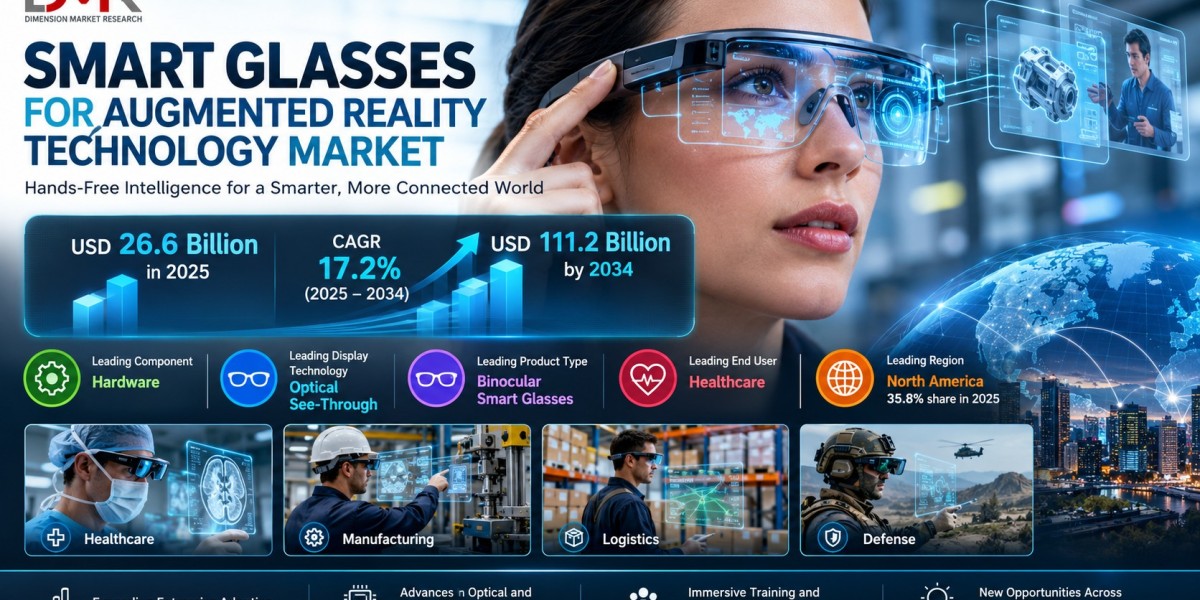

The global Smart Glasses for Augmented Reality Technology Market is entering an important phase of development as wearable computing, artificial intelligence, and immersive digital experiences become increasingly relevant across industries. According to Dimension Market Research, the market is projected to reach USD 26.6 billion in 2025 and expand to USD 111.2 billion by 2034, registering a CAGR of 17.2% from 2025 to 2034.
Growing demand for hands-free information access, real-time visualization, remote collaboration, and intelligent workplace assistance is influencing the adoption of augmented reality smart glasses. Healthcare, manufacturing, logistics, and defense organizations are exploring these technologies to improve operational workflows and strengthen human-machine interaction.
Advances in optical displays, artificial intelligence, spatial computing, and wireless connectivity are also making AR smart glasses more practical for enterprise and consumer applications.
What Is the Smart Glasses for Augmented Reality Technology Market?
The Smart Glasses for Augmented Reality Technology Market includes wearable eyewear solutions that integrate digital information with physical surroundings. Unlike conventional virtual reality headsets, which create immersive virtual environments, AR smart glasses allow users to interact with digital content while maintaining awareness of their real-world environment.
These devices integrate optical displays, cameras, sensors, processors, connectivity systems, and specialized software to support contextual information delivery.
Applications include industrial maintenance, surgical visualization, interactive learning, warehouse navigation, remote technical assistance, and defense operations.
Their ability to provide information without requiring users to hold or operate separate devices makes them valuable for activities where mobility, visibility, and productivity are important.
Get a Free Sample of the Smart Glasses for Augmented Reality Technology Market Report
Evaluating opportunities in augmented reality wearables? Request a free sample to explore the report's market coverage, segmentation framework, growth factors, and competitive landscape.
Get a Free Sample:
Key Market Statistics and Growth Indicators
● 2025 Market Size: USD 26.6 Billion
● 2034 Market Forecast: USD 111.2 Billion
● Forecast CAGR: 17.2%
● Leading Region: North America, 35.8% share in 2025
● Leading Component: Hardware
● Leading Display Technology: Optical See-Through
● Leading Product Type: Binocular Smart Glasses
● Leading End User: Healthcare
These projections highlight the expanding role of AR wearables within the broader digital transformation landscape.
Why Is the Smart Glasses for Augmented Reality Technology Market Growing?
Advances in Optical Displays and Spatial Computing
Improvements in microdisplays, waveguide optics, projection systems, and eye-tracking technologies are contributing to the development of more capable AR smart glasses.
High-resolution OLED and micro-LED technologies improve visual clarity, while advanced optical systems support lightweight designs and more natural interaction with digital information.
Artificial intelligence further strengthens these capabilities through object recognition, contextual assistance, and real-time environmental interpretation.
For manufacturers, this creates opportunities to differentiate products through display quality, ergonomics, processing performance, and integration with enterprise software.
Expanding Industrial and Enterprise Applications
Organizations are increasingly evaluating AR smart glasses for operational activities requiring hands-free guidance and immediate access to information.
Manufacturing personnel can receive assembly instructions, maintenance teams can access remote technical support, and warehouse employees can use visual guidance for inventory-related tasks.
Important enterprise applications include:
● Remote inspection and maintenance support
● Hands-free technical instruction delivery
● Interactive workforce training programs
● Real-time equipment information visualization
These capabilities may help organizations improve workflow consistency and reduce dependence on conventional screens during operational activities.
Which Market Segments Are Leading Adoption?
Hardware and Optical See-Through Smart Glasses
Hardware is projected to lead the market by component in 2025, reflecting the importance of displays, sensors, processing units, and other integrated electronic systems.
Optical See-Through Smart Glasses are expected to hold the leading position by display technology. Their ability to combine real-world visibility with digital overlays makes them suitable for healthcare procedures, industrial maintenance, and interactive enterprise applications.
Binocular smart glasses are also projected to lead the product-type segment, supported by dual-display functionality, improved depth perception, and immersive visualization capabilities.
Healthcare as a Major End-User Segment
Healthcare is anticipated to lead the market by end user in 2025.
AR smart glasses can support surgical navigation, medical education, remote consultations, and visualization of anatomical information. Healthcare professionals can access relevant digital information while remaining focused on patients and procedures.
Manufacturing also represents an important application area, particularly for complex assembly, equipment troubleshooting, quality control, and technical training.
Regional Market Outlook: Why North America Leads
North America is projected to account for 35.8% of global market revenue in 2025, supported by technology development, enterprise digitalization, and investment in augmented reality applications.
The United States market is estimated at USD 8.0 billion in 2025 and forecast to reach USD 30.8 billion by 2034, growing at a CAGR of 16.1%.
The presence of major technology companies, advanced connectivity infrastructure, and adoption across healthcare, manufacturing, and defense supports the regional outlook.
Asia-Pacific also presents opportunities through industrial modernization, wearable technology development, and expanding applications for immersive computing.
Market Challenges and Emerging Opportunities
Despite the positive outlook, AR smart glasses face several commercialization challenges.
Limited battery capacity can restrict prolonged operation, particularly when applications require continuous graphics processing, spatial mapping, and sensor activity.
High product costs also influence purchasing decisions because advanced displays, specialized processors, and optical components increase manufacturing expenses.
Privacy considerations remain relevant when devices incorporate cameras, microphones, and contextual data collection capabilities.
However, opportunities continue to emerge in healthcare visualization, intelligent manufacturing, and remote assistance. Improvements in energy efficiency, device miniaturization, and software integration could help address existing limitations.
Competitive Landscape and Technology Innovation
The market includes major technology developers and specialist wearable device manufacturers.
Prominent companies identified in the research include Google LLC, Apple Inc., Microsoft Corporation, Samsung Electronics Co., Ltd., Sony Corporation, Vuzix Corporation, Magic Leap, Inc., Niantic, Inc., and Nreal Ltd.
Competition centers on optical performance, device comfort, battery efficiency, artificial intelligence capabilities, software compatibility, and enterprise integration.
For technology suppliers, the commercial opportunity extends beyond standalone eyewear to supporting hardware components, application software, development platforms, and technical services.
Future Outlook Through 2034
The evolution of AR smart glasses is closely connected to developments in AI-powered assistance, spatial interfaces, and enterprise digital infrastructure.
The market's projected expansion through 2034 suggests continued opportunities for display manufacturers, semiconductor companies, wearable device developers, and industrial software providers.
Successful adoption will depend on how effectively companies balance device performance, affordability, security, comfort, and practical business value.
Explore the Complete Smart Glasses for Augmented Reality Technology Analysis
The complete market report provides a framework for understanding revenue projections, component categories, display technologies, product types, end-user demand, regional dynamics, and competitive positioning.
Proceed to Checkout and Explore Purchase Options:
https://dimensionmarketresearch.com/checkout/smart-glasses-for-augmented-reality-technology-market/Frequently Asked Questions
1. What is the global Smart Glasses for Augmented Reality Technology Market size?
The global market is projected to reach USD 26.6 billion in 2025 and USD 111.2 billion by 2034.
2. What is the expected CAGR from 2025 to 2034?
The market is forecast to grow at a CAGR of 17.2% during 2025 to 2034.
3. Which product type is expected to dominate the market?
Binocular smart glasses are projected to lead in 2025, supported by immersive visualization and enhanced depth perception.
4. Which region has the largest market share?
North America is projected to lead with a 35.8% revenue share in 2025.
5. What are the major factors driving market expansion?
Key drivers include advances in optical technology, increasing enterprise adoption, AI integration, and demand for hands-free digital assistance.
Conclusion
The Smart Glasses for Augmented Reality Technology Market is positioned for substantial growth through 2034 as businesses adopt more interactive and intelligent methods of accessing digital information.
Improvements in optical systems, artificial intelligence, and wearable hardware are expanding practical use cases across healthcare, manufacturing, logistics, and other industries.
While affordability, privacy, and battery performance remain important challenges, continued technology development and enterprise adoption create significant opportunities across the AR wearable ecosystem.
Related Augmented Reality and Wearable Technology Market Insights
The AI Smart Glasses Market Size is projected to reach USD 1,188.7 million in 2026 and USD 13,565.9 million by 2035, expanding at a CAGR of 31.1%. Growth is supported by demand for AI-enabled wearable computing, real-time assistance, and hands-free interaction across enterprise and consumer applications.
The Japan Augmented Reality Market Share analysis covers an industry projected at USD 10.4 billion in 2026 and USD 109.8 billion by 2035, representing a CAGR of 29.9%. Industrial modernization, spatial computing, workforce training, and advanced visualization technologies are important growth influences.
The Augmented Reality Hardware Market Growth outlook indicates expansion from USD 19.5 billion in 2025 to USD 192.8 billion by 2034 at a CAGR of 29.0%. Developments in optical displays, sensors, processors, and connectivity systems are supporting the broader AR hardware ecosystem.