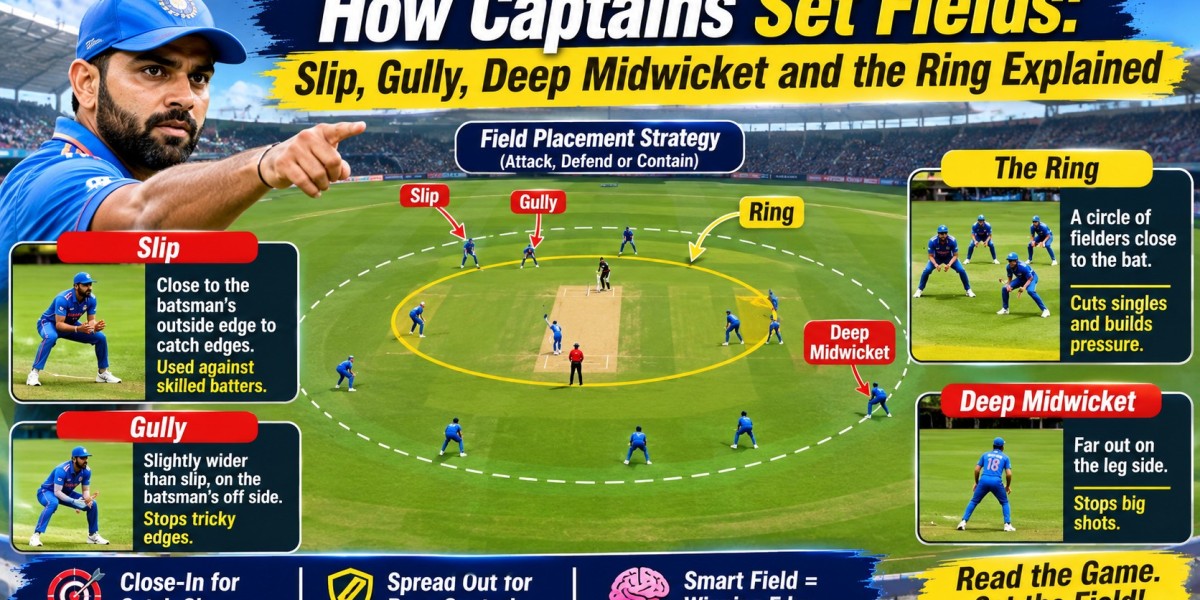

A cricket field looks random, until you know what you are looking at. Then it looks like a plan.
A captain sets a field to do two things, at the same time: to take a wicket, and to stop runs. He cannot do both, with the same field, in the same over, so he has to choose, ball by ball, and over by over, whether he wants a catch, or a dot ball, or a single, or a boundary saved.
This is how he does it, with slip, gully, deep midwicket, and the ring, and with the fielding restrictions that decide how many fielders can be outside the circle.
First, learn the map: off side and leg side
Stand behind the batter, and look at the pitch.
The off side is the side of the batter's bat, away from his legs. For a right-handed batter, the off side is to his right, as he faces the bowler. For a left-handed batter, the off side is to his left.
The leg side is the side of the batter's legs, away from his bat. For a right-handed batter, the leg side is to his left, as he faces the bowler. For a left-handed batter, the leg side is to his right.
Every fielding position is named by which side it is on, and how far it is from the batter, and whether it is in front of the batter, square with the batter, or behind the batter.
In front of the batter is towards the bowler, and towards the boundary at the bowler's end. Square with the batter is level with the batter, on the off side or the leg side. Behind the batter is towards the wicketkeeper, and towards the boundary behind the batter.
A captain will set a field for a right-handed batter, and then he will have to flip it, mirror-image, for a left-handed batter, because the off side and the leg side swap, when the batter swaps hands. That is why you will see a captain move fielders, in the middle of an over, when a left-handed batter comes to the crease, after a right-handed batter is out.
Slip, gully and the cordon: the catching positions
Slip is the most famous fielding position in cricket, and the most important, in Tests.
A slip stands behind the batter, on the off side, in a line with the wicketkeeper, waiting for an outside edge, from a ball that swings or seams away, and that the batter nicks, with the edge of his bat, to slip, for a catch.
There can be one slip, two slips, three slips, or four slips, in a Test, in a slip cordon, with first slip closest to the wicketkeeper, second slip next, third slip next, and fourth slip furthest away, in a diagonal line, behind the batter, on the off side.
A captain will set three or four slips, in a Test, with a new ball, and with a fast bowler, who is swinging and seaming the ball away, because he wants a catch, behind the wicket, and he is willing to give up runs, in front of the wicket, to get that catch.
In a T20 or an ODI, a captain will rarely set more than one slip, and often no slip at all, because he does not want to give up runs, in front of the wicket, in a limited-overs game, where a single is worth more than a catch, in the powerplay, when only two fielders can be outside the circle.
Gully is next to slip, but wider, and squarer, behind the batter, on the off side, waiting for a cut shot, or a thick edge, that flies squarer than a slip catch, and that would go past slip, if there was no gully.
A gully is a catching position, for a ball that is cut, or edged, square, on the off side, and it is often used with a fast bowler, who is bowling short, and wide, and who wants the batter to cut, and to edge, to gully, for a catch.
Real example: Arshdeep Singh's 150th T20I wicket, Auckland, 30 October 2026.
Arshdeep Singh reached 150 T20I wickets in Auckland on 30 October 2026, dismissing Mitchell Santner for 5 in the 19th over, caught at sweeper cover by Nitish Kumar Reddy, finishing 1/38 in four overs, as the first Indian to 150 T20I wickets. That was not a slip catch, it was a sweeper cover catch, in the deep, on the off side, because Santner, who was set, and who was trying to hit a boundary, in the death overs, hit the ball in the air, to sweeper cover, and Nitish, who was on the boundary, caught it, and Arshdeep got his 150th wicket, not with a slip, but with a deep fielder, on the off side.
In a Test, that same ball, from Arshdeep, with a new ball, would have had three slips, and a gully, behind the batter, waiting for an edge, not a sweeper cover, on the boundary, waiting for a lofted drive.
Point, cover and mid-off: the ring on the off side
Point stands square with the batter, on the off side, about 20 to 25 metres from the batter, waiting for a cut shot, or a square drive, that is hit hard, and square, on the off side.
Cover stands in front of square, on the off side, about 25 to 30 metres from the batter, waiting for a cover drive, that is hit in front of square, on the off side, through the covers, for four.
Mid-off stands in front of the batter, on the off side, about 25 to 30 metres from the batter, waiting for a straight drive, that is hit back past the bowler, on the off side, for four, or for a single, to mid-off.
Point, cover and mid-off are the ring, on the off side. The ring is the infield, inside the 30-yard circle, in limited-overs cricket, and it is the fielders who stop singles, in the powerplay, and in the middle overs, and who save boundaries, in the death overs.
In a T20 powerplay, overs 1 to 6, only two fielders can be outside the 30-yard circle, so the other nine fielders, including the bowler and the wicketkeeper, must be inside the circle, in the ring, on the off side and the leg side, to stop singles, and to take catches, in front of the wicket.
In an ODI, overs 1 to 10, only two fielders can be outside the circle, and in overs 11 to 40, only four fielders can be outside, and in overs 41 to 50, five fielders can be outside. That is why the ring is so important, in an ODI, in the middle overs, when only four fielders can be outside, and the other five fielders must be inside the circle, to stop singles, and to rotate the strike.
Mid-on, midwicket and square leg: the ring on the leg side
Mid-on stands in front of the batter, on the leg side, about 25 to 30 metres from the batter, waiting for a straight drive, that is hit back past the bowler, on the leg side, for four, or for a single, to mid-on.
Midwicket stands square with the batter, on the leg side, about 25 to 30 metres from the batter, waiting for a pull shot, or a flick shot, that is hit square, on the leg side, through midwicket, for four.
Square leg stands square with the batter, on the leg side, but behind the batter, waiting for a pull shot, or a hook shot, that is hit square, on the leg side, behind square, for four, or for a catch, at square leg, if the batter top-edges a pull.
Mid-on, midwicket and square leg are the ring, on the leg side. They are the fielders who stop singles, on the leg side, in the powerplay, and in the middle overs, and who save boundaries, on the leg side, in the death overs, when a batter is trying to hit a pull, or a flick, for six, through midwicket.
Real example: Ishan Kishan, caught at deep midwicket, Hamilton, 1 November 2026.
Ishan Kishan made 61 off 32 balls in Hamilton on 1 November 2026, with 5 fours and 5 sixes, in a 93-run stand with Shreyas Iyer, who made 50 off 23, after India were 19/2, with Samson making 4 off 10, and Abhishek making 1 off 2, both to Adam Milne. Kishan was dismissed by Blair Tickner, caught by Nathan Smith at deep midwicket, after Kishan had hit a pull shot, in the air, to deep midwicket, where Smith, who was on the boundary, on the leg side, caught it, and Kishan was out, for 61, and India made 191/8, and lost by seven wickets, as New Zealand chased 195/3 in 18 overs, with Tim Seifert making 93 off 50, and Glenn Phillips making 65 not out off 38.
Deep midwicket is the deep version of midwicket, on the boundary, on the leg side, square with the batter, waiting for a pull shot, that is hit in the air, to deep midwicket, for six, or for a catch, if the batter does not time it, and hits it straight to the fielder, on the boundary.
Deep positions: third man, fine leg, long-on, long-off, deep cover
Deep positions are on the boundary, 70 to 80 metres from the batter, waiting for a boundary, or a catch, in the deep, when the batter tries to hit the ball in the air, over the infield, for four or six.
Third man is behind the batter, on the off side, on the boundary, waiting for an edge, or a late cut, that flies behind the batter, on the off side, for four, or for a catch, at third man, if the batter edges it, in the air, to third man.
Fine leg is behind the batter, on the leg side, on the boundary, waiting for a glance, or a flick, that flies behind the batter, on the leg side, for four, or for a catch, at fine leg, if the batter glances it, in the air, to fine leg.
Long-on is in front of the batter, on the leg side, on the boundary, waiting for a straight drive, that is hit back past the bowler, on the leg side, for six, or for a catch, at long-on, if the batter does not time it, and hits it straight to the fielder.
Long-off is in front of the batter, on the off side, on the boundary, waiting for a straight drive, that is hit back past the bowler, on the off side, for six, or for a catch, at long-off, if the batter does not time it.
Deep cover is in front of square, on the off side, on the boundary, waiting for a cover drive, that is hit in the air, through the covers, for four or six, or for a catch, at deep cover, if the batter does not time it.
For fans following the ODI series, and the field settings in it, the scores, squads and form are often checked in one place during a tour. Cricbet99 is one of the platforms fans use to follow those updates, scores and player form. Cricbet99 is a gaming and betting-related platform, not an official broadcaster, and any betting-related features are for adults only, where legally permitted. Use responsibly and check local rules, as betting law in India varies by state.
How a captain sets a field, by format
Test: A captain wants wickets, not dot balls, and he will set an attacking field, with three or four slips, a gully, a short leg, and a silly point, close to the batter, waiting for a catch, and he will give up runs, in front of the wicket, to get that catch, because a Test is five days, and a wicket is worth more than a run, in a Test.
In a Test, there are no fielding restrictions, and no circle, and a captain can put as many fielders as he wants, outside the circle, or inside the circle, except for the leg-side limit, of a maximum of five fielders on the leg side, and a maximum of two fielders, other than the wicketkeeper, behind the popping crease on the leg side.
ODI: A captain wants wickets, and dot balls, and singles stopped, in the middle overs, and he will set a field with two fielders outside the circle, in the powerplay, overs 1 to 10, and four fielders outside, in the middle overs, overs 11 to 40, and five fielders outside, in the death overs, overs 41 to 50, with a ring, inside the circle, to stop singles, and with deep fielders, on the boundary, to save boundaries, in the death overs.
T20: A captain wants wickets, in the powerplay, and dot balls, in the middle overs, and boundaries saved, at the death, and he will set a field with two fielders outside the circle, in the powerplay, overs 1 to 6, and five fielders outside, after the powerplay, overs 7 to 20, with a ring, inside the circle, to stop singles, and with deep fielders, on the boundary, to save boundaries, in the death overs, when a batter is trying to hit a six, on every ball.
The over-rate penalty: In T20Is, from January 2022, and in ODIs, from 2023, a side that is behind the required over rate must bring an extra fielder inside the circle, for the overs it is short, so a maximum of four fielders outside, instead of five, at the death. That is a penalty, for slow over rates, and it changes the field, in the death overs, when a captain would normally have five fielders outside, to save boundaries.
How a captain sets a field, by bowler and batter
For a fast bowler, with a new ball: A captain will set slips, a gully, and a short leg, to take a catch, behind the wicket, and he will set point, cover and mid-off, in the ring, to stop singles, and he will set a third man, on the boundary, to save a boundary, from an edge, behind the wicket.
For a spinner, in the middle overs: A captain will set a slip, for a left-arm spinner, or for a leg-spinner, who drifts the ball away, and turns it back in, and he will set a short leg, and a silly point, close to the batter, to take a catch, from a ball that turns, and bounces, and he will set a deep midwicket, and a long-on, on the boundary, to save a boundary, from a batter who steps out, and hits the ball in the air, to long-on, for six.
Mitchell Santner, New Zealand's captain, and left-arm spinner, took 4/21 in Christchurch on 24 October 2026, with a field that had a slip, a short leg, and a deep midwicket, to take a catch, from a ball that drifted, and turned, and beat the bat, and trapped the batter LBW, or bowled him, or caught him, at slip, or at short leg, as India made 181/6 in 19.5 overs, chasing 181, after being 70/5, and 112/6.
For a batter who hits through midwicket: A captain will put a deep midwicket, on the boundary, on the leg side, to save a boundary, and a midwicket, in the ring, to stop a single, and a square leg, behind square, to take a catch, from a pull shot, that is top-edged, to square leg.
For a batter who hits through cover: A captain will put a deep cover, on the boundary, on the off side, to save a boundary, and a cover, in the ring, to stop a single, and a point, square, to take a catch, from a cut shot, that is hit hard, and square, on the off side.
Frequently asked questions
What is a slip?
A slip stands behind the batter, on the off side, in a line with the wicketkeeper, waiting for an outside edge, from a ball that swings or seams away, for a catch.
What is a gully?
A gully stands next to slip, but wider, and squarer, behind the batter, on the off side, waiting for a cut shot, or a thick edge, that flies squarer than a slip catch.
What is deep midwicket?
Deep midwicket is on the boundary, on the leg side, square with the batter, waiting for a pull shot, that is hit in the air, to deep midwicket, for six, or for a catch, if the batter does not time it.
What is the ring?
The ring is the infield, inside the 30-yard circle, in limited-overs cricket, with fielders at point, cover, mid-off, mid-on, midwicket and square leg, to stop singles, and to take catches, in front of the wicket.
How many fielders can be outside the circle?
In a T20, overs 1 to 6, a maximum of 2 outside, and overs 7 to 20, a maximum of 5 outside. In an ODI, overs 1 to 10, a maximum of 2, overs 11 to 40, a maximum of 4, and overs 41 to 50, a maximum of 5.
What is the leg-side limit?
A maximum of 5 fielders on the leg side, at the instant of delivery, and a maximum of 2 fielders, other than the wicketkeeper, behind the popping crease on the leg side, in all formats, including Tests.
The verdict
A field is not a random set of positions. It is a plan, by a captain, to take a wicket, and to stop runs, at the same time, with the fielders he has, and with the restrictions he has, in the format he is playing.
Slip and gully are for catches, behind the wicket, with a new ball, in a Test. Point, cover, mid-off, mid-on, midwicket and square leg are the ring, inside the circle, to stop singles, in the powerplay, and in the middle overs, in a T20 and an ODI. Deep midwicket, long-on, long-off, deep cover, third man and fine leg are on the boundary, to save boundaries, and to take catches, in the deep, in the death overs, when a batter is trying to hit a six, on every ball.
If you can see the ring, and the deep fielders, and the slip cordon, you can see what the captain wants: a catch, or a dot ball, or a single, or a boundary saved. And if you can see what the captain wants, you can see the game, before the ball is bowled.
Source list: Fielding restrictions, ICC playing conditions, men's circle 30 yards / 27.43 m, women's 23 m. T20I powerplay 1-6 max 2 outside, 7-20 max 5 outside. ODI PP1 1-10 max 2, PP2 11-40 max 4, PP3 41-50 max 5, fixed since 2015. Leg-side limit max 5 on leg side, max 2 behind popping crease on leg side. Arshdeep 150th wicket, Auckland 30 Oct 2026, Santner 5, caught sweeper cover Nitish Kumar Reddy. Kishan caught deep midwicket, Hamilton 1 Nov 2026, Tickner, caught Nathan Smith, 61 off 32. Santner 4/21 Christchurch 24 Oct 2026, 1/17 Wellington 27 Oct 2026.