
The growing focus on sustainable agriculture, carbon sequestration, and resource-efficient waste management is creating new opportunities for the Biochar Market. As industries and governments explore practical solutions to environmental challenges, biochar is gaining attention as a versatile material that connects agricultural productivity with climate-focused initiatives.
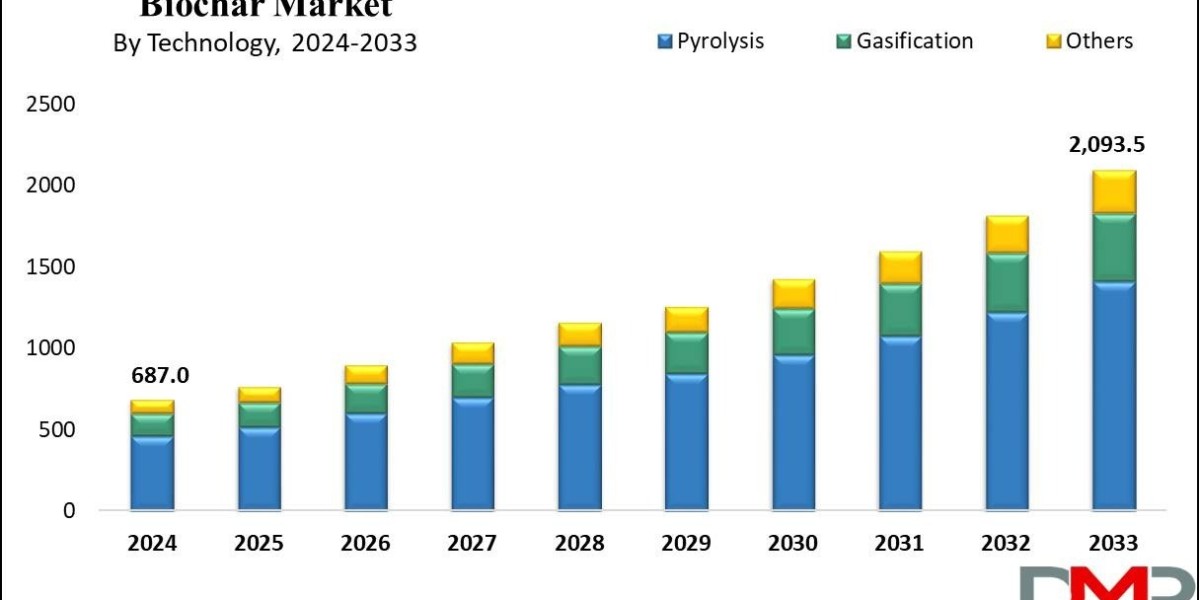
According to Dimension Market Research, the Global Biochar Market reached USD 604.9 million in 2023 and is projected to reach USD 2,093.5 million by 2033, registering a compound annual growth rate (CAGR) of 13.2% during the forecast period. The market's expansion is supported by increasing adoption of sustainable soil management, government initiatives, and growing interest in carbon removal and biomass utilization.
Beyond traditional agricultural applications, biochar is attracting interest from environmental remediation, water treatment, and construction industries. Its ability to convert organic waste into a useful material makes it relevant to the broader transition toward circular resource management.
What Is the Biochar Market?
Biochar is a charcoal-like material produced by heating organic materials such as agricultural residues, forestry waste, wood waste, and animal manure under controlled conditions. The production process converts biomass into a carbon-rich product that can be used across several environmental and industrial applications.
In agriculture, biochar is primarily used as a soil amendment. It can improve soil structure, support nutrient retention, increase water-holding capacity, and reduce fertilizer runoff. These properties make it relevant to farming systems seeking better soil health and more efficient resource utilization.
Biochar also has applications in environmental remediation, where its adsorption properties can help remove contaminants from soil and water. Additionally, its capacity to store carbon in a relatively stable form makes it an important material in carbon sequestration strategies.
Key Factors Driving Biochar Market Growth
Increasing Adoption of Sustainable Agriculture
Agriculture remains a major demand-generating application for biochar. Farmers are increasingly exploring soil management solutions that can improve fertility, retain moisture, and support crop productivity.
Biochar can contribute to these objectives by improving soil characteristics and nutrient efficiency. Its potential role in reducing fertilizer requirements and supporting sustainable farming practices is strengthening its commercial relevance.
The growing integration of precision farming technologies and agricultural innovation also creates opportunities for biochar adoption. However, wider market penetration depends on greater farmer awareness and evidence of economic benefits across different soil conditions.
Growing Focus on Carbon Sequestration
Carbon sequestration is another important factor supporting the Biochar Market. Biochar can retain carbon in a stable form, making it relevant to climate mitigation strategies and carbon management initiatives.
The increasing integration of biochar with carbon credit and carbon offset markets is creating additional commercial possibilities. Producers and users may benefit from recognizing the carbon storage value of biochar through eligible carbon programs.
This connection between agricultural applications and carbon management is helping position biochar as more than a conventional soil improvement product.
Government Support and Waste Management Initiatives
Government grants, subsidies, and research funding are supporting the development and adoption of biochar technologies. These initiatives aim to encourage sustainable agriculture, environmental restoration, and more effective biomass utilization.
Biochar production also offers a productive route for managing agricultural and forestry waste. Converting residues into useful materials can reduce waste disposal challenges while creating additional value from available biomass resources.
Biochar Market Segmentation and Technology Trends
The Biochar Market is primarily segmented by technology and application.
Technology Segment
Pyrolysis is expected to remain the leading technology segment. This process involves heating organic feedstock under controlled conditions and can produce biochar with desirable stability and carbon content.
Gasification is another important technology, particularly in applications associated with energy generation. However, the DMR report notes that its suitability for producing stable agricultural biochar can be a limitation.
Other production approaches include alternative methods used by smaller-scale manufacturers to process locally available biomass.
Technological improvements are also influencing production economics. More efficient pyrolysis techniques, energy-efficient reactors, and mobile biochar production units are helping improve production feasibility, scalability, and product consistency.
Application Segment
Agriculture is expected to account for the largest revenue share in 2024.
Biochar supports farming through improved water retention, nutrient availability, and soil productivity. Its use in livestock-related applications is also relevant because of its potential to provide nutrients and support animal well-being.
Beyond agriculture, environmental remediation, carbon sequestration, waste management, and water filtration represent important application areas. Research into construction materials and animal feed additives could further broaden its potential uses.
Get a Free Sample of the Biochar Market Report
Understand the market's growth drivers, technology developments, application opportunities, and competitive environment with detailed research from Dimension Market Research.
https://dimensionmarketresearch.com/request-sample/biochar-market/
Regional Outlook: North America Leads the Market
North America is expected to hold a 34.8% revenue share of the Global Biochar Market in 2024, making it the leading regional market according to the report's key takeaways and regional analysis.
The region benefits from greater awareness of biochar, established agricultural activity, and participation from domestic and international manufacturers. Demand from farming and livestock-related applications is also contributing to regional adoption.
The United States is identified as a major contributor to regional market revenue. Its market position is supported by manufacturer participation and growing awareness of biochar's agricultural and environmental benefits.
The report also covers Europe, Asia Pacific, Latin America, and the Middle East and Africa, highlighting the global scope of the industry.
Growth Opportunities and Market Challenges
The expansion of biomass utilization presents an important opportunity. Agricultural residues, forestry by-products, and urban green waste can serve as feedstocks for biochar production, connecting waste management with the development of commercially useful materials.
Advanced applications in water treatment and construction materials may also expand the market beyond conventional agriculture. Biochar's contaminant adsorption properties and material characteristics create opportunities for further research and product development.
However, high production costs remain a challenge. Equipment investment, feedstock procurement, and energy consumption can make biochar more expensive than conventional soil amendments. These factors can limit adoption among smaller farmers and producers.
The lack of standardized production processes and quality control is another concern. Differences in feedstock and manufacturing methods can affect product properties and performance. Consistent quality standards and certification systems will be important for strengthening market confidence.
Competitive Landscape of the Biochar Market
The competitive landscape includes established biochar manufacturers, technology providers, and companies involved in biomass conversion and pyrolysis solutions.
Prominent companies identified in the DMR report include Coaltec Energy USA, Carbofex Ltd., Biochar Supreme, Proactive Agriculture, Biochar Products, Inc., ArSta Eco, Carbon Gold Ltd., Phoenix Energy, Airex Energy Inc., and Pacific Biochar Benefit Corporation.
Competition is influenced by production efficiency, feedstock availability, product quality, technological capabilities, and the ability to serve agricultural and environmental applications. Technology improvements and investment in scalable production processes are likely to remain important areas of competitive differentiation.
Future Outlook for the Biochar Market
The future of the Biochar Market will depend on the intersection of sustainable agriculture, biomass utilization, and carbon management. As demand for soil improvement solutions and environmentally responsible waste processing increases, biochar has opportunities to serve multiple industries.
Advancements in pyrolysis technology, better production economics, and the development of new applications could strengthen its commercial potential. At the same time, greater standardization, quality assurance, and awareness among end users will be essential for broader adoption.
Key Biochar Market Statistics
● 2023 Market Size: USD 604.9 Million
● 2024 Market Size: USD 687.0 Million
● 2033 Forecast Value: USD 2,093.5 Million
● Forecast CAGR: 13.2% (2024-2033)
● Leading Technology: Pyrolysis
● Leading Application: Agriculture
● Leading Region: North America, with a projected 34.8% share in 2024
Frequently Asked Questions About the Biochar Market
1. What is the current size of the Biochar Market?
The Global Biochar Market reached USD 604.9 million in 2023. The DMR report estimates its 2024 market size at USD 687.0 million.
2. What is the expected CAGR of the Biochar Market?
The Biochar Market is projected to grow at a CAGR of 13.2% during the 2024-2033 forecast period.
3. Which technology segment leads the Biochar Market?
Pyrolysis is expected to lead the technology segment due to its ability to produce biochar with high stability and carbon content.
4. Which application segment dominates the Biochar Market?
Agriculture is expected to account for the largest revenue share in 2024, supported by biochar's soil improvement and nutrient retention applications.
5. Which region leads the Biochar Market?
North America is expected to lead the Global Biochar Market with a projected revenue share of 34.8% in 2024, according to the report's regional analysis.
Conclusion
The Biochar Market is developing as sustainable agriculture, carbon sequestration, and biomass waste utilization gain importance. With a projected market value of USD 2,093.5 million by 2033, the industry offers opportunities across agriculture, environmental remediation, and emerging industrial applications. Continued technology improvements, cost optimization, and standardized product quality will play an important role in supporting its long-term growth.
Related Carbon Management Market Insights
Carbon Dioxide Removal Market Size
The Carbon Dioxide Removal Market complements the biochar industry's carbon sequestration theme. According to Dimension Market Research, this market is projected to reach USD 926.0 million in 2026 and USD 4,153.6 million by 2035, growing at a CAGR of 18.1%. Biochar is also identified as one of the approaches relevant to agricultural carbon sequestration, connecting the two markets through their contribution to carbon management.