
The global lithium iron phosphate battery market is witnessing strong expansion as electric vehicle manufacturers, energy storage developers, and battery technology companies increasingly adopt cost-effective and reliable energy storage solutions. Growing demand for electric mobility, renewable energy integration, and advancements in battery manufacturing technologies are encouraging the adoption of lithium iron phosphate (LFP) batteries across multiple industries.
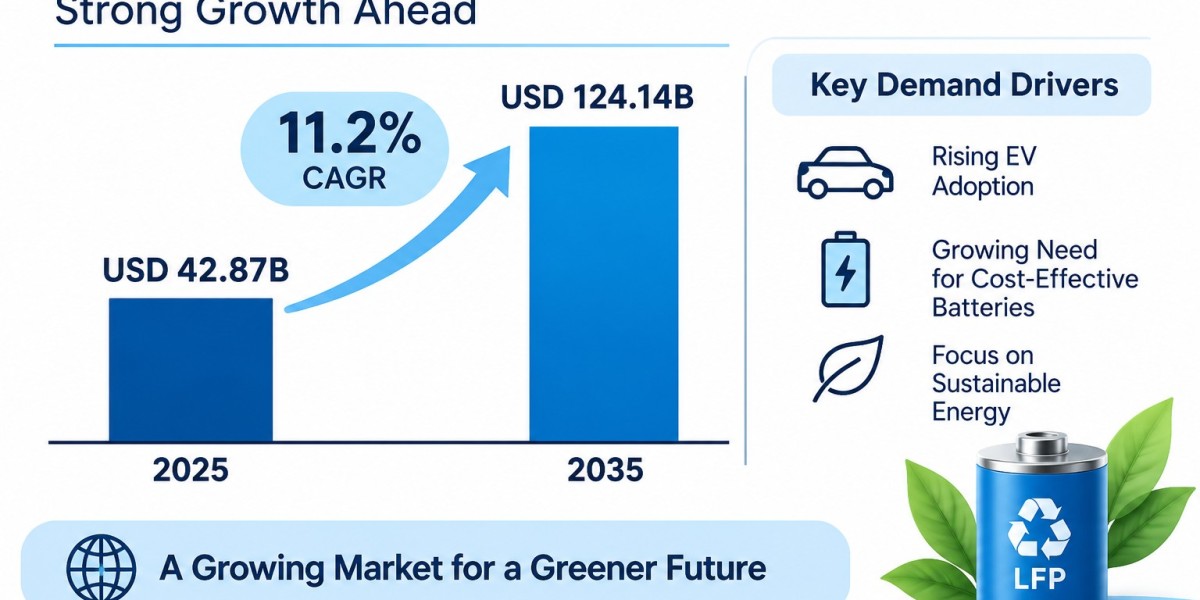
According to Faradex Partners, the global lithium iron phosphate battery market was valued at USD 42.87 billion in 2025 and is projected to register a revenue CAGR of 11.2% during the forecast period. The growing cost advantage of LFP chemistry, supported by the absence of cobalt and nickel in its cathode composition, is creating opportunities for manufacturers to expand production and strengthen their market positions.
As electric vehicle adoption continues to increase and energy storage requirements become more complex, LFP battery technology is gaining importance as an alternative to conventional nickel-based battery chemistries.
Explore the Full Lithium Iron Phosphate Battery Market Report:- https://www.faradexpartners.com/reports/lfp-battery
Understanding the Lithium Iron Phosphate Battery Market
Lithium iron phosphate batteries are rechargeable lithium-ion batteries that use lithium iron phosphate as their cathode material. These batteries are recognised for their thermal stability, long operating life, safety characteristics, and relatively lower manufacturing costs.
LFP batteries are increasingly used in electric vehicles, battery energy storage systems, industrial equipment, and renewable energy applications. Their ability to support frequent charging and discharging cycles makes them suitable for applications requiring reliable and long-term energy storage.
Unlike nickel manganese cobalt (NMC) and nickel cobalt aluminium (NCA) battery chemistries, LFP batteries do not require cobalt or nickel in their cathode composition. This provides manufacturers with a structural material cost advantage and reduces exposure to fluctuations in certain critical mineral markets.
Key Factors Driving Lithium Iron Phosphate Battery Market Growth
1. Increasing Adoption of Electric Vehicles
The growing global electric vehicle industry is one of the major factors supporting lithium iron phosphate battery market growth. Automotive manufacturers are increasingly incorporating LFP batteries into standard-range electric vehicle models because of their cost efficiency, durability, and safety advantages.
According to the International Energy Agency's Global EV Outlook 2025, LFP chemistry accounted for approximately 42% of global electric vehicle battery deployments by volume in 2024, compared with 18% in 2021. The increasing adoption of LFP technology by Chinese automotive manufacturers and Tesla has further strengthened its market position.
The availability of relatively affordable battery cells is also encouraging manufacturers to develop competitively priced electric vehicles, supporting wider adoption across different consumer segments.
2. Declining Battery Manufacturing Costs
The absence of cobalt and nickel in LFP cathode chemistry provides an important cost advantage over several alternative lithium-ion battery technologies. Expanding manufacturing capacity and improvements in production efficiency are further supporting battery price reductions.
Chinese domestic LFP cell prices were approximately USD 62 to USD 82 per kWh during Q2 2025, with further cost reductions anticipated as manufacturers expand production capabilities.
Lower manufacturing costs can improve the commercial viability of electric vehicles and stationary energy storage projects. This is encouraging battery producers to invest in advanced production facilities and improve their manufacturing processes.
3. Technological Advancements in Battery Performance
Continuous developments in battery engineering are helping manufacturers improve LFP battery energy density and overall performance. Improvements in active material loading, electrolyte formulations, and cell architecture are contributing to better energy storage capabilities.
In January 2026, BYD reported that its latest-generation Blade Battery achieved a gravimetric energy density of 182 Wh/kg at the cell level. This represented a 12% improvement over its first-generation Blade Battery through active material loading optimisation and electrolyte additive refinement.
These developments demonstrate the potential for LFP technology to narrow the performance gap with nickel-based battery chemistries while maintaining its material cost advantages.
Market Segmentation and Emerging Opportunities
The lithium iron phosphate battery market is segmented based on cell format and application, with prismatic, cylindrical, and pouch cell technologies representing the major product categories.
Prismatic cells account for a significant revenue share because their design supports efficient packaging and integration into large battery systems. Their suitability for automotive applications and stationary energy storage has encouraged manufacturers such as CATL, BYD, and CALB to expand their prismatic LFP product portfolios.
Cylindrical LFP batteries are also gaining attention as manufacturers explore their use in electric vehicles and grid-scale energy storage applications. Developments in large-format cylindrical battery technologies are expected to expand opportunities across the market.
Beyond cell formats, electric vehicles and battery energy storage systems represent important application areas. Increasing investments in renewable energy infrastructure are creating additional demand for batteries capable of supporting grid stability and electricity storage.
Regional Outlook and Industry Expansion
Asia Pacific accounted for the largest revenue share of the global lithium iron phosphate battery market in 2025. China remains the dominant regional market due to its extensive battery manufacturing infrastructure, established supply chains, and strong electric vehicle industry.
Major manufacturers, including CATL, BYD, CALB, and EVE Energy, are contributing to the region's competitive position through production expansion and technological innovation. India is also emerging as an important market, supported by investments in electric mobility, battery assembly, and domestic manufacturing initiatives.
Europe is expected to register rapid market growth as regional manufacturers and automotive companies invest in battery production, recycling infrastructure, and supply chain development. Regulatory requirements under the European Union Battery Regulation are also influencing investment in sustainable battery manufacturing.
North America is witnessing increasing investment in domestic battery production, supported by manufacturing incentives and electric vehicle industry expansion. The United States is strengthening its battery manufacturing capabilities through investments involving Tesla, General Motors, LG Energy Solution, Panasonic Energy, and Samsung SDI.
Latin America offers opportunities through its lithium resources, particularly in Chile and Argentina, while the Middle East and Africa region has potential for future battery material processing and manufacturing development.
Challenges Facing the Lithium Iron Phosphate Battery Market
Despite its strong growth potential, the lithium iron phosphate battery market faces certain technical and competitive challenges. One of the primary limitations is its comparatively lower energy density than advanced nickel-rich battery chemistries.
LFP batteries generally achieve approximately 150 to 185 Wh/kg at the cell level, compared with around 240 to 300 Wh/kg for NMC811 pouch cells. This difference can limit their suitability for premium electric vehicles requiring longer driving ranges and compact battery pack dimensions.
The development of lithium manganese iron phosphate (LMFP) technology is another emerging competitive factor. LMFP batteries incorporate manganese to improve energy density while retaining the advantages of iron-phosphate-based chemistry.
Addressing energy density limitations, improving manufacturing efficiency, and maintaining competitive pricing will remain important for manufacturers seeking to strengthen their market positions.
Conclusion
The lithium iron phosphate battery market is expected to experience significant growth as electric vehicle adoption, renewable energy integration, and battery storage investments continue to expand worldwide. Improvements in battery performance, declining manufacturing costs, and increasing production capacity are creating new opportunities for manufacturers and industry participants.
However, energy density limitations and competition from emerging battery technologies will continue to influence the market's development. Companies investing in advanced battery engineering, manufacturing capabilities, and strategic partnerships are expected to play an important role in shaping the industry's future.
For additional industry insights, market intelligence, and research covering emerging technologies and global business opportunities, visit Faradex Partners.
Businesses seeking detailed market assessments, customised forecasts, regional analysis, or competitor intelligence can also Request Customized Market Research to support their strategic planning and investment decisions.