
The global DDI Market is becoming increasingly important as enterprises modernize network infrastructure, adopt hybrid cloud environments, and strengthen cybersecurity operations. Managing IP addresses, domain name resolution, and device connectivity across distributed systems requires greater automation, visibility, and operational control.
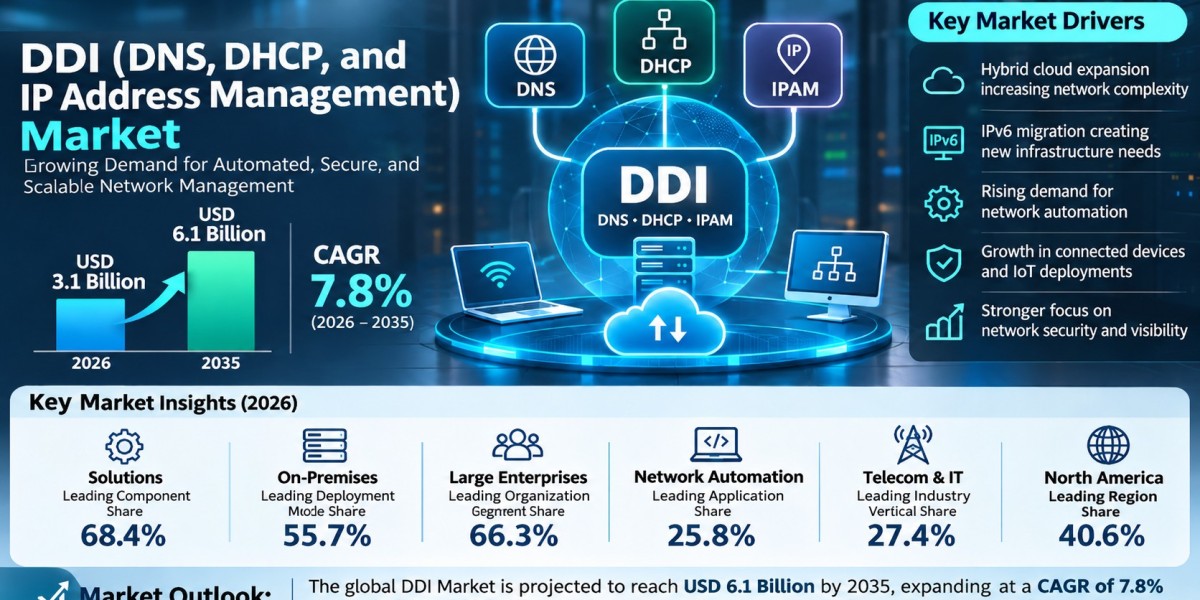
According to Dimension Market Research, the global DDI Market is projected to reach USD 3.1 billion in 2026 and expand to USD 6.1 billion by 2035, registering a CAGR of 7.8% during 2026 to 2035.
Growth is supported by rising IPv6 adoption, expansion of connected devices, cloud-native applications, and demand for secure network administration. Organizations are increasingly replacing fragmented management processes with integrated platforms that improve connectivity, reduce configuration errors, and support automated infrastructure operations.
What Is the DDI (DNS, DHCP, and IP Address Management) Market?
The DDI Market covers integrated solutions and services that combine three foundational networking functions: Domain Name System (DNS), Dynamic Host Configuration Protocol (DHCP), and IP Address Management (IPAM).
DNS translates domain names into IP addresses, DHCP automates IP address assignments, and IPAM provides centralized visibility into address allocation, utilization, and network resources.
Together, these capabilities help enterprises maintain reliable connectivity, manage network assets, and enforce consistent policies across physical infrastructure, virtual environments, and cloud platforms.
DDI solutions are particularly relevant to telecommunications, banking, healthcare, manufacturing, government organizations, and enterprises managing extensive digital infrastructure.
Why Is the Global DDI Market Growing?
Hybrid Cloud Expansion Is Increasing Network Complexity
Organizations are distributing workloads across private data centers, public cloud platforms, branch offices, and edge environments. Each additional workload or connected device introduces new requirements for IP address allocation, DNS management, and network security.
Traditional spreadsheets and disconnected administration tools become difficult to maintain as infrastructure expands.
Integrated DDI platforms provide centralized management, automated address provisioning, and synchronized network records across multiple environments.
For enterprise IT teams, this can translate into fewer configuration inconsistencies, faster service deployment, and improved infrastructure visibility.
IPv6 Migration Is Creating New Infrastructure Requirements
The transition from IPv4 to IPv6 is another important growth factor.
Enterprises must manage increasingly complex address spaces while supporting dual-stack networking environments. Automated address planning, subnet administration, and network discovery help reduce migration challenges.
DDI platforms also support more structured management of connected devices, which is important as IoT deployments and edge infrastructure expand.
Get a Free Sample of the DDI (DNS, DHCP, and IP Address Management) Market Report
Organizations evaluating network modernization, cloud infrastructure management, or DDI technology investments can request a sample to review the market study's scope and assess its relevance to their strategic priorities.
Get a Free Sample:
https://dimensionmarketresearch.com/request-sample/ddi-market/
Key DDI Market Statistics and Segment Insights
The report identifies several important market characteristics for 2026:
● Global Market Size: USD 3.1 Billion
● Forecast Market Size by 2035: USD 6.1 Billion
● Forecast CAGR: 7.8%
● Leading Component: Solutions, 68.4% share
● Leading Deployment Mode: On-Premises, 55.7% share
● Leading Organization Segment: Large Enterprises, 66.3% share
● Leading Application: Network Automation, 25.8% share
● Leading Industry Vertical: Telecom and IT, 27.4% share
● Leading Region: North America, 40.6% share
These figures indicate the importance of integrated network solutions, established enterprise infrastructure, and automated network operations within the overall DDI technology landscape.
How Are Cloud Deployment and Network Automation Reshaping the Market?
Solutions are expected to account for 68.4% of DDI Market revenue in 2026, supported by enterprise demand for integrated DNS, DHCP, IPAM, network discovery, reporting, and security capabilities.
On-premises deployment is projected to maintain the largest share at 55.7%, reflecting requirements for infrastructure control, customization, security, and data sovereignty.
However, cloud-based deployment is forecast to grow at a 10.2% CAGR, reflecting increasing demand for subscription-based network administration and centralized management across distributed environments.
Network automation is anticipated to represent the largest application segment, accounting for 25.8% of the market in 2026.
Automated provisioning, configuration management, and address reconciliation help reduce repetitive administrative tasks and improve infrastructure reliability.
Meanwhile, IoT and device management is expected to record a 10.6% CAGR as organizations connect more endpoints, sensors, and operational technology systems.
Regional DDI Market Outlook
North America Maintains Market Leadership
North America is projected to account for 40.6% of global DDI revenue in 2026.
The region benefits from substantial cloud infrastructure adoption, enterprise cybersecurity spending, established network management practices, and the presence of major technology vendors.
The United States represents an important market for integrated DNS security, IPAM modernization, and hybrid cloud management.
Asia Pacific Offers Faster Growth Opportunities
Asia Pacific is projected to register the fastest regional CAGR of 9.6% through 2035.
Regional demand is supported by expanding data center infrastructure, 5G networks, IoT adoption, cloud services, and digital transformation initiatives.
Countries including China, Japan, India, Australia, and South Korea represent important markets for network modernization and advanced connectivity management.
For DDI providers, these developments suggest opportunities in scalable cloud management, automated network provisioning, and infrastructure integration services.
Competitive Landscape and Emerging Technology Trends
The DDI Market includes established network infrastructure vendors and specialized technology providers such as Infoblox, BlueCat Networks, EfficientIP, Cygna Labs, Cisco Systems, Microsoft, Nokia, F5, SolarWinds, and ManageEngine.
Competition increasingly involves cloud management capabilities, DNS security, interoperability, automation, and integration with existing enterprise systems.
Artificial intelligence is also influencing DDI technology development. AI-assisted capabilities can support DNS anomaly detection, address capacity planning, device classification, and operational troubleshooting.
In November 2025, Infoblox announced that its Universal DDI portfolio had exceeded 200 customers and introduced additional management capabilities for Microsoft-hosted DNS and DHCP services.
However, implementation costs, legacy infrastructure integration, technical skill requirements, and migration risks remain important adoption challenges.
Future Opportunities in the DDI Market Through 2035
The market's development is expected to be influenced by cloud-native DDI, infrastructure-as-code workflows, DNS security, and integrated network operations.
Cloud-delivered services may create opportunities among smaller enterprises seeking advanced management capabilities without extensive infrastructure investments.
Growing demand for automated IPv6 migration and secure IoT device management also provides potential expansion opportunities.
For technology suppliers, competitive differentiation will increasingly depend on reliable integrations, deployment flexibility, security capabilities, and support for complex hybrid networks.
For enterprises, DDI investment decisions will require balancing automation benefits against operational continuity, implementation costs, and long-term platform compatibility.
Explore the Complete DDI (DNS, DHCP, and IP Address Management) Market Analysis
The complete market report provides additional information on segmentation, regional opportunities, competitive developments, and the industry's forecast outlook. Organizations can use this research to support network technology planning, supplier evaluation, and market-entry decisions.
View Report and Purchase Options:
https://dimensionmarketresearch.com/checkout/ddi-market/
Frequently Asked Questions
1. What is the global DDI Market size in 2026?
The global DDI Market is projected to reach USD 3.1 billion in 2026 and USD 6.1 billion by 2035.
2. What is the expected CAGR of the DDI Market?
The market is forecast to grow at a CAGR of 7.8% during 2026 to 2035.
3. Which component leads the DDI Market?
The solutions segment is projected to lead with a 68.4% revenue share in 2026, supported by demand for integrated DNS, DHCP, and IPAM platforms.
4. Which region dominates the global DDI Market?
North America is anticipated to hold the largest market share at 40.6% in 2026, while Asia Pacific is forecast to grow fastest.
5. What factors are driving DDI Market growth?
Major drivers include hybrid cloud adoption, IPv6 migration, network automation, IoT expansion, cybersecurity requirements, and increasing network infrastructure complexity.
Conclusion
The global DDI (DNS, DHCP, and IP Address Management) Market is positioned for continued expansion through 2035 as enterprise networks become more distributed, automated, and security-focused.
Hybrid cloud adoption, IPv6 migration, and connected-device growth are increasing the importance of centralized network resource management.
Although legacy integration and implementation complexity remain challenges, cloud-native platforms, automated provisioning, and AI-assisted network operations are creating new opportunities for technology providers and enterprise infrastructure teams.
Related Network Infrastructure and Automation Market Insights
The Network Automation Market Size is projected to increase from USD 7.0 billion in 2025 to USD 46.6 billion by 2034, expanding at a CAGR of 23.5%. Growth reflects rising enterprise adoption of AI-driven networking, software-defined infrastructure, automated provisioning, and intent-based network management. These developments also reinforce the importance of integrated DDI capabilities within broader network automation strategies.
The Japan Network Automation Market Share analysis highlights a market projected to grow from USD 424.5 million in 2026 to USD 2,296.0 million by 2035, registering a 20.6% CAGR. Demand is supported by software-defined networking, 5G infrastructure, AI-driven operations, cloud integration, and the modernization of enterprise and telecommunications networks.