
Multilayer material bonding has a familiar failure mode: air trapped between film layers turns into bubbles under heat and pressure, raising internal resistance, attenuating performance, and shortening service life. Guangdong Taihe Machinery Equipment Co., Ltd., which operates under the brand name Taihe, builds servo vacuum hot press systems aimed directly at that problem. Its equipment is positioned for precision bonding and lamination in new energy, new materials, laboratory research, and advanced manufacturing, and the company's headquarters sits at No. 2, Weide Industrial Park, 7 Weiziling East Road, Qingxi Town, Dongguan City, Guangdong Province, China.
What a Servo PCB Hot Press Changes in Precision Lamination
Precision material bonding requires simultaneous control of temperature, pressure, holding time, and vacuum. Lose any one of the four and the interface shows it: delamination, interface defects, or inconsistent contact between layers. A servo PCB hot press built on vacuum assistance removes interlayer air before pressing begins, which reduces bubble-related defects, while servo drive with full closed-loop control governs pressure, speed, position, and thrust. Independent upper and lower heating control, plus vacuum control, give process engineers room to shape a recipe to the material rather than the other way around.
Taihe's Platform and Proprietary R&D
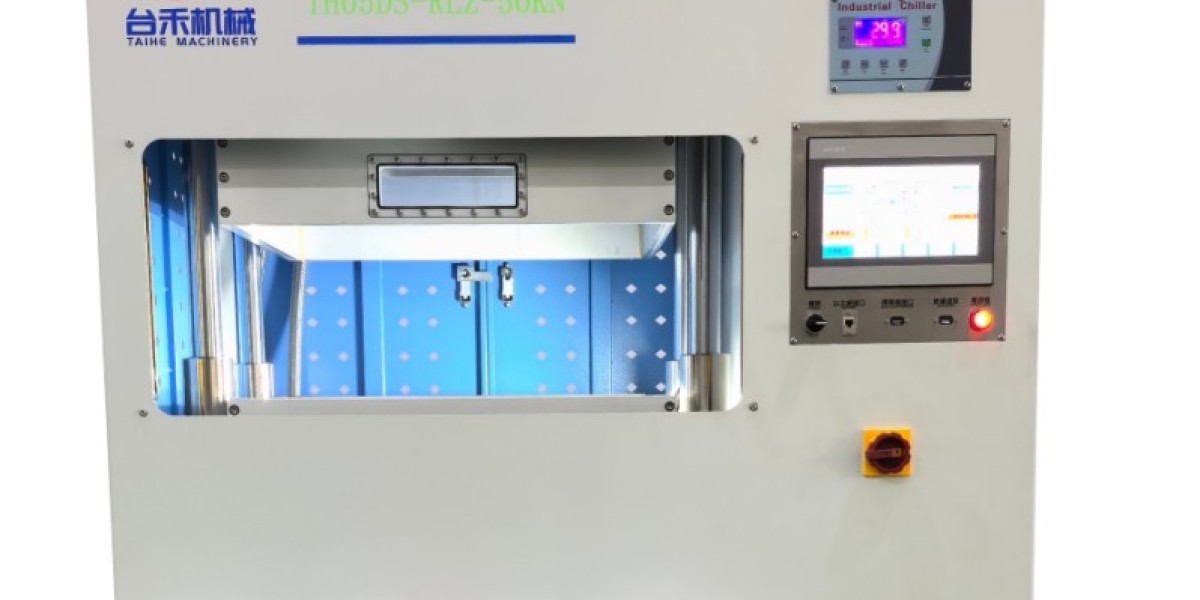
Taihe's technology platform is a three-plate four-column servo vacuum hot press with PLC and touchscreen HMI control, available with either hydraulic or electric cylinder actuation. The company develops its own heating system, insulation system, and heat preservation system for the hydraulic model, and a Taihe heating system, insulation system, heat preservation system, and self-developed vacuum system for the electric cylinder model.
Key operating features common to the product line include:
· Process recipe management supporting setting, saving, querying, and recalling 100 pressing process recipes, with the ability to increase quantity per requirements.
· Multi-stage control across pressure, stroke, speed, and temperature settings.
· Real-time curve display of the pressure-time relationship on the HMI, with storage, query, export, printing, and curve image capture.
· Electrical protection — overload protection switch, short-circuit protection switch, and buzzer alarm when temperature exceeds the upper limit.
· Abnormal alarm handling with audible-visual alarm light and buzzer, and the alarm cause shown on the HMI.
· Pressure and position interlock alarms, plus safety light curtain response and stop functions.
· Intelligent compensation for pressure and temperature, and I/O monitoring of communication port status for fault location.
· Reserved communication ports for connection to other equipment.
Hydraulic or Electric Cylinder: Matching the Specification to the Job
The two models in the line differ most sharply in achievable precision. For the Servo Vacuum Hot Press (Hydraulic Type), pressure accuracy is 1%F.S, displacement repeatability is +/-0.02mm, worktable flatness and parallelism are each +/-0.02mm, temperature control accuracy is +/-1°C, servo clamping and mold opening speeds are 80mm/s, detection/pressing/buffering speed runs 0.5-20mm/s, holding time spans 1-999999s, and data extraction frequency is 300Hz/s. Pressure setting resolution is 0.1T and displacement setting resolution is 0.1mm.
The Servo Vacuum Hot Press (Electric Cylinder Type) pushes the precision further: pressure accuracy of 0.1%F.S, displacement repeatability of +/-0.008mm, temperature control accuracy of +/-0.5°C, and a vacuum degree of -101.2kPa, with fast clamping and mold opening speeds of 60mm/s and detection/pressing/buffering speed of 0.001-20mm/s. Pressure setting resolution is 0.1kg and displacement setting resolution is 0.001mm. The electric cylinder's closed-loop system releases no heat during operation, and the servo motor idles during standby — no energy consumption, no noise.
Process Data, Recipes, and Traceability
Data capability is where these systems earn their place in a quality system. The controller stores 200,000+ groups of pressing data and extracts readings at 300Hz/s, displaying real-time pressure-time curves on the HMI with EXCEL report export via USB flash drive. The system self-collects, analyzes, evaluates, and archives pressing data, including date, serial number, shift, operator information, product name, pressing pressure, pressing position, and pressing result. Multi-group process formula storage lets different bonding processes — anode bonding, eutectic bonding, temporary bonding — each save a set of parameters separately, so production retrieves the formula instead of re-entering it, and the complete process data is recorded in real time and exportable for experimental reports or quality traceability.
A Documented Deployment
For Central Plains Graphene Laboratory, the business scenario was equipment procurement specified in a technical specification dated August 24, 2026. The solution delivered was a 10T Servo Vacuum Hot Press (Electric Cylinder Type), Model TH05DX-RZ-10T.
Installation, Documentation, and Service Assurance
Delivery follows on-site installation and commissioning with operator training included, and the electric control cabinet must be installed within 5m of the equipment. On-site requirements for the hydraulic model include three-phase AC480V +/-10%, 50Hz, while the electric cylinder model specifies three-phase AC380V +/-10%, 50Hz; both call for ambient temperature from room temperature to 40°C and humidity of 0-90%. Documentation covers layout drawings, assembly drawings, electrical schematics, an equipment operation and maintenance manual, a wear parts list, and a test and acceptance report, each in paper and electronic form. Warranty runs 12 months from final acceptance, with post-repair response within 2 hours, quality-related parts replacement by the seller, and free technical service for customer-caused improper operation with consumables charged separately.
Who This Equipment Fits
The product line suits glass, silicon wafers, semiconductor wafer die, sapphire, quartz, batteries, new materials, composite panels, wood, phenolic resin, metallurgical powder, and new energy products, alongside laboratory research, medical process research, new materials research, lithium battery research, and hydrogen fuel cell MEA lamination. For teams weighing a servo PCB hot press against a hydraulic alternative, the deciding variables are displacement repeatability, vacuum degree, and whether the process data needs to survive an audit — and Taihe publishes numbers for all three.