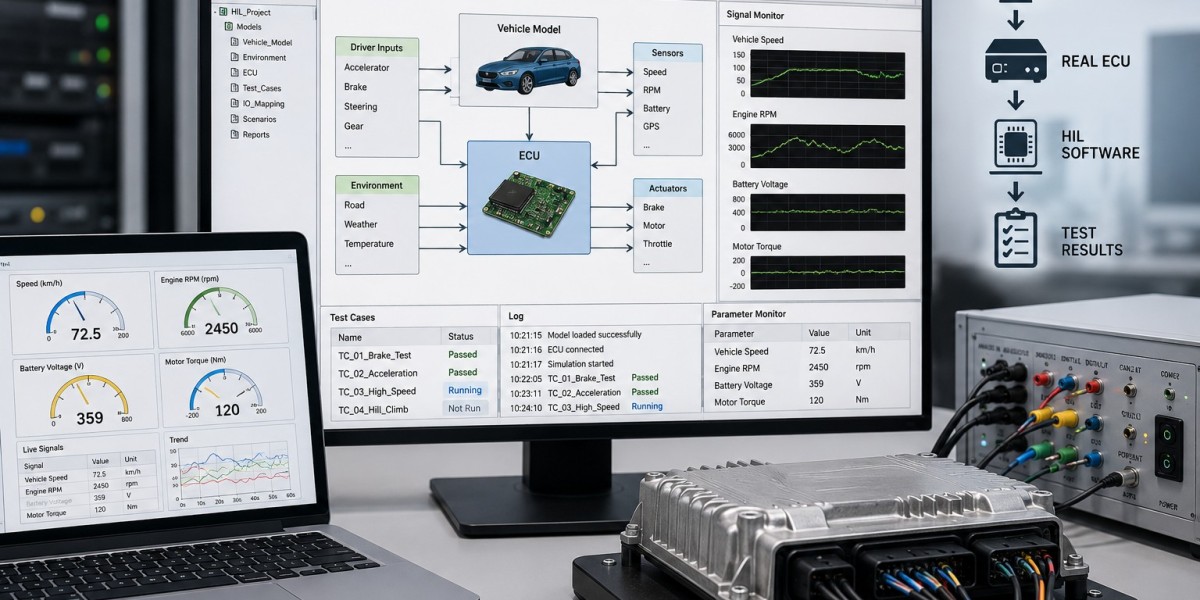

For this reason, engineers use specialised testing methods to evaluate system performance under different conditions. HIL Software Testing is one such approach that helps developers examine real controller behaviour in a controlled and repeatable environment.
Understanding Safety-Critical Engineering Systems
A safety-critical system is one in which a failure may lead to serious consequences, including equipment damage, injury, or disruption of essential operations.
Examples include aircraft control systems, automotive braking controllers, industrial safety systems, and certain medical devices.
These systems require careful development, verification, and validation. Engineers must examine how the software behaves during normal operation as well as when unexpected conditions occur.
How HIL Testing Supports Safety Validation
HIL testing connects an actual electronic controller to a simulated model of the system it controls.
The simulator generates input signals representing different operating conditions. The controller processes these signals and produces outputs that engineers can monitor.
This makes it possible to evaluate the controller's response to situations that may be difficult, expensive, or unsafe to reproduce using physical equipment.
For example, engineers can simulate unusual sensor readings or system faults and examine whether the controller responds according to its defined requirements.
Testing Normal and Abnormal Operating Conditions
A strong testing strategy should cover different types of operating conditions.
Normal Conditions: These tests confirm that the controller performs expected functions under regular operating conditions.
Boundary Conditions: These tests examine behaviour near defined operating limits, such as minimum or maximum sensor values.
Fault Conditions: Engineers introduce simulated failures to evaluate how the system responds to incorrect inputs or component problems.
Recovery Conditions: These tests examine whether the system returns to an acceptable operating state after a fault or interruption.
Timing Conditions: These tests evaluate whether the controller responds within the required time limits.
Advantages for Safety-Critical Applications
HIL testing can support safety and reliability activities in several ways.
It provides a controlled environment for examining difficult scenarios. Engineers can repeat the same test and compare results, making it easier to identify differences in system behaviour.
It also allows developers to investigate potential problems before the complete product is deployed. This can support earlier corrective action and reduce the risk of unexpected failures.
Another advantage is traceability. When test cases and results are documented properly, engineering teams can maintain evidence of how specific requirements were evaluated.
However, HIL testing is only one part of a wider safety assurance process. It should be combined with other verification, validation, analysis, and physical testing activities.
Industries That Benefit from Safety-Focused HIL Testing
Automotive manufacturers use HIL testing to evaluate electronic braking, steering, battery, and engine control systems.
Aerospace organisations may use simulation-based hardware testing to evaluate flight-control electronics and other embedded systems.
Industrial companies can apply HIL methods to machine controllers, motor drives, and process-control equipment.
Power electronics and energy systems also benefit from testing methods that help engineers examine controller responses under different electrical and operating conditions.
Best Practices for Effective Testing
To achieve meaningful results, engineers should begin with clearly defined requirements and test objectives.
Simulation models should be reviewed to ensure that they represent the important behaviour of the physical system. Test cases should include expected operating conditions, boundary situations, and relevant fault scenarios.
The testing environment should also be calibrated and checked regularly. Results need to be recorded clearly, and identified issues should be investigated before the system moves to the next development stage.
Conclusion
HIL Software Testing supports the evaluation of safety-critical controllers by allowing engineers to examine real hardware responses under simulated conditions. It helps teams investigate normal operation, unusual situations, and potential faults in a controlled environment. When combined with a complete verification and validation strategy, HIL testing contributes to developing more dependable engineering systems.
Frequently Asked Questions
1. Why is HIL testing important for safety-critical systems?
It allows engineers to evaluate how real electronic controllers respond to simulated operating conditions and potential faults. This is valuable when certain scenarios are difficult or dangerous to reproduce using physical equipment. The results can support verification activities and help identify problems before a system is deployed.
2. Can HIL testing simulate system failures?
Yes. Depending on the capabilities of the testing platform, engineers can introduce simulated sensor failures, abnormal signals, communication interruptions, and other fault conditions. They can then observe whether the controller responds according to its defined requirements and safety logic.
3. Does HIL testing guarantee system safety?
No testing method can independently guarantee complete system safety. HIL testing provides valuable evidence about controller behaviour, but it should be combined with requirements analysis, software verification, hardware testing, safety assessments, and real-world validation where appropriate.
4. What is fault injection in HIL testing?
Fault injection is a testing technique in which engineers deliberately introduce simulated faults into a system to evaluate its response. For example, they may simulate an incorrect sensor value or interrupted communication signal. The purpose is to determine whether the controller detects the problem and responds as expected.