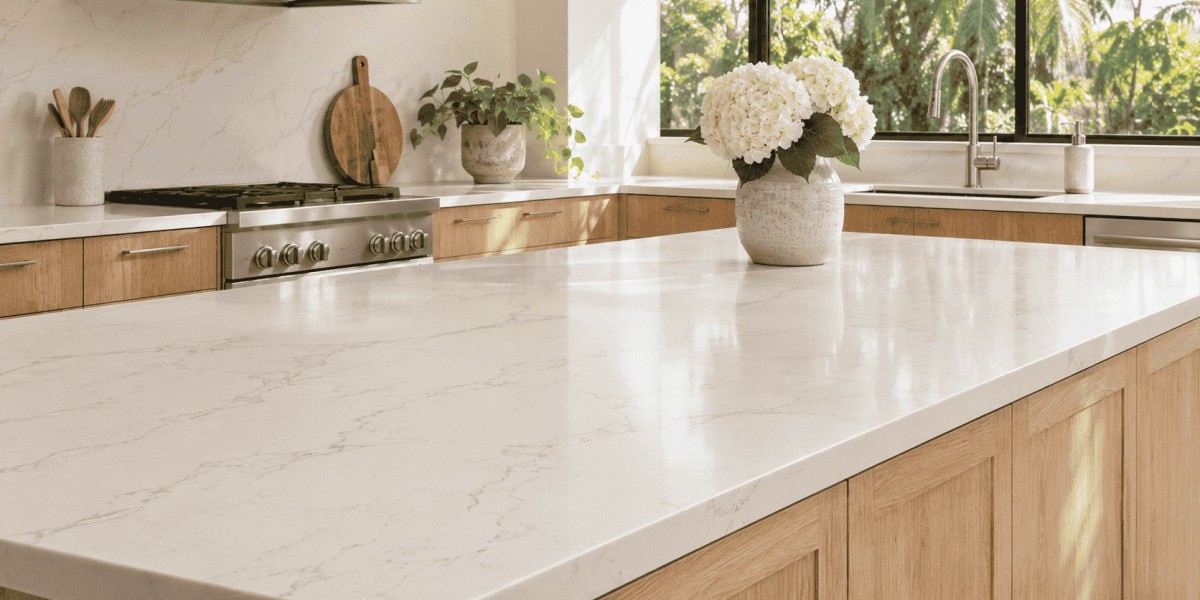

You chose a quartz sample for its quiet gray veining. At the slab viewing, you notice the gray is concentrated in one sweeping line, with long stretches of white on either side. You still like the design, but now there’s a decision the sample couldn’t help you make: where should that line go? If you’re ordering quartz countertops for a Tampa Bay kitchen, ask whether you can review the slabs and the proposed layout before cutting. It’s your chance to see how the material you chose will look in the pieces you’ll actually use.
Make Sure You’re Looking at the Slab for Your Job
Start by asking whether you’re seeing a display slab or the material set aside for your kitchen. A display is useful if you’re still deciding on a design. Once you’re ready to approve a layout, though, you want to know which slab the fabricator intends to cut. If your project needs more than one, ask to see each of them or get a photo of each one.
Compare the product name, color, and finish on the label with what’s listed on your order. If the names are similar or something looks different from the sample you brought home, ask about it while you’re both looking at the material. It’s easier to sort out a finish or color mix-up before anyone starts marking cuts.
Keep a photo of the label and a full view of each slab if the showroom allows it. If you review a layout by email later, you can refer to a specific slab and point out the area you mean. That’s clearer than trying to describe “the one with the gray line near the top.”
Step Back Before You Look Closely
Your first instinct might be to walk right up to the slab to check the color. Take a few steps back first. Notice where your eye goes. Does the pattern run diagonally? Is one end busier than the other? Are there quiet stretches you’d like to use somewhere small, such as the counter beside the fridge?
Then look closer at the sections you’re likely to use. Something that reads as a gray vein from across the room may have a warmer brown edge up close. You might love that detail with your cabinet finish or decide you’d rather keep it away from a backsplash you’ve already chosen. Bring a cabinet or tile sample if you can. Even if the lighting differs from your kitchen, you’ll be able to see those materials together.
If you notice a mark you weren’t expecting, point to it and ask the fabricator what they see. Find out whether it’s part of the design and whether that area is included in the proposed cut. You don’t have to decide whether it’s a problem until you know where it would end up.
Give the Island and Sink Run Different Jobs
Think about which parts of the kitchen should show the pattern. A long vein can look striking across an open island, where you’ll see it from the stools and the next room. A narrow run between the refrigerator and the range might look better with a quieter piece. Start by telling the fabricator which surface matters most to you visually.
Then look at how the sink and cooktop openings affect the view. If your favorite detail falls inside the sink cutout, you won’t see it on the finished counter. You might still see part of it behind the faucet or on the strip in front of the bowl, which can be a different effect from the one you pictured. Ask the fabricator to show where those openings land in relation to the pattern.
If the fabricator can share a marked photo or a layout drawing, check which edge faces the room. The slab may be standing upright when you see it, and a piece can look quite different once you picture it lying flat with the main vein running toward the window or along the length of the island.
Look at the Pieces Where They’ll Meet
If two sections join at a seam, review the areas on both sides together. Looking at them separately won’t tell you how the patterns will meet. You may be comfortable with a visible change in direction around a corner but prefer a quieter transition across a long, straight counter. Tell the fabricator which view you care about, such as the one from the dining table or the kitchen entrance.
Ask to see the proposed arrangement rather than assuming the veins can line up the way you want. The fabricator may need to explain how the available material, the shape of the pieces, and the fixture openings affect the options. If shifting the layout would use a different part of the slab, ask what that would change elsewhere in the kitchen. Moving a vein away from a seam might also move it off the part of the island where you wanted it.
Review the Edges You’ll See Every Day
Look at the front edge of the island, the end beside the hallway, and any vertical panel you’ve ordered. Ask the fabricator to show which parts of the slab will be visible in those places. That’s particularly useful if you’re choosing the design for one strong vein and expect to see it as you approach the kitchen. You may see that detail clearly on the top but barely notice it from the side.
Stand where you’ll usually be when you look at the counter. A person sitting at the island sees a different part of the surface from someone walking in through the garage. If you’re deciding between two arrangements, think about which one looks better from the view you’ll have most often. That can make the choice easier than comparing two drawings from above.
Confirm the Layout You Want to Approve
Before the material is cut, ask which version of the plan the fabricator will use. Make sure it shows the changes you discussed, whether that’s moving the island piece, using a quieter part near the sink, or leaving a distinctive vein where you can see it from the dining room. If you have a question about an area, mark it on the drawing or photo so you’re both looking at the same thing.
You don’t need to choose the placement of every line in the pattern. Pick the few details you’d miss if they landed somewhere else, then check those against the final layout. The sample helped you choose a surface you liked. The slab review helps you put the parts you like most where you’ll get to see them.