
A filling machine is rated in bottles per hour. A reverse osmosis plant is rated in cubic meters per hour. These are not two ways of saying the same thing, and the mistake of treating them as interchangeable has a predictable outcome: a water treatment plant that is the wrong size for the line behind it.
The error is easy to make because both numbers are printed on the same project sheet. "A water treatment plant should never be sized by reading a filling machine's BPH figure" sounds obvious once stated — what is less obvious is how far apart the two figures actually land, and which way the error runs.
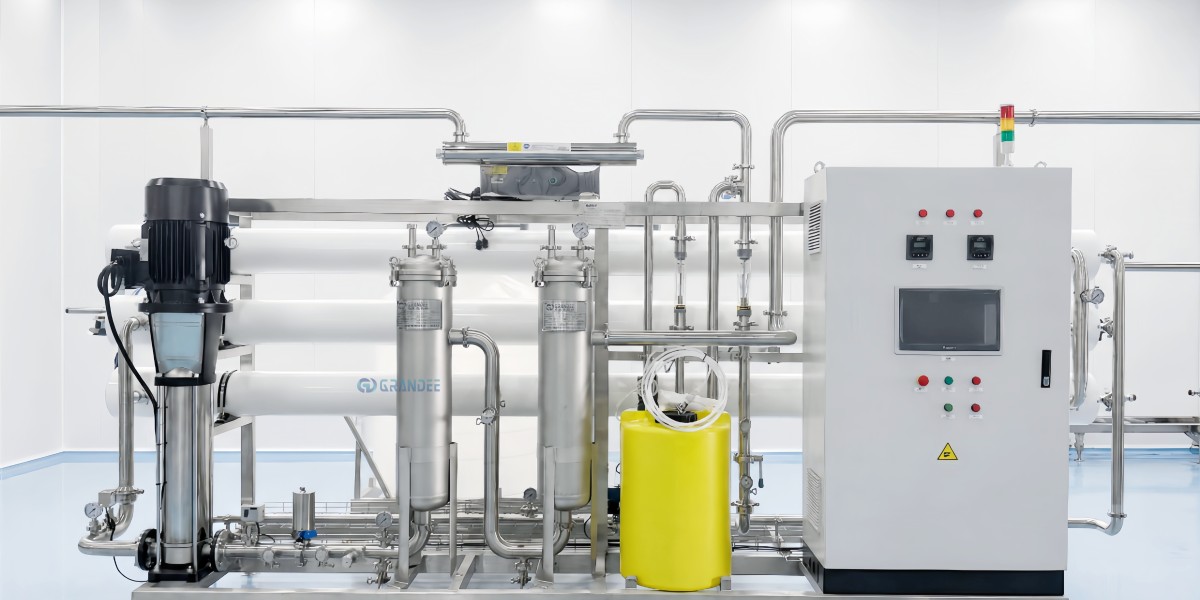
Zhangjiagang Grandee Machinery Co., Ltd., which sells under the Grandee Machine brand, supplies water treatment plants as part of a complete water line rather than as a separate purchase. This article works through the conversion with the numbers from one of those plants — the SH-RO-12, rated 12 m³/h at 70 percent recovery — because the arithmetic is where the sizing decision is actually made.
Why a Bottle Count Cannot Size a Water Plant
BPH counts containers. It does not measure liquid. A filling machine rated at 6,000 BPH moves 6,000 bottles through rinse, fill and cap in an hour, and that figure is genuinely what you need to size the capper, the conveyor and the labeler. It tells you nothing about the mass of water that has to be treated, because the bottle it counts could hold 500 ml or 20 L.
A water treatment plant, by contrast, is a continuous-flow device. Its output is a volumetric rate, and its internal components — membranes, pump, pressure vessel — are selected against that rate. One number counts objects and the other measures flow; there is no factor that converts them without the bottle volume.
The second part of the problem is that process water demand is larger than product water demand. Rinsing, CIP cycles and make-up all draw from the same treated stream, so the plant is never sized on the filled volume alone. That gap has to be quantified, not estimated — and it belongs in the water balance before a model is chosen.
The Conversion: Bottles per Hour × Liters ÷ 1,000
The bridge between the two units is one multiplication. Take the filling rate, multiply by the net fill volume in liters, divide by 1,000, and the answer is cubic meters per hour of product water.
That is the whole method. What makes it worth writing down is what happens when you run it across a real product range, because the results are not in the order most buyers expect.
Six Formats, Six Water Demands
Every filling rate below sits inside the published range for the machine type: the 3-in-1 bottled water filler covers 2,000–32,000 BPH at a 500 ml basis, the big-bottle line covers 3–20 L at 500–4,000 BPH, and the 5-gallon barrel line covers 18.9–20 L at 150–1,500 BPH. The right-hand column is the product water each one needs.
Bottle format | Filling rate | Product water required |
500 ml PET | 2,000 BPH | 1.0 m³/h |
500 ml PET | 6,000 BPH | 3.0 m³/h |
500 ml PET | 32,000 BPH | 16.0 m³/h |
3 L | 4,000 BPH | 12.0 m³/h |
18.9 L barrel | 900 BPH | 17.0 m³/h |
20 L | 4,000 BPH | 80.0 m³/h |
Read the third and fifth rows together. A 32,000 BPH small-bottle line and a 900 BPH 5-gallon line land within 1 m³/h of each other — 16.0 against 17.0. The 5-gallon line counts one thirty-fifth as many containers and needs slightly more water, because an 18.9 L barrel holds almost 38 times what a 500 ml bottle does.
This is the direction of the error that catches people. A buyer who reads BPH as a proxy for water demand will under-size the plant on a barrel line and over-size it on a small-bottle line. The BPH figure is not merely imprecise for this purpose — it is misleading in the opposite direction to most buyers' intuition.
The Number on the RO Is Permeate, Not Feed Water
Here is the second place the arithmetic goes wrong, and it is inside the water plant rather than between the two units. A reverse osmosis system's model number states its permeate output — the treated water that comes out of the membrane. It does not state how much water you have to feed it.
The SH-RO-12 is rated 12 m³/h at 70 percent recovery, over a feed temperature of 16–30 °C and an operating pressure of 0.8–1.5 MPa. Read those two figures together:
At 70 percent recovery, 12 m³/h of permeate requires about 17 m³/h of feed water, and about 5 m³/h leaves as concentrate. The recovery figure is the divider: output divided by recovery gives input, and the remainder is what goes to drain.
Two consequences follow, and both are construction decisions rather than equipment decisions. The source water — a well, a municipal connection, a storage tank and the pre-treatment ahead of the membranes — has to supply 17 m³/h, not 12. And the plant room needs a drain that carries 5 m³/h of concentrate continuously, because that stream runs whenever the RO runs.
The high-pressure pump on the same skid is rated 20 m³/h at a 146 m head, in 304 stainless steel, drawing 15 kW. That is the feed side, and the margin over 17 m³/h is the part of the rating that absorbs pressure loss through pre-treatment and the elements as they age — which is the reason the pump figure and the permeate figure are not meant to match.
Capacity Is a Count of Elements, Not a Dial
The membrane on the same system is a BW30-400: 99.6 percent rejection, 1.0 m³/h of permeate per element, aromatic polyamide construction. A 12 m³/h plant is a stack of elements at that rating, which is why a membrane plant's capacity steps in whole elements rather than sliding continuously.
That has a practical meaning at the specification stage. If your water balance comes out at 13 m³/h, you do not get a 13 m³/h plant by asking politely; you move to the next configuration up, or you accept a plant that runs its elements slightly harder than the rating. Ask which of those two the quotation is doing, because the second option changes how often the membranes get replaced.
The Skid, Component by Component
Component | Model | Key specifications |
Reverse osmosis system | SH-RO-12 | 12 m³/h · 70% recovery · 16–30 °C · 0.8–1.5 MPa |
RO high-pressure pump | CDLF20-12 | 15 kW · 20 m³/h · head 146 m · 304 stainless steel |
Membrane element | BW30-400 | 99.6% rejection · 1.0 m³/h permeate · aromatic polyamide |
Three rows, three numbers, and none of them is the plant's capacity on its own. The RO states its permeate; the pump states what it can push into the membranes; an element states what it can pass. A plant's capacity is its narrowest component, not its nameplate — and the narrowest component is often a stage the model number does not mention: a stainless contact or storage unit downstream, a transfer pump, or the drain itself.
So the question to put to a supplier is not only "how many cubic meters per hour is the RO" but "what is the flow rate of every stage between the raw water inlet and the filler, and which one is the lowest". A skid whose headline unit reads 12 m³/h can still deliver less if a downstream stage is rated below it, and the purchase order is the wrong place to discover that.
Temperature: The Window the Rating Depends On
The 12 m³/h figure is quoted over a feed temperature of 16–30 °C, and that qualifier is part of the rating rather than a footnote. Membrane flux depends on how easily water passes the membrane, and that changes with temperature — which is why the window is printed at all.
For a plant in a temperate climate drawing from a surface source, winter feed water can arrive well below 16 °C. The question to ask is not "what is the output" but "what is the output at my coldest feed temperature" — and if the answer is a different number, that is the number to size the filling line against.
Ozone: Two Generators That Have to Match
The same plant carries ozone equipment, and the pairing is the part that gets overlooked. The oxygen generator and the ozone generator are specified as a set, because one feeds the other.
Parameter | Oxygen generator OW-10TB | Ozone generator SOZ-YB-32G |
Output | 8 L/min, 90% ± 5 purity | 32 g/h ozone |
Gas feed | Requires air at dew point ≤ −40 °C | Oxygen 8–10 L/min, or air 30–40 L/min |
Ozone concentration | — | 50–60 g/m³ on oxygen; 8–15 g/m³ on air |
Power | 60 W, 220 V / 50 Hz | 380 W, 220 V / 50 Hz |
The oxygen generator's 8 L/min output is the same 8–10 L/min the ozone generator wants as oxygen feed, which is what makes them a matched pair. Feed the ozone generator on air instead and the concentration drops from 50–60 g/m³ to 8–15 g/m³ for the same 32 g/h, so the gas volume has to rise from 8–10 L/min to 30–40 L/min. Same ozone output, roughly four times the feed gas.
Two details fall out of that table and both are site requirements. The oxygen generator needs compressed air at a dew point of −40 °C or below, which means a dryer upstream that is not on the equipment list. And on oxygen feed the oxygen generator has to run whenever ozone is being produced — the ozone unit has no independent supply of its own.
What This Table Does Not Tell You
A component table is a list of what the plant does, not a description of the project. These are the items a water balance has to settle before a model is chosen, and none of them appear above:
Feed water analysis. Hardness, TDS, iron, manganese, chlorine and silica decide the pre-treatment ahead of the membranes — softener, carbon filter, antiscalant dosing, or none of them. The RO rating is meaningless without the water it is being asked to treat.
Rinse and CIP demand. Automatic CIP is standard line capability, and it draws from the same treated stream. How much of the 12 m³/h remains available while a CIP cycle runs is a real figure that belongs in the quotation, not an assumption.
Permeate storage. A tank between the RO and the filler decouples the two, which matters because the filler draws in bursts and the RO prefers to run steadily. Tank volume is not on the component table.
Concentrate disposal. The 5 m³/h of reject water has to go somewhere lawful — drain, recovery, or irrigation. This is a permit question as much as a plumbing one.
Electrical and air supply. A 15 kW high-pressure pump, a 380 W ozone generator and a 60 W oxygen generator on the same skid, plus instrument air for the oxygen generator. Starting current and cable sizing are the plant's to provide.
Four Steps to a Number You Can Buy Against
The whole method fits in four lines, and each one needs a figure that only the buyer can supply:
1. Product water. Filling rate × net fill in liters ÷ 1,000. This is the number the filling line actually consumes.
2. Process water. Add rinse, CIP and make-up to the product water figure. Ask the line supplier for the consumption of the CIP cycle at your line size — it is a schedule, not a constant.
3. Feed water. Divide the process water figure by the recovery rate. This is what the source, the pre-treatment and the drain have to handle.
4. The model. Choose above the process water figure, then check that no component on the skid is rated lower than the headline unit. The smallest number wins.
Run in that order, the two units stop competing. BPH sets the filling rate; liters per bottle converts it to volume; recovery converts volume to feed; the water balance adds what the line does not drink.
Turnkey Scope, and Where It Stops
Grandee Machine supplies the water treatment plant as one stage of a turnkey project: water treatment, bottle blowing where the format requires it, 3-in-1 filling, capping and end-of-line packaging, with bottle design, factory layout including paperless 3D factory design, installation, commissioning and operator training under one contract. Sizing water treatment inside that scope is what allows the m³/h figure and the BPH figure to be reconciled by one engineering team instead of two suppliers who never compare notes.
Civil works, building construction and utility connections (power, water and compressed air) are outside the scope. On a water plant that boundary is unusually concrete: the plant room floor, the drain that takes 5 m³/h of concentrate, the raw water supply that delivers 17 m³/h, and the compressed-air dryer that gives the oxygen generator its −40 °C dew point all belong to the building, not to the skid.
FAQ
Can I size a water treatment plant from my filling machine's BPH?
No — but you can get most of the way there with one extra input. BPH × net fill in liters ÷ 1,000 gives product water in m³/h. What BPH alone cannot tell you is the bottle volume, and that is the factor that decides everything: the same 4,000 BPH is 12 m³/h at 3 L and 80 m³/h at 20 L.
What does 70 percent recovery mean in practice?
Of every 100 liters fed to the membranes, 70 liters come out as permeate and 30 liters leave as concentrate. So a plant rated 12 m³/h of permeate needs about 17 m³/h of feed and sends about 5 m³/h to drain. Both of those figures are larger than the number in the model name, and both are construction requirements.
Is a 12 m³/h plant enough for a 6,000 BPH line?
The filling line itself consumes 3 m³/h at 500 ml. Whether 12 m³/h is the right size depends on what else draws from the plant — rinse water, CIP cycles and make-up — and on whether more lines are planned on the same skid. Ask for the water balance for the whole factory, not for the filling machine alone.
Why does a slower barrel line need more water than a faster bottle line?
Because bottle count is not volume. 900 barrels of 18.9 L per hour is about 17 m³/h of product water; 32,000 bottles of 500 ml per hour is 16 m³/h. The barrel line fills 35 times fewer containers and draws slightly more water. Any sizing method that starts from a container count will get this case wrong by a wide margin.
Does the ozone generator need its own oxygen supply?
It draws 8–10 L/min of oxygen, which is exactly what the OW-10TB oxygen generator produces at 90 percent purity — that is why the two are quoted together. On air feed the same 32 g/h needs 30–40 L/min, because the achievable concentration falls to 8–15 g/m³. Either way the ozone unit has no independent gas supply of its own.
What if my feed water is colder than 16 °C?
Then the rated output is not the output you will see, because the 12 m³/h figure is quoted over a 16–30 °C feed window. Ask for the capacity at your coldest month's water temperature before the filling line is sized against it — the answer may change the model rather than just the schedule.
About Grandee Machine
Zhangjiagang Grandee Machinery Co., Ltd. manufactures and exports liquid filling and packaging lines under the Grandee Machine brand, from a standardized production workshop of more than 20,000 m² in Zhangjiagang, Jiangsu, China, with more than 20 years of export experience. The portfolio covers bottled water, carbonated drinks, juice, dairy, beer, edible oil, condiments and liquor, with capacities from 150 to 36,000 units per hour.
Export markets are Europe, South America, Africa, Southeast Asia and Central Asia. Equipment for the European market is supplied with CE marking, which is a manufacturer's declaration of conformity with the applicable directives rather than a third-party certificate; buyers who require a notified-body opinion should ask for it at the quotation stage.
Water treatment sits inside that range as the first stage of a complete water line rather than as a separate purchase — which is the arrangement that lets one team reconcile the plant's m³/h with the filler's BPH.
Next Step
Four figures size the plant: the bottle formats and net fills you will run, the filling rate you need for each, your feed water analysis including temperature for the coldest month, and how many times a day the line runs CIP. Send them through the inquiry form on this page and ask for the answer in m³/h at the plant outlet — then check it against the smallest component on the skid.
Related Reading
· Bottled water filling machines