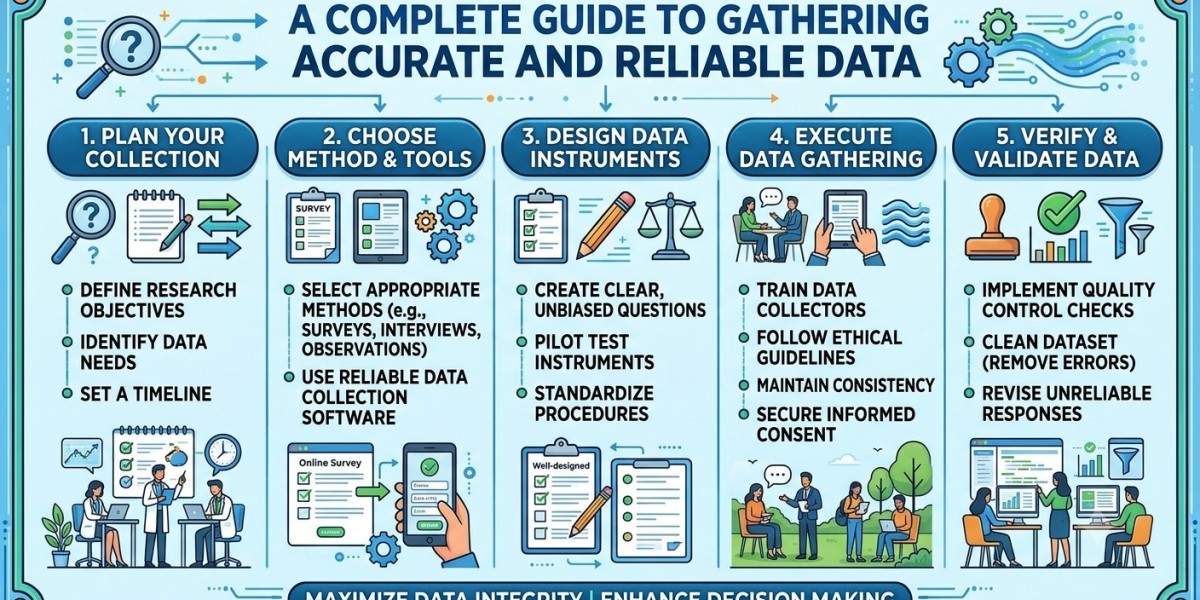

In the contemporary data-focused world, organizations use accurate information to make better business decisions. From analyzing consumer behavior to studying market trends, to improving operations of their business – all require proper information. And here comes data collection methods which assist in organizing and analyzing the information.
Using the right data collection method will enhance the accuracy of information gathered, save time and also make sure that the information collected serves its intended purpose.
What Are Data Collection Methods?
Data collection methods are the processes used to collect information from various sources. They assist researchers or business entities to collect relevant information in the form of facts, opinions, statistics or anything else that can be considered useful.
The data collection process will depend on several factors including the aim of the research, resources available, target audience and nature of the information needed. In general, there are two types of data collection.
1. Primary Data Gathering Methods
Primary data gathering includes obtaining original information from its source. The information obtained here is done with a certain purpose in mind.
The following are some common methods of primary data gathering:
Survey/questionnaire: Here, people are surveyed via structured questions in order to obtain information about their views.
Interviews: It involves talking to the respondent to collect detailed information.
Observations: This involves collecting data on the subject being watched.
Focus groups: This involves putting together a group of people and discussing certain topics.
Experiments: This is done in order to test the relationship between different variables.
They can be used especially when organizations want to collect original and first-hand information.
2. Secondary Data Gathering Methods
Secondary data gathering involves the use of information that has already been collected by other individuals, researchers, or organizations. This is an effective method since there is no need to conduct any further research.
Some sources where secondary data can be found include:
Government publications and public databases
Research journals and other academic publications
Industrial reports and market research studies
Business records and documents
Statistical information online
Selection of Appropriate Method for Data Collection
The selection of a proper method is based on your objectives and needs. Some essential considerations in this regard are:
Set your objectives: Determine what information you require and why do you require it.
Determine your sources of data: Determine whether primary or secondary data would be more suitable for you.
Think of your budget: Determine which method is best suited to your budget.
Assess the accuracy of data: Make sure that data is relevant, valid and updated.
Ensure data security: Secure any confidential data.
Using multiple methods and approaches in data collection will help understand the subject matter better.
Significance of Proper Data Collection
Proper data collection helps in making sound decisions and minimizes the chances of drawing wrong conclusions. Companies may make use of the data collected to learn the needs of their customers, to improve their services, for monitoring purposes, and also to discover new areas of business.
But the use of poor-quality data may give misleading results. Hence, data validation, documentation, proper collection procedures, and good data management should be given priority by firms.
Conclusion
Knowing various data collection techniques is very significant as it will help firms and researchers collect valuable data to make good decisions. Different techniques are used for different purposes.
In this way, with correct data gathering, validation, and management, organizations may transform raw data into valuable business information.