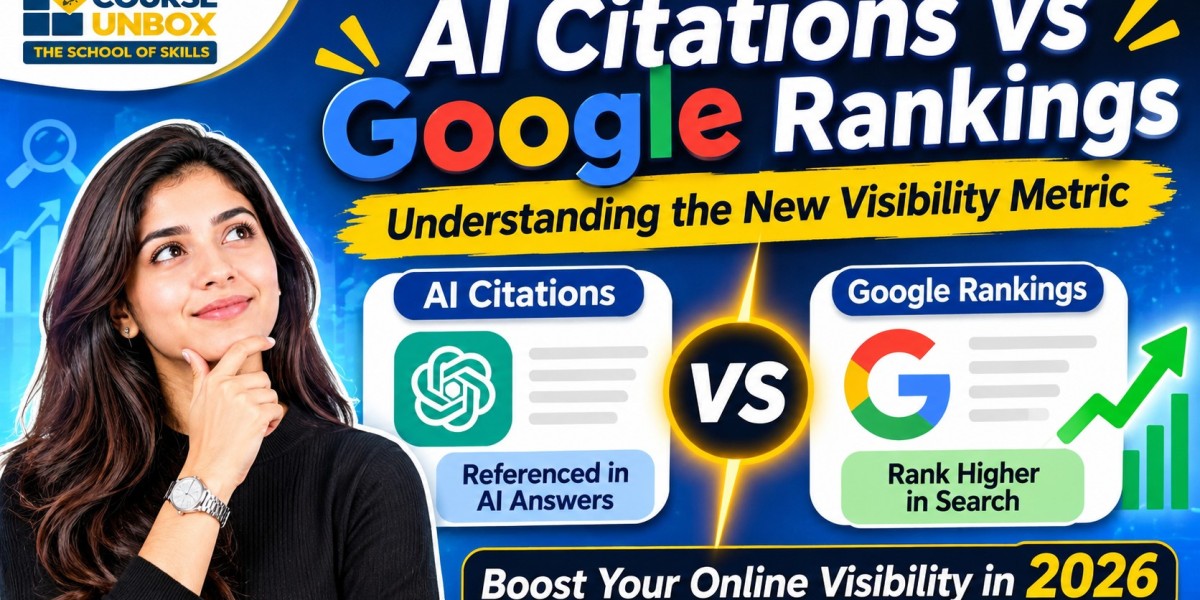

AI citations and Google rankings are becoming two important factors in determining how visible a website is online. Traditional Google rankings measure how high a webpage appears in search engine results, while AI citations measure how frequently and accurately a website is referenced as a source in AI-generated answers. With platforms such as Google AI Overviews, ChatGPT, Perplexity, and other generative search tools changing how people discover information, businesses can no longer depend entirely on traditional keyword rankings to measure their online visibility. A website might rank on the first page of Google but receive very few AI citations, while another website with lower traditional rankings might become a trusted source in AI-generated responses. Understanding the difference between these two visibility metrics is essential for businesses, marketers, SEO professionals, and content creators planning their digital marketing strategies for the future.
Understanding Traditional Google Rankings
Google rankings refer to the position a webpage occupies in Google's organic search results for a particular search query. For example, when someone searches for a digital marketing course, Google evaluates numerous factors to determine which pages should appear at the top of the results.
Traditional SEO focuses on improving these positions through relevant content, keyword optimization, website performance, backlinks, internal linking, user experience, and search intent satisfaction.
Higher Google rankings can increase organic impressions, website clicks, and potential conversions. However, ranking in the first position does not automatically guarantee that every searcher will visit the website.
Search features such as featured snippets, knowledge panels, advertisements, and AI Overviews can influence how users interact with traditional search results. This means that organic ranking positions remain important, but they do not represent the complete picture of search visibility.
Understanding AI Citations in Modern Search
AI citations refer to references or source links that AI-powered search experiences provide when generating answers to user questions. Instead of displaying only a list of webpages, generative search systems can combine information from multiple sources and present a summarized response.
For example, a user searching for the best digital marketing strategies for small businesses may receive an AI-generated explanation containing recommendations supported by links to relevant websites.
When an AI platform references a website while generating its response, that website receives an opportunity to build visibility and credibility even if the user does not click through immediately.
AI citations are particularly important because users are increasingly asking conversational and detailed questions rather than searching only with short keywords. Search visibility is therefore expanding beyond traditional rankings to include how effectively a website contributes to AI-generated answers.
AI Citations vs Google Rankings: Key Differences
Although AI citations and Google rankings are connected, they measure different aspects of online visibility.
Google rankings primarily measure the position of a webpage in organic search results. AI citations measure whether a source is selected and referenced within an AI-generated response.
Another important difference is consistency. Google rankings can be monitored for specific keywords and locations, although positions may change depending on competition, search context, and personalization. AI citations can vary depending on the wording of a question, the AI platform, available sources, and the context of the generated answer.
Google SEO generally focuses on helping search engines discover, understand, and rank relevant webpages. AI visibility also requires content that is easy to understand, factually reliable, well-organized, and useful for answering specific questions.
Neither metric completely replaces the other. Both contribute to a broader understanding of how potential customers discover brands online.
Why AI Citations Are Becoming an Important Visibility Metric
The growth of generative search is changing how users research products, services, educational programs, and business solutions. Instead of visiting several websites to compare information, users may receive an initial summary directly from an AI-powered platform.
This development creates a new visibility opportunity for businesses. When an AI system references a website, the brand can become part of the user's research process before they visit a traditional search result.
AI citations can also help businesses demonstrate subject-matter expertise. Websites that consistently publish accurate, relevant, and comprehensive information have more opportunities to become useful sources for AI-generated answers.
However, receiving an AI citation does not automatically guarantee traffic, leads, or sales. Marketers should evaluate citations alongside referral traffic, brand mentions, conversions, and traditional organic performance.
How Google Rankings and AI Citations Work Together
Google rankings and AI citations should be treated as complementary visibility indicators rather than competing marketing objectives.
Strong traditional SEO provides a foundation through crawlable pages, clear website architecture, relevant content, and authoritative information. These elements can also help search systems understand a website's subject matter.
At the same time, AI visibility requires content that directly addresses user questions, explains complex topics clearly, and supports important claims with reliable information.
For example, an educational website publishing a detailed guide about SEO may attract organic search traffic while also becoming a potential source for AI-generated explanations about search engine optimization.
Businesses should therefore build an integrated strategy that improves traditional search performance while making their content useful for generative search experiences.
The Role of SEO Skills in Improving AI and Search Visibility
Understanding search engine optimization is still essential for marketers who want to improve website visibility. Keyword research, search intent, technical SEO, content optimization, and link-building fundamentals provide the foundation for developing effective search strategies.
Professionals who want to develop these capabilities can explore an SEO Course Online to understand how search engines evaluate websites and how organic visibility can be improved through structured optimization techniques.
The Growing Importance of Artificial Intelligence in Digital Marketing
Artificial intelligence is influencing content research, customer analysis, keyword discovery, campaign planning, and marketing automation. Digital marketers increasingly need to understand how AI tools can support their existing marketing activities.
Learning how to combine AI technologies with traditional marketing methods can help professionals develop more efficient workflows and adapt to changing search behaviour.
An AI Digital Marketing Course Online can help learners understand the practical applications of AI in digital marketing, including content workflows, campaign optimization, and emerging search strategies.
AI Digital Marketing Course in Noida for Modern Marketing Skills
Noida has become an important location for students and working professionals interested in developing digital marketing skills. As AI-powered search and marketing technologies continue to evolve, understanding both SEO fundamentals and AI applications can help learners prepare for changing industry requirements.
Those interested in developing these skills locally can explore an AI Digital Marketing Course in Noida to learn about AI-driven marketing concepts and their practical applications.
AI Digital Marketing Course in Delhi for Industry-Relevant Learning
Delhi offers learning opportunities for students, graduates, entrepreneurs, and working professionals interested in digital marketing. Understanding AI-assisted marketing, search optimization, and online customer acquisition can help learners develop skills relevant to modern businesses.
An AI Digital Marketing Course in Delhi is a relevant option for individuals looking to understand the connection between artificial intelligence and digital marketing practices.
AI Digital Marketing Course in Ghaziabad for Career Development
Businesses increasingly use digital channels to attract customers, communicate with audiences, and improve their online presence. This creates opportunities for professionals who understand SEO, paid advertising, social media, and AI-assisted marketing.
Learners interested in developing these capabilities can explore an AI Digital Marketing Course in Ghaziabad to understand modern marketing techniques and emerging industry tools.
AI Digital Marketing Course in Greater Noida for Future-Ready Skills
Greater Noida has a growing student and professional community interested in technology-driven career opportunities. Digital marketing is an evolving field where knowledge of search engines, content strategies, AI applications, and performance measurement can support professional development.
An AI Digital Marketing Course in Greater Noida can help interested learners explore the practical relationship between artificial intelligence and online marketing.
Content Creation and Its Impact on AI Citations
Content quality plays an important role in both traditional search visibility and AI-generated responses. Websites need informative content that explains topics accurately and provides meaningful answers to user queries.
Content creation involves more than writing articles. It includes developing educational resources, social media content, videos, visual explanations, and other formats that communicate information effectively.
Professionals interested in improving their creative and communication skills can explore a content creation course online to understand different content formats and approaches to digital content development.
Performance Marketing and Search Visibility Measurement
AI citations can increase brand exposure, but businesses also need to understand whether their digital marketing activities generate measurable business outcomes. This is where performance marketing becomes relevant.
Performance marketing focuses on measurable results such as leads, clicks, conversions, customer acquisition, and campaign return on investment. It helps businesses evaluate how effectively their marketing budgets contribute to business objectives.
Those interested in learning about data-driven advertising and campaign measurement can explore a performance marketing course online.
Technical Knowledge and the Future of Digital Platforms
Search visibility also depends on the technical quality of digital platforms. Website speed, accessibility, security, structured data, and proper website architecture can influence how effectively information is delivered and discovered.
As businesses become more dependent on digital platforms, technical knowledge can provide additional career opportunities for individuals interested in website development and technology.
A full stack development course online can introduce learners to frontend and backend development concepts that support modern web applications.
Website Security and Trust in the Digital Environment
Trust is an important consideration when users interact with online platforms. Businesses must protect their websites, customer information, and digital infrastructure against potential security threats.
Although cybersecurity is not a direct guarantee of better Google rankings or AI citations, maintaining a secure website is an important part of building a reliable digital presence.
Individuals interested in understanding digital security concepts can explore a cybersecurity course online to learn about security practices and the protection of digital systems.
Exploring Digital Marketing Courses in Gurgaon
Digital marketing education includes several specializations, such as search engine optimization, social media marketing, paid advertising, content marketing, and AI-powered marketing.
Choosing a suitable program requires evaluating the curriculum, practical training, learning objectives, and career relevance rather than relying only on promotional claims.
Readers comparing available learning options can refer to the guide on the top 10 digital marketing courses in Gurgaon to explore different educational options.
Understanding Digital Marketing Course Fees in Noida
The cost of digital marketing education can vary depending on the course duration, curriculum, practical training, learning format, and additional resources included in the program.
Before selecting a course, learners should compare what is covered in the curriculum and whether the training matches their professional goals.
For a better understanding of the available pricing information, readers can explore this guide on digital marketing course fees in Noida.
Digital Marketing Learning Opportunities in Indirapuram
Digital marketing skills are relevant for business owners, students, freelancers, and professionals interested in online customer acquisition and brand development.
Understanding SEO, content strategy, paid campaigns, and AI-powered marketing can help learners explore different career and business opportunities.
Individuals researching local learning opportunities can visit the guide to a Digital Marketing Course in Indirapuram.
SEO Course in Greater Noida for Search Optimization Skills
Search engine optimization requires an understanding of technical website structure, keyword research, on-page optimization, content development, and off-page strategies.
These skills remain relevant as search engines and AI-powered discovery platforms continue to evolve. Learning how traditional SEO works can provide a foundation for understanding broader search visibility.
Learners interested in developing these skills can explore an SEO Course in Greater Noida.
Digital Marketing Education and Institute Selection in Haldwani
Selecting a digital marketing institute requires understanding the available learning modules, practical exposure, course structure, and relevance to current industry requirements.
Students should evaluate whether a program covers important areas such as SEO, social media, paid advertising, analytics, and emerging AI technologies.
Those researching local educational options can refer to this resource on the Top Digital Marketing Institute in Haldwani.
Digital Marketing Course in Laxmi Nagar for Skill Development
Laxmi Nagar is a well-known educational area in Delhi, attracting students interested in different professional and technical learning programs.
Digital marketing offers opportunities to develop practical skills in search engine optimization, social media management, online advertising, and content strategy.
People exploring training options in this area can learn more about a Digital Marketing Course in Laxmi Nagar.
SEO Course in Noida for Understanding Search Visibility
SEO professionals need to understand how search engines discover, index, and rank website content. They must also evaluate keyword performance, organic traffic, technical issues, and content relevance.
As AI-powered search experiences become more prominent, these foundational skills can help professionals adapt their strategies to changing methods of online information discovery.
An SEO Course in Noida can be explored by learners interested in developing practical search engine optimization knowledge.
SEO Course in Delhi for Developing Search Marketing Expertise
Businesses operating in competitive markets need effective SEO strategies to improve their online visibility and reach relevant audiences.
Learning SEO involves understanding search intent, website optimization, keyword targeting, content quality, and performance analysis. These concepts are important for both traditional search rankings and broader digital discovery.
Individuals looking to develop their search marketing skills can explore an SEO Course in Delhi.
SEO Course in Ghaziabad for Practical SEO Knowledge
SEO is a valuable digital marketing skill for professionals working with websites, online businesses, agencies, and content platforms.
A strong understanding of technical SEO, on-page optimization, keyword research, and analytics can help learners understand how websites compete for organic visibility.
Those interested in learning search engine optimization can explore an SEO Course in Ghaziabad.
Content Creation Course in Delhi for Modern Digital Communication
Content plays an important role in communicating brand expertise and answering audience questions. Businesses need useful and engaging content across websites, blogs, videos, and social media platforms.
Learning content planning, storytelling, writing, and creative production can help individuals develop skills relevant to modern digital communication.
Learners interested in developing these capabilities can explore a Content Creation Course in Delhi.
How to Measure AI Citations and Traditional Search Performance
Measuring AI visibility requires a broader approach than simply tracking keyword positions. Businesses should monitor how often their websites appear as cited sources across relevant AI platforms and compare this information with traditional organic search performance.
Google Search Console remains useful for monitoring website clicks, impressions, average positions, and search queries. Google Analytics can help identify referral traffic and user engagement from available traffic sources.
For AI visibility, marketers can maintain a structured list of relevant questions and periodically evaluate whether their websites are cited in responses from different AI platforms. They should record the source URLs, cited pages, brand mentions, and changes over time.
There is currently no single universal AI citation metric or standardized reporting method covering every AI platform. Results should therefore be interpreted carefully, with attention to platform differences and variations in generated responses.
Best Practices for Improving AI Citations and Google Rankings
Create Helpful and Informative Content
Content should focus on solving actual user problems rather than repeating keywords. Detailed explanations, relevant examples, and accurate information make articles more useful for readers.
Organize Content With Clear Headings
A logical H1, H2, and H3 structure helps readers understand the relationship between different sections. Descriptive headings also make it easier to identify the information covered on a webpage.
Demonstrate Experience and Expertise
Businesses should provide accurate author information, relevant experience, supporting evidence, and reliable references wherever appropriate. Content should demonstrate genuine subject knowledge rather than simply making unsupported claims.
Improve Technical SEO
Website speed, mobile usability, crawlability, indexability, internal linking, and structured data contribute to a technically sound website. Structured data should accurately describe visible page content and follow relevant search engine guidelines.
Build Relevant Topical Authority
Publishing interconnected articles around a specific subject can help establish comprehensive website coverage. Instead of publishing unrelated articles, businesses should develop content clusters that answer different aspects of their target audience's questions.
Keep Content Updated
Information that changes frequently should be reviewed and updated. Businesses should correct outdated statistics, broken links, inaccurate explanations, and irrelevant recommendations to maintain content quality.
The Future of Search Visibility Beyond Traditional Rankings
Search visibility is moving towards a more comprehensive model in which traditional organic rankings, AI citations, brand mentions, and referral traffic all provide useful information about digital performance.
Businesses that focus exclusively on keyword positions may overlook opportunities to become recognized sources in AI-powered search experiences. Similarly, focusing only on AI citations without monitoring website traffic and conversions can create an incomplete picture of marketing performance.
The most effective approach is to combine traditional SEO with useful content development, technical optimization, brand building, and consistent performance measurement.
Google rankings continue to matter because they help websites attract organic visitors. AI citations introduce another opportunity for brands to become visible within AI-generated answers. Together, these metrics provide a broader understanding of how users discover and interact with online information.
Frequently Asked Questions (FAQs)
1. What is the difference between AI citations and Google rankings?
Google rankings measure the position of a webpage in organic search results, whereas AI citations measure whether an AI-generated response references a website as a source. Both indicate different aspects of online visibility.
2. Why are AI citations important for SEO?
AI citations can help businesses gain visibility within AI-generated answers, establish brand recognition, and reach users researching specific topics. They provide an additional visibility indicator alongside traditional organic rankings.
3. Do AI citations improve Google rankings?
An AI citation does not directly guarantee improved Google rankings. Google rankings depend on Google's own ranking systems and signals. However, high-quality content and strong brand authority can support broader search visibility.
4. Can a website receive AI citations without ranking first on Google?
Yes. A website does not necessarily need to rank first for a keyword to be referenced in an AI-generated answer. Source selection can depend on relevance, available information, the question being asked, and the AI platform.
5. How can I check whether my website receives AI citations?
You can test relevant questions across AI platforms such as ChatGPT, Perplexity, and Google AI Overviews where available. Record the websites and specific pages referenced in the answers and repeat the process periodically.
6. Is traditional SEO still important in the age of AI search?
Yes. Technical SEO, keyword research, content quality, internal linking, and website accessibility remain important. These practices help search systems discover and understand website content.
7. What is Generative Engine Optimization (GEO)?
Generative Engine Optimization refers to strategies designed to improve the visibility of content and brands in AI-generated responses. It generally focuses on useful information, clear explanations, topical relevance, and credible sources.
8. Does publishing more blogs guarantee AI citations?
No. Publishing a large number of articles does not guarantee AI citations. Content needs to be relevant, accurate, well-structured, and useful for answering specific questions.
9. Are backlinks important for AI visibility?
Relevant and authoritative backlinks can contribute to a website's broader authority and discoverability. However, there is no universal backlink formula that guarantees AI citations.
10. What type of content is more suitable for AI citations?
Detailed educational articles, original research, comparison guides, expert explanations, statistics with reliable sources, and clearly structured informational content can be useful for AI-generated answers.
11. How often should businesses monitor AI citations?
Businesses can establish a regular monitoring schedule, such as monthly or quarterly, depending on their industry and marketing objectives. Using consistent questions and recording results helps identify changes over time.
12. Can small businesses compete for AI citations?
Yes. Small businesses can create useful, specialized content that directly addresses their audience's questions. Developing expertise around a focused subject can create opportunities for visibility in both traditional and AI-powered search.
13. What tools can help measure Google rankings and AI visibility?
Google Search Console, Google Analytics, keyword tracking platforms, and dedicated AI visibility monitoring tools can support performance analysis. Different platforms measure different metrics, so their results should not be treated as directly interchangeable.
14. Is AI visibility more important than organic search rankings?
Neither metric should be considered universally more important. Their value depends on business objectives, target audiences, search behaviour, and conversion opportunities. A balanced strategy should monitor both.
15. What is the best strategy for improving online visibility in 2026?
The most effective approach combines technical SEO, helpful content, topical authority, relevant backlinks, brand credibility, and AI visibility monitoring. Businesses should focus on providing reliable information and measuring performance across multiple discovery platforms.
Conclusion
AI citations and Google rankings represent two different but increasingly connected dimensions of digital visibility. Traditional SEO helps websites compete for organic positions, while AI citations create opportunities for brands to become recognized sources within AI-generated responses. Neither metric should be evaluated in isolation. Businesses and digital marketers should focus on developing helpful content, maintaining technically sound websites, demonstrating expertise, and monitoring visibility across both traditional and AI-powered search experiences. As search behaviour continues to evolve, an integrated SEO and AI visibility strategy will be essential for building sustainable online presence and long-term digital growth.