
Customer communication drives business growth. Whether you’re following up on a sales lead, reminding a customer about an EMI, confirming an e-commerce order, or scheduling a hospital appointment, every conversation is a chance to improve both experience and operations.
The problem is that managing thousands of those conversations by hand is getting harder. Businesses deal with unanswered calls, delayed follow-ups, inconsistent messaging, and support teams that can only stretch so far. Traditional IVR systems and auto-diallers handle basic calling, but they stumble the moment a customer asks something unexpected, switches language, or needs help beyond the preset options. That’s where AI-powered voice is changing business communication. An AI Caller can talk to customers, understand their responses, follow conversation workflows, and complete defined tasks by voice, so instead of relying on recorded messages or keypad menus, you get flexible, conversational interactions. In India this matters even more, because businesses talk to customers across different regions, languages, and segments, from Hindi and Hinglish to regional languages, and they need systems that understand how people actually speak. But a successful rollout takes more than picking a voice tool. You have to think about conversation design, telephony, language support, CRM integration, regulation, and human escalation. This article walks through how Indian businesses can design effective AI calling workflows, where voice automation creates value, and what to evaluate before you implement one.
Understanding AI caller technology and how it works
An AI Caller is an AI-powered system that holds telephone conversations with customers or prospects, making outbound calls or answering inbound ones depending on the need. Unlike a conventional auto-dialler that mainly connects calls and plays recordings, it can process spoken responses and generate relevant conversational replies. Picture an NBFC contacting customers about upcoming EMIs: a recorded call announces the date and hangs up, while an AI-powered system communicates the due date, understands whether the customer has already paid, answers basic questions, and records a payment commitment where appropriate. The interaction becomes genuinely conversational and plugs into your existing processes.
Under the hood, a typical AI voice conversation strings together several technologies. Speech recognition converts the customer’s spoken words into text or a structured form. Natural language understanding identifies intent, relevant information, and context. Conversation management decides the right response from business rules, history, and available information. Response generation produces a suitable reply using the configured model, logic, or workflow. Text-to-speech turns that reply into audio. System integration lets the AI, where authorised, retrieve information or perform defined actions through connected CRM, scheduling, or payment systems. And human escalation transfers the call or creates a follow-up with full context when a person is needed. Together these support a complete interaction rather than just an automated recording, the foundation the companion guide on how AI callers are transforming customer calls in India builds on.
Why AI Caller India solutions need a different approach
Deploying voice automation in India means designing for the country’s communication reality. Customers use different languages, regional expressions, accents, and styles, and a single person might open in Hindi, switch to English for a technical term, and return to Hindi to explain a problem. A solution built mainly around English won’t deliver the same experience across every segment, so a suitable AI Caller India solution should be judged on its ability to support the business’s actual language requirements.
Regional behaviour matters too. A bank may need Hindi for North India, a healthcare provider Tamil or Telugu for regional outreach, an e-commerce company multilingual order confirmation, and a real estate business the language its homebuyers prefer. Customers also don’t follow a script; they interrupt, ask several questions at once, request clarification, or give information out of order. An effective workflow should recognise this. During an appointment reminder, if a patient says “I can’t come tomorrow, can you reschedule it for Friday morning?”, the system should understand the request, check scheduling information if authorised, and follow the rescheduling workflow, not simply repeat the original reminder.
Hindi, Hinglish and multilingual voice AI: why language matters
Language is one of the biggest design considerations for automated conversations in India, because many customers are far more comfortable discussing financial, healthcare, or purchasing matters in their preferred tongue. An effective Hindi Hinglish Voice AI solution needs to understand natural conversation, not just formal, scripted sentences. Hinglish is everywhere in everyday speech. A customer might say “Sir, meri EMI kal deduct hogi ya payment aaj karna hai?” or “Mujhe appointment Friday ko reschedule karni hai”, mixing Hindi and English naturally, so the system should be tested on these patterns, including shifts in pronunciation, regional expressions, and technical terms.
For businesses across multiple states, a Multilingual Voice AI India deployment may need Hindi, English, Tamil, Telugu, Kannada, Malayalam, Marathi, Bengali, Gujarati, Punjabi, and others depending on the customer base. Evaluate it with actual customer conversations, not just a vendor’s language-support list, testing recognition of regional accents, understanding of mixed-language sentences, correct pronunciation of names and locations, recognition of dates, amounts, and account details, the ability to handle interruptions, and consistency across different telephony conditions. For an NBFC call, the system must correctly understand amounts and payment dates, since a small recognition error can change the meaning of the whole conversation, so run language-specific testing before scaling.
Selecting the right Voice AI Platform India businesses can depend on
Choosing a Voice AI Platform India businesses can rely on means evaluating the whole communication process, not just voice quality, because a platform can sound natural in a demo and still struggle with real interactions. Look at conversation quality first, since the system should understand intent, respond appropriately, and manage interruptions without restarting the conversation. Decide whether you need inbound support, outbound campaigns, or both, since inbound covers enquiries, appointment requests, and support questions, while outbound covers reminders, lead follow-ups, order confirmation, and feedback. Check CRM and business-system integration, because an agent calling an existing customer may need the CRM record, previous interactions, and current service status, and should be able to write call outcomes back afterward, exactly what the AI voice agent and CRM integration approach enables. Confirm the human handoff, since not every interaction should be finished by AI, and the system should recognise when a person is needed and escalate practically. And review analytics and reporting across call connection rates, conversation completion, customer response categories, task completion, escalation frequency, call duration, and unresolved queries, so you can see where workflows need improving.
AI Voice Bot India: the difference between IVR and intelligent calling
Traditional IVR still works for structured call routing, but its model is built on predefined menus. An AI Voice Bot India solution offers more conversational interactions by understanding spoken responses and following contextual workflows. Picture a customer calling a hospital: a traditional IVR asks them to press one for appointments, two for reports, three for billing, while an AI voice bot asks what they need and works out whether they want to schedule an appointment, enquire about a diagnostic test, or reach hospital staff. That distinction matters most when customer needs don’t fit neatly into menu options.
IVR suits straightforward routing, fixed-option selection, simple menu experiences, and cases where complex conversation handling isn’t needed. Voice AI suits conversational assistance, calls with multiple questions, high volumes of repetitive enquiries, regional-language interactions, situations where customer information must be retrieved mid-call, and workflows where follow-up actions must be recorded in business systems. They can also work together, with IVR handling initial routing and AI voice agents taking specific interactions from there.
AI Call Automation India: building complete business workflows
The value of AI Call Automation India lies in connecting conversations to actual business activities, because making an automated call isn’t much use if employees still have to process every response by hand. A well-designed workflow links the calling system to the operational process behind it. For lead qualification and follow-ups, when enquiries arrive through websites, ads, social, and marketplaces faster than sales can reach them, an AI workflow can contact new enquiries, understand basic requirements, gauge interest, and record the outcome; a real estate business might ask about preferred location, budget, configuration, timeline, and site-visit preference, then route interested prospects to the right rep. For e-commerce order confirmation, it can verify cash-on-delivery orders, confirm details, record whether the customer intends to accept delivery, and trigger an approved follow-up channel if needed. For abandoned-cart recovery, it can contact eligible customers, see whether they need product information, and direct them to purchase or support while respecting marketing-consent requirements. And for appointment scheduling, it can remind customers, capture rescheduling requests, and coordinate them with the scheduling application, useful for hospitals, diagnostic centres, salons, and professional services.
AI Calling India: improving customer communication
Adopting AI Calling India solutions isn’t only about cutting manual calling, it’s about improving the consistency and availability of communication. An organisation with a large customer database might have an internal team juggling lead follow-ups, payment reminders, service updates, and feedback all at once, which makes consistent communication across every segment hard. An AI-powered system can manage repetitive interactions to predefined workflows, delivering consistent communication through approved scripts and rules, better follow-up coordination by recording outcomes in connected systems, extended availability beyond a traditional team’s hours depending on configuration, and improved operational visibility through call analytics that surface common concerns, unresolved queries, and workflow performance. The goal is to automate where it genuinely helps while keeping employees in the conversations that need judgment, empathy, or specialist assistance.
Voice AI for NBFC: managing financial customer communication
NBFCs communicate constantly about loan applications, EMIs, documentation, and account services, work that’s repetitive but demands accuracy, transparency, and responsible handling. Voice AI for NBFC applications can coordinate routine interactions when the workflows are properly designed. An agent can deliver EMI reminders with approved repayment information and record whether the customer has paid or needs help. It can run payment follow-ups, capture responses, and route complex situations to authorised representatives. It can handle loan lead qualification, collecting basic information like loan requirement, preferred amount, and interest in continuing, while sensitive eligibility and lending decisions stay inside the lender’s approved assessment framework. And it can send KYC and documentation reminders, explaining next steps and directing customers to secure channels for submission.
Responsible calling is non-negotiable here. Workflows must avoid threatening language, repeated unwanted contact, misleading statements, and unnecessary disclosure of customer information, and RBI requirements applicable to regulated entities and their recovery agents stay relevant even when a technology provider supports the communication. The RBI’s August 2022 circular specifically addresses intimidation, harassment, persistent recovery calls, and calling outside the prescribed 8am to 7pm window for overdue-loan recovery, with stated applicability and exceptions (rbi.org.in). The depth of that compliance picture is covered in the DPDP, TRAI DLT and RBI compliance guide for AI calling.
Voice AI for Hospital: improving appointment and patient communication
Hospitals handle a constant flow of enquiries, appointment requests, and follow-ups, often with front-desk teams juggling registration and billing at the same time. Voice AI for Hospital workflows can support routine communication without replacing clinical judgment. An agent can send appointment reminders with date, time, and location and capture confirmations or rescheduling requests. It can send diagnostic-test reminders with approved preparation instructions. It can run patient follow-ups, collecting basic feedback or reminding patients about scheduled visits, while routing clinical questions to qualified staff. And it can manage inbound enquiries about doctors, departments, availability, visiting hours, and services, transferring complex ones to the right department. Patient privacy is critical, since healthcare communication involves sensitive information, so control access to records, recordings, and transcripts tightly, and the AI should never independently diagnose conditions, interpret reports, or recommend medication unless the use case has been properly designed, validated, and authorised.
DPDP Compliant Voice AI: privacy must be part of the design
Customer conversations can contain names, phone numbers, account details, appointment information, and other identifiers, so data protection belongs at the start of any implementation, not the end. A DPDP Compliant Voice AI deployment isn’t a software setting or a vendor certificate; compliance depends on how you collect, process, store, and use personal data, and on the applicable legal requirements. The Digital Personal Data Protection Act, 2023 establishes the framework for processing digital personal data in India, and its provisions and rules should be assessed against the relevant commencement notifications (meity.gov.in). Build in the key considerations: a clear purpose for communication consistent with your lawful basis; appropriate notice and consent where required, with processes to record and manage it; suitable recording disclosure practices; a justified, documented data-retention policy rather than indefinite storage; strict access control so only authorised people reach recordings and personal information; and real data security across encryption, storage, vendor access, monitoring, and incident response. These matter especially for financial services and healthcare.
TRAI DLT Voice AI: understanding commercial calling requirements
Telecom compliance is another must for outbound voice automation. Understand the applicable Telecom Commercial Communications Customer Preference Regulations, related TRAI directions, and your telecom provider’s requirements. A TRAI DLT Voice AI implementation should be planned around your actual calling use case, not on the assumption that an AI platform handles every regulatory responsibility. Evaluate Principal Entity and telemarketer registration for the sender and service providers involved; consent and customer preferences, since uploading a contact list doesn’t make every number eligible for commercial calling; the correct calling category, purpose, classification, and template requirements; DND and preference management built in before campaigns start; and call records and auditability, keeping campaign records, interaction information, and supporting documentation. TRAI’s 2025 amendment to the TCCCPR framework includes changes concerning customer preferences and consent, so review the current regulations and directions rather than an outdated checklist (trai.gov.in).
RBI Fair Practices AI Calling: building responsible financial workflows
Financial institutions have to ensure technology-assisted communication follows applicable RBI requirements and their own customer-protection policies. RBI Fair Practices AI Calling should focus on respectful communication, accurate information, and appropriate escalation, not on simply increasing automated collection attempts. The operational controls are concrete: identify the organisation properly during the conversation, use approved and accurate scripts, avoid threatening, abusive, or misleading statements, respect applicable calling-time restrictions, prevent persistent or inappropriate contact, keep records of relevant interactions, provide escalation routes for complaints and disputes, and ensure human representatives can handle sensitive cases. The regulated institution keeps responsibility for its obligations even when a third-party provider supports communication, so the AI system should be configured around the institution’s approved processes and monitored regularly.
How to evaluate an AI calling platform before implementation
Before selecting a provider, run a practical evaluation with your own customer scenarios, because a demo rarely reveals how a system performs under real conditions. Test language and conversation handling with actual customer patterns across Hindi, Hinglish, English, and relevant regional languages, including interruptions, background noise, pronunciation, objections, and unexpected questions. Test telephony performance on inbound and outbound calls in your real telecom environment, checking audio quality, connection stability, response delays, and transfer behaviour. Confirm CRM and application integration with your existing CRM, scheduling system, LMS, or other applications, and how information is retrieved and written back. Test the full human escalation path, which situations trigger it, who receives the call, and what information is shared. Review security and compliance across data processing, recording, access controls, retention, and telecom requirements. Evaluate reporting and analytics on customer responses, successful interactions, unresolved queries, and operational performance. And understand scalability, concurrent-call capacity, integration limits, support arrangements, and commercial terms. A structured pilot using representative calls beats a long-term decision made on a sales demo.
How Caller Digital supports AI calling workflows in India
Caller Digital is an AI-powered call automation and conversational AI platform built for Indian business communication, with support for inbound and outbound calling, multilingual conversations, customer-engagement workflows, and communication across voice, WhatsApp, web chat, and email. Its positioning suits organisations that want to connect conversations to operational workflows: automated calling for lead qualification, follow-ups, appointment reminders, and order confirmation; multilingual customer conversations across Hindi, Hinglish, English, and regional languages; and industry-specific applications across financial services, healthcare, real estate, insurance, and e-commerce, with its BFSI offering covering EMI reminders, KYC-related communication, payment reminders, and follow-ups (caller.digital/industries/bfsi). It also supports intelligent escalation and omnichannel communication, connecting voice to other channels and routing to human representatives when needed. You can explore these capabilities via Caller Digital’s AI calling platform and its AI Voice Agent India solution, with the right configuration always based on your specific requirements, integrations, and compliance responsibilities.
The future of AI calling in India
AI calling will increasingly connect with broader customer-experience and automation systems, so instead of treating calls as isolated interactions, organisations can link voice agents to CRM, messaging, scheduling, and internal workflows. Expect more natural multilingual conversations as speech recognition and language models improve at handling regional expressions, code-switching, an d context, though you’ll still need to test accuracy against your own demographics and telephony. Expect connected omnichannel experiences, where a customer starts on a call, gets information on WhatsApp, and finishes in a web app, reducing repetition. Expect greater workflow automation, with voice agents coordinating multiple steps, an appointment reminder that connects to scheduling, captures a rescheduling request, and updates the system after validation. And expect more focus on responsible automation, since as voice AI integrates more closely with financial, healthcare, and customer-data systems, stronger governance, access controls, monitoring, and human oversight become essential, and the organisations that automate responsibly will be best placed to build customer trust.
Conclusion: successful AI calling is about better conversations and better workflows
AI-powered calling is changing how businesses communicate with customers in India, from lead qualification and order confirmation to EMI reminders and hospital appointment management. But implementing an effective solution takes more than choosing a voice bot. You need to weigh language capabilities, conversation quality, telephony integration, CRM connectivity, customer preferences, data protection, and responsible human escalation, and for financial institutions, healthcare providers, and other customer-facing organisations, those considerations matter even more because the conversations involve sensitive information and real business decisions. The right approach is to start from a clearly defined business problem, design the customer journey, test the technology with real scenarios, and measure whether the workflow delivers the intended outcome. As AI calling develops, the most useful solutions won’t simply make more calls, they’ll help businesses manage conversations more effectively, understand customer needs, and connect communication to meaningful action.
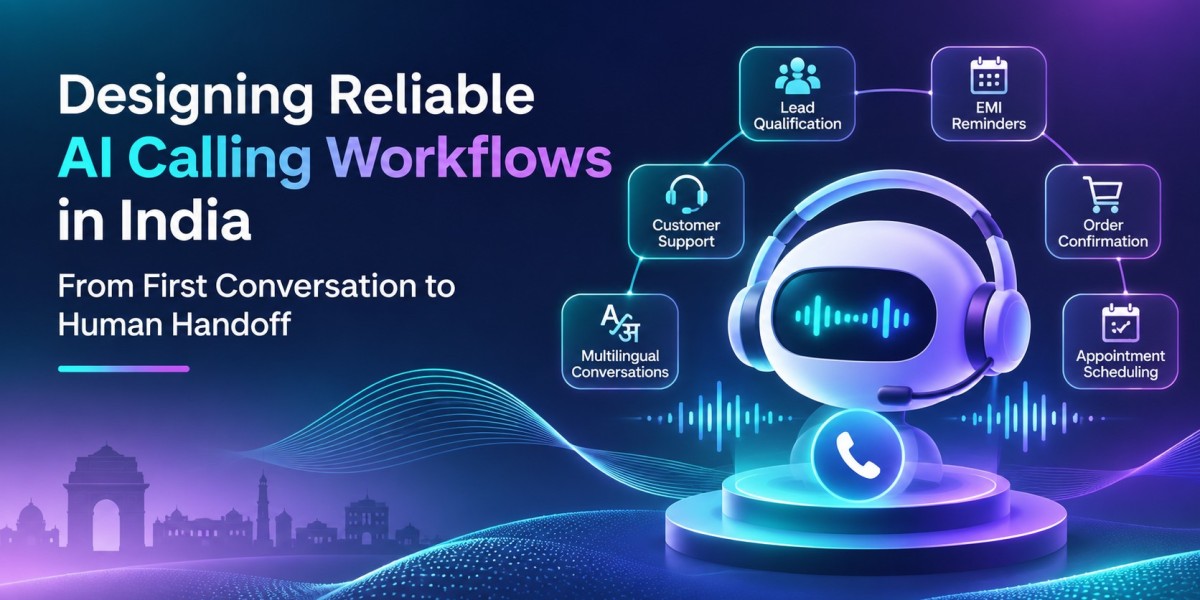
A practical guide to designing reliable AI calling workflows in India, from the first conversation to human handoff, covering language and conversation design, CRM integration, DPDP, TRAI DLT, and RBI compliance, and how to evaluate a voice AI platform before you implement it.
Make Every Call Smarter with Caller Digital.
Discover how AI-powered voice agents can automate conversations, improve customer engagement, and help your business scale effortlessly.
Explore Caller Digital – Book Your Free Demo Today!