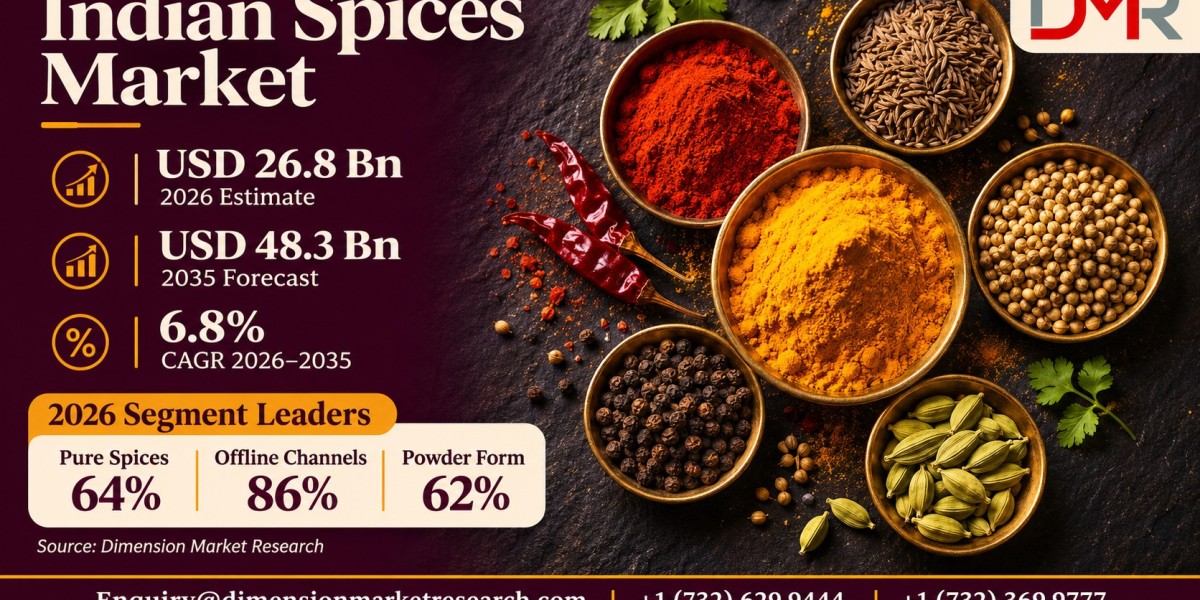

The Indian Spices Market is expanding as households buy more branded masalas and food manufacturers seek seasonings that deliver consistent flavour across batches. According to Dimension Market Research, the market is estimated at USD 26.8 billion in 2026 and projected to reach USD 48.3 billion by 2035, with a compound annual growth rate of 6.8% from 2026 to 2035.
The commercial opportunity depends on who is buying. A household may choose a recipe-specific masala to save preparation time. A snack manufacturer needs a seasoning that delivers the same taste throughout a production run. A restaurant may need the same blend in larger packs. Each buyer creates demand for spices, with different expectations for formulation, packaging and supply.
What Does the Indian Spices Market Cover?
The market includes pure spices such as turmeric, cumin, red chilli and coriander, as well as blends such as garam masala, chole masala and sambhar masala. The report tracks whole spices, powders and pastes sold to households, foodservice outlets and industrial customers. It also examines applications ranging from curries to frozen meals, snacks, sauces and dressings.
Get a Free Sample of the Indian Spices Market Report
Review the free sample to see how the study distinguishes pure spices from blends and breaks down demand by application, product form and sales channel. The sample can help you assess whether the research covers the products and buyers you are evaluating.
https://dimensionmarketresearch.com/request-sample/indian-spices-market/
Which Products and Applications Lead Spice Demand?
Pure spices are projected to account for 64% of the market by product type in 2026. Their use spans home kitchens, restaurants and industrial food production. By form, powder is expected to lead with 62%, while curries are the largest application at 38%. These figures answer different questions. A curry blend can contribute to demand for powdered spices by form and to curry demand by application.
Recipe-specific blends give manufacturers room to differentiate within that established demand. A consumer buying a paneer masala wants a familiar result with fewer preparation steps. A packaged food producer buying a custom blend may place more weight on batch consistency. That distinction can guide investments in regional recipes, foodservice packs or industrial seasoning systems.
Where Do Indian Consumers Buy Spices?
Offline distribution is projected to account for 86% of the market in 2026. Neighbourhood shops, supermarkets and wholesalers keep frequently purchased spices close to consumers, while direct sales serve institutional and industrial buyers purchasing in larger quantities. North India is projected to lead domestic demand with around 30% share, supported by consumption and trade.
Online grocery and quick-commerce platforms give regional and premium products another route to shoppers. For a brand considering wider distribution, a digital listing can help test interest in a new blend. Repeat purchases can give the brand a better basis for deciding which products to offer through physical retailers.
How Are Processors Competing at Home and Abroad?
The report identifies Tata Consumer Products Limited, Aachi Masala Foods Private Limited, Everest Food Products Private Limited, ITC Limited and Synthite Industries Private Limited among the prominent companies. The scope for competition extends from branded retail packs to custom seasonings and extracts. The report cites ITC’s June 2025 acquisition of Sresta Natural Bioproducts, which added 24 Mantra Organic’s packaged spices to its organic-food portfolio.
The report puts Indian spice and spice product exports at USD 4.43 billion in 2025–26. It identifies opportunities in tested powders, customised blends and concentrated ingredients such as oleoresins. Crop variability and raw-material price changes can pressure margins, while export requirements can raise testing and documentation costs. For processors weighing an export opportunity, maintaining consistent specifications across suppliers and harvests can matter as much as securing the first order.
Explore the Complete Indian Spices Market Analysis
Use the full report to compare demand across products, applications and sales channels when planning a branded range, evaluating foodservice demand or assessing an export opportunity.
https://dimensionmarketresearch.com/checkout/indian-spices-market/
Frequently Asked Questions
1. How big is the Indian Spices Market?
The market is estimated at USD 26.8 billion in 2026 and projected to reach USD 48.3 billion by 2035.
2. What is the projected Indian Spices Market CAGR?
The market is projected to grow at a CAGR of 6.8% from 2026 to 2035.
3. Which product type has the largest market share?
Pure spices lead the product-type segment with an estimated 64% share in 2026.
4. Which sales channel leads the Indian Spices Market?
Offline channels lead with an estimated 86% share in 2026, supported by physical retail, wholesale networks and direct sales.
5. What challenges do Indian spice processors face?
Crop variability, fluctuating input prices and food safety compliance can increase costs. Exporters also have to meet testing and documentation requirements that vary by destination.
Conclusion
Everyday demand for pure spices gives the market a broad base. Branded masalas, industrial seasonings and processed export ingredients offer ways to build on it. The product choice determines what a supplier needs to do well, whether that means keeping a frequently purchased powder available locally or delivering a custom blend to the same specification throughout the year.