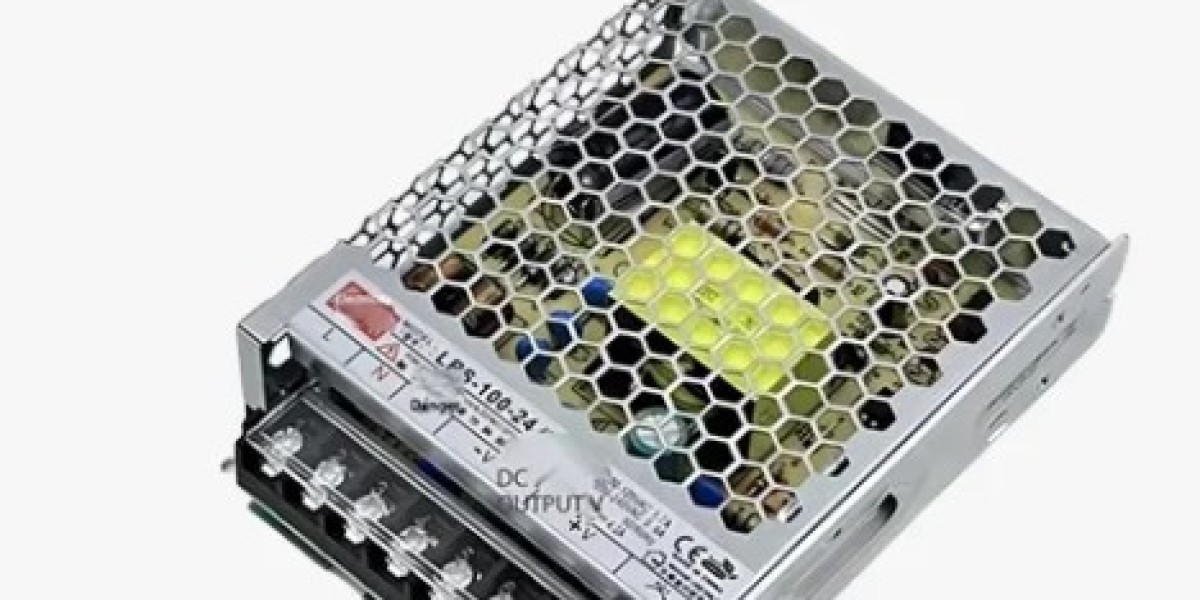

Industrial SMPS power supply maker in China mainly produces inverter-based arc welding power sources, also known as arc welding inverters, which are a new type of welding power source. It converts commercial frequency (50Hz) AC power into DC power through rectification and filtering by a rectifier, and then inverts it into medium frequency AC power ranging from several kHz to tens of kHz using high-power switching electronic components (such as thyristors SCR, transistors GTR, field-effect transistors MOSFET, or IGBTs). Simultaneously, the power is stepped down to a voltage suitable for welding, typically tens of volts, through a transformer. After rectification and filtering through a reactor, a relatively stable DC welding current is output.
The transformation sequence can be simply represented as:
Mains frequency AC (after rectification and filtering) → DC (after inversion) → Medium frequency AC (after voltage reduction, rectification, and filtering) → DC.
That is: AC→DC→AC→DC
Because the AC power after inverter step-down has a high frequency and large inductive reactance, the active power in the welding circuit will be greatly reduced. Therefore, rectification is required again. This is the mechanism commonly used by industrial SMPS power supply manufacturers in China.
The working principle of the half-bridge inverter circuit is illustrated in Figure 11.2
pIYBAFq0b-AGXmeAABs6G-j9vE269
Working Principle:
①tl time: Switch K1 is on and K2 is off. The current direction is as shown in ① in the figure. The power supply provides power to the main transformer T and charges the capacitor C2.
② Time t2: Both switches K1 and K2 are turned off, and no current flows through the negative section (dead zone).
③ t3 time: Switch K1 is turned off and K2 is turned on, allowing capacitor C2 to discharge to the load.
④ t4 time: Both switches K1 and K2 are turned off, forming a dead zone again. By repeating this process, the current shown in Figure 11.3 is obtained on the load, achieving the purpose of inverting.
2. Operating principle of IGBT welding machine
① Power supply:
Like welding machines using field-effect transistors (FETs) as inverter switches, the welding machine power supply is provided by mains electricity, which is rectified and filtered before being supplied to the inverter.
② Inverter:
Due to the high operating current of IGBTs, a half-bridge inverter can be employed, with IGBTs serving as switches, whose turn-on and turn-off are controlled by drive signals.
③ Generation of drive signal:
The drive signal still adopts the form of processing the output signal of the pulse width modulator. This ensures that the phases of the two drive signals are staggered (with a dead zone) to prevent the two switch tubes from simultaneously conducting and generating excessive current that could damage the switch tubes. The midpoint of the drive signal is also lowered by a certain amplitude to prevent interference from causing the switch tubes to conduct erroneously.
④ Protection circuit:
IGBT welding machines are also equipped with protections against overcurrent, overvoltage, and overheating, and some models also feature current limiting, to ensure the safety of both the welding machine and personnel. Their working principles are similar to those of field-effect transistor welding machines.
Inversion and rectification are two opposite concepts. Rectification is the process of converting alternating current (AC) into direct current (DC), while inversion is the process of converting DC into AC. Arc welding power sources that employ inversion technology are called inverter welding machines. The inversion process requires high-power electronic switching devices, and inverter welding machines that use insulated gate bipolar transistors (IGBTs) as switching devices become IGBT inverter welding machines.
The working process of an inverter welder is as follows: Three-phase or single-phase mains frequency AC power is rectified and filtered to obtain a smoother DC power. An inverter circuit composed of IGBTs converts this DC power into AC power at tens of kHz. After being stepped down by the main transformer, it undergoes rectification and filtering to obtain a stable DC output welding current.
Advantages of industrial SMPS power supply manufacturers in China: Due to the high inverter operating frequency, the core cross-sectional area and coil turns of the main transformer are significantly reduced. Therefore, inverter welding machines can save a considerable amount of metal materials, reduce external dimensions and weight, and significantly reduce power loss. More importantly, inverter welding machines can adjust the output current within microseconds, enabling ideal control processes required for the welding process and achieving satisfactory welding results.
industrial smps power supply maker china https://www.aeolisstech.com/12v-24v-48v-switching-power-supply-industrial-smps-for-led-cnc-cctv4.html