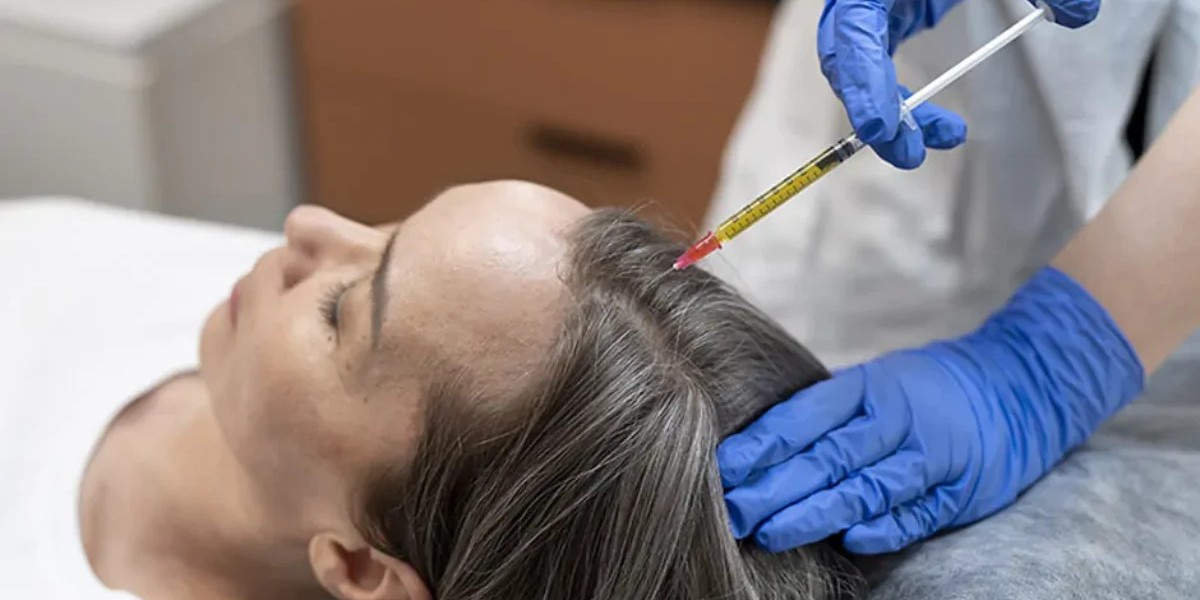

PRP (Platelet-Rich Plasma) hair treatment has become one of the most discussed non-surgical options for alopecia, but many people still ask a simple question: does it actually work? Alopecia, whether androgenetic (pattern hair loss) or areata, can be emotionally distressing, and PRP is often promoted as a natural way to stimulate regrowth using the body’s own healing factors. However, its effectiveness depends on the type of hair loss, disease stage, and individual response.
What PRP Does in Alopecia:
PRP works by injecting a concentrated portion of the patient’s own blood plasma, rich in platelets and growth factors, into the scalp. These biological signals help stimulate follicle activity and improve scalp health. Research suggests PRP can support hair regrowth mainly in early or active hair loss stages. Key actions include:
- Activation of weakened or miniaturized hair follicles
- Increased blood supply and nutrient delivery to the scalp
- Prolongation of the hair growth (anagen) phase
- Reduction in hair shedding over time
- Improvement in hair thickness and density
Scientific reviews show that PRP can increase hair density in many patients, particularly those with androgenetic alopecia, although results vary and are not guaranteed for everyone .
What the Science Says About Effectiveness:
Clinical studies and meta-analyses generally suggest that PRP can improve hair density compared to placebo or no treatment, but the evidence is not uniform. Some trials report moderate improvements in hair count and thickness, especially after multiple sessions. However, researchers also highlight variability in preparation methods and treatment protocols. Key findings include:
- Increased hair density in several controlled trials
- Better response in early-stage androgenetic alopecia
- Mixed or weak results for alopecia areata in some studies
- Lack of standardization across PRP techniques
- Overall low to moderate quality of evidence in many reviews
For example, systematic reviews show statistically significant improvements in hair density, but also note inconsistencies and heterogeneity across studies .
PRP for Alopecia Areata vs Pattern Hair Loss:
PRP does not work equally for all types of alopecia. Its effectiveness depends heavily on the underlying cause of hair loss. In general:
- Androgenetic alopecia (pattern hair loss): More responsive, especially in early stages
- Alopecia areata: Less predictable, with mixed clinical evidence
- Telogen effluvium: May help recovery indirectly by improving scalp environment
Important distinctions include:
- PRP supports existing follicles but cannot revive completely destroyed ones
- It is more effective when follicles are still alive but weakened
- Autoimmune-driven hair loss (like alopecia areata) may respond inconsistently
- Results vary widely between individuals
What Results You Can Realistically Expect:
PRP is not an instant or dramatic cure for alopecia. It works gradually and usually requires multiple sessions. Most patients who respond well notice improvements over time rather than sudden regrowth. Typical expectations include:
- Reduced hair shedding within 1–2 months
- Noticeable thickening after 3–4 months
- Best results after a full treatment course (3–6 sessions)
- Maintenance sessions every 6–12 months
- Subtle to moderate improvement, not full restoration
It is important to understand that PRP enhances existing hair rather than creating entirely new follicles.
Limitations of PRP for Hair Loss:
While PRP shows promise, it has clear limitations that affect its overall success rate. It is not considered a standalone cure for advanced alopecia. Key limitations include:
- Ineffective in completely bald areas with no active follicles
- Variable results depending on individual biology
- Lack of standardized treatment protocols
- Requires repeated sessions for sustained benefit
- Results may plateau after initial improvement
Because of these limitations, many dermatologists recommend PRP as part of a combination approach rather than a single solution.
Safety and Side Effects:
One of the strongest advantages of PRP is its safety profile. Since it uses the patient’s own blood, the risk of allergic reaction or rejection is extremely low. However, minor side effects can still occur, including:
- Mild scalp pain or tenderness
- Temporary swelling or redness
- Minor bruising at injection sites
- Slight headache or pressure sensation
- Short-lived discomfort after treatment
Serious complications are rare when performed by trained professionals.
Final Verdict: Does PRP Work for Alopecia?
Yes—but with important conditions. PRP can work for alopecia, especially for early-stage androgenetic hair loss, where it has shown consistent improvements in hair density and shedding reduction. However, it is not a miracle cure, and results vary widely between individuals. It is most effective when:
- Hair follicles are still active
- Treatment is done in multiple sessions
- It is combined with other therapies (when needed)
- Expectations are realistic
Overall, PRP is best understood as a supportive, regenerative treatment—not a replacement for medical or surgical hair restoration in advanced cases.










