
Introduction: The Digital Imperative for Modern Enterprises
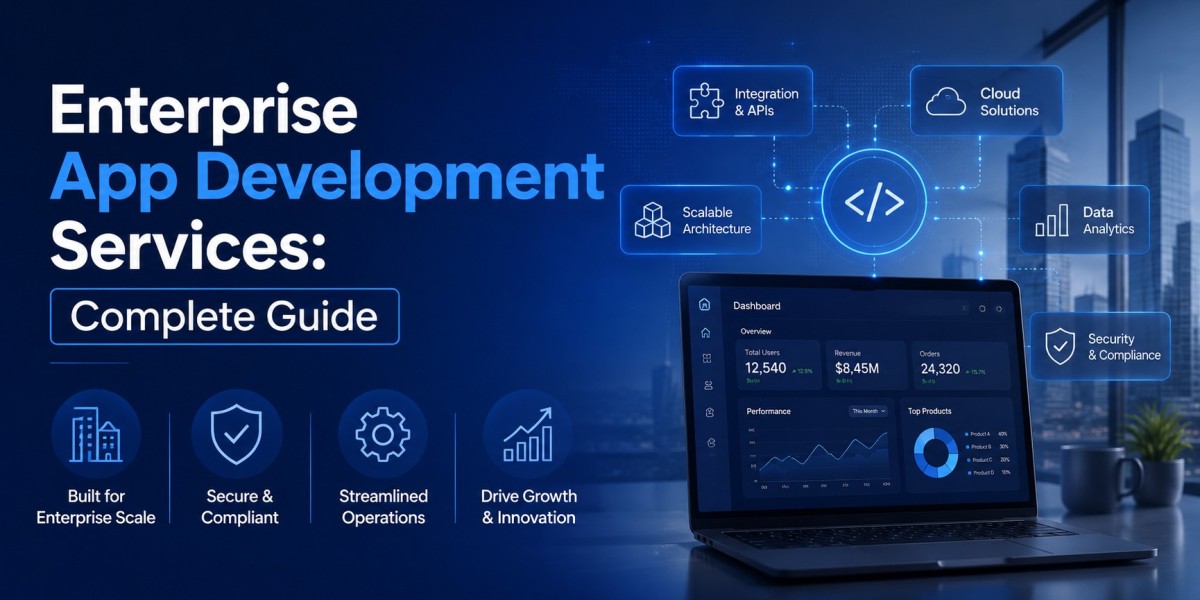
The way enterprises operate, communicate, and serve their customers has changed irrevocably. Employees expect to access business systems from anywhere. Customers expect seamless, fast, and personalized digital experiences on their mobile devices. Business owners who recognize this shift and act on it are pulling ahead — while those who delay are quietly losing ground to more agile competitors. At the heart of this transformation is a critical investment: enterprise app development services that turn complex business requirements into powerful, reliable, and scalable digital applications.
Building an enterprise application is not the same as building a consumer app. The stakes are higher, the user base is broader, the data is more sensitive, and the technical requirements are far more demanding. Enterprise applications must integrate with existing IT infrastructure, comply with industry regulations, support thousands of concurrent users, and deliver consistent performance across devices and geographies. Getting this right requires more than a capable development team — it requires a strategic partner who understands your business and has the experience to translate that understanding into software that works at scale.
This complete guide is designed to help business owners understand everything they need to know about enterprise app development — from the types of apps that drive business value, to the process of building them, to how to choose the right enterprise app development company for your organization.
What Are Enterprise App Development Services?
Enterprise app development services refer to the full lifecycle of designing, building, deploying, and maintaining applications that serve the operational needs of large organizations. These services span web applications, mobile applications, desktop applications, and hybrid solutions — all built with enterprise-grade architecture that prioritizes security, scalability, reliability, and integration capability. Unlike consumer apps that serve millions of anonymous users with simple interactions, enterprise apps serve known users — your employees, partners, and customers — with complex workflows and high stakes data.
The scope of enterprise app development is broad and deeply tied to business function. An enterprise app might be a field service management tool that technicians use on their tablets, a procurement portal that connects your finance team with suppliers, or a customer-facing mobile banking application that handles millions of transactions daily. What these applications have in common is that they are mission-critical — when they go down or underperform, the impact is felt directly in business operations, customer satisfaction, or regulatory compliance. This is precisely why enterprise app development demands a higher standard of engineering, architecture, and project management than typical application builds.
Core categories within enterprise app development services include:
- Enterprise Mobile App Development – Native and cross-platform mobile apps for iOS and Android that serve employees or customers
- Enterprise Web App Development – Scalable, browser-based applications for internal tools, portals, and customer platforms
- Cloud-Native App Development – Applications architected to run on AWS, Azure, or GCP with elastic scaling and high availability
- Progressive Web Apps (PWAs) – Web-based apps that deliver a native-like mobile experience without app store distribution
- Enterprise Application Integration (EAI) – Connecting new applications with legacy systems, ERPs, CRMs, and third-party APIs
- IoT Application Development – Apps that communicate with connected devices and sensors in manufacturing, logistics, and healthcare
- AI-Powered Enterprise Apps – Applications embedded with machine learning, NLP, and predictive analytics capabilities
Why Enterprise Mobile Apps Are a Business Priority
Mobile has become the primary interface through which people interact with digital services — and enterprises are no exception. Your field sales team needs real-time CRM access on their phones. Your warehouse staff needs inventory management on handheld devices. Your customers expect to engage with your brand, place orders, track deliveries, or access support through a polished mobile app. The demand for mobile-first enterprise solutions is not a trend — it is a permanent shift in how work gets done and how businesses serve their markets.
Partnering with a qualified enterprise mobile app development company gives business owners access to teams that understand both the technical intricacies of mobile platforms and the operational realities of large organizations. Building a mobile app that looks great is relatively easy — building one that integrates securely with your backend systems, works offline in low-connectivity environments, handles push notifications at scale, and maintains performance across hundreds of device models is an entirely different challenge. The right development partner will architect your mobile application for the long term, not just the launch date.
Why enterprise mobile apps deliver measurable business value:
- Workforce Productivity – Mobile apps eliminate paper-based processes and give employees real-time access to the tools and data they need, wherever they are
- Faster Decision-Making – Managers and executives can access dashboards, reports, and approvals on the go, accelerating business decisions
- Improved Customer Engagement – A well-designed customer-facing mobile app increases loyalty, purchase frequency, and lifetime value
- Operational Visibility – Mobile apps connected to IoT sensors and logistics systems give operations teams live visibility into assets and processes
- Reduced IT Overhead – Well-designed mobile apps reduce the volume of support requests and manual data reconciliation
- Competitive Differentiation – A superior mobile experience becomes a brand differentiator that's difficult for competitors to replicate quickly
- Data Collection at the Edge – Mobile apps capture valuable operational and behavioral data that feeds your analytics and AI systems
Key Types of Enterprise Applications by Business Function
Not all enterprise applications are created equal — and the type of app that will create the most value for your organization depends heavily on your industry, your workflows, and your strategic priorities. A knowledgeable enterprise app development company will work with you to identify where the highest-value opportunities lie before committing to a build. Understanding the major categories of enterprise applications helps business owners align their investments with the areas of greatest operational impact.
Across industries, enterprise applications typically cluster around four major business functions: operational efficiency, customer experience, workforce enablement, and strategic intelligence. Operational apps automate and streamline internal processes. Customer experience apps deliver seamless digital journeys to your buyers. Workforce apps empower employees with the tools they need to do their jobs better. Intelligence apps surface data-driven insights that inform strategy and planning. The most sophisticated enterprises build interconnected ecosystems that serve all four functions — but most successful digital transformation journeys start with one clear priority and expand from there.
Major enterprise application types by function:
- ERP Applications – Unified platforms that manage finance, HR, supply chain, and operations in a single integrated system
- CRM Applications – Tools that manage customer data, sales pipelines, support tickets, and marketing campaigns
- Supply Chain Management Apps – Applications that provide real-time visibility and control across procurement, inventory, and logistics
- Human Resource Management Systems (HRMS) – Apps for payroll, attendance, performance reviews, onboarding, and talent management
- Field Service Management Apps – Mobile-first tools for technicians and field agents to manage schedules, work orders, and reporting
- Learning Management Systems (LMS) – Platforms that deliver employee training, track progress, and manage certifications
- Business Intelligence & Reporting Apps – Dashboards and analytics tools that aggregate data from multiple sources into actionable insights
- Collaboration & Communication Apps – Internal tools that facilitate team communication, document sharing, and project coordination
The Enterprise App Development Process: A Step-by-Step Overview
Building an enterprise application is a structured, multi-phase journey that requires careful planning, rigorous execution, and ongoing collaboration between the development team and your internal stakeholders. Business owners who engage actively in this process — rather than delegating entirely to IT — consistently achieve better outcomes. The best enterprise app development services providers structure their engagement to keep business leaders informed and in control at every stage, ensuring that technical decisions are always grounded in business reality.
The process typically begins long before any code is written. A comprehensive discovery and requirements analysis phase ensures that the team fully understands your business context, user needs, existing systems, and success criteria. This phase is the foundation upon which everything else is built — cutting it short to save time almost always results in costly rework down the line. From there, the project moves through design, iterative development sprints, testing, deployment, and into a steady-state support and evolution phase. At every sprint boundary, there is an opportunity to review progress, incorporate feedback, and course-correct as needed.
The enterprise app development lifecycle:
- Stage 1 – Discovery & Business Analysis – Stakeholder workshops, process mapping, technical audits, and scope definition to establish a clear project charter
- Stage 2 – Architecture & Solution Design – Defining the technology stack, system architecture, data models, security framework, and integration points
- Stage 3 – UI/UX Design & Prototyping – Creating wireframes, interactive prototypes, and visual designs that reflect your brand and meet user expectations
- Stage 4 – Agile Development – Building the application in iterative two-to-four-week sprints, with working software demonstrated at the end of each sprint
- Stage 5 – Quality Assurance & Testing – Comprehensive testing covering functionality, performance, security, usability, and device compatibility
- Stage 6 – Deployment & Rollout – Staged deployment to production with user training, documentation, and hypercare support
- Stage 7 – Maintenance & Continuous Improvement – Ongoing monitoring, bug resolution, OS updates, security patches, and feature enhancements
How to Choose the Right Enterprise App Development Company
The market for enterprise app development is crowded with vendors who all claim to deliver world-class solutions. For business owners, the challenge is not finding options — it is finding the right partner. The right enterprise app development company is one that goes beyond technical competence to become a genuine business partner: understanding your industry, challenging your assumptions constructively, managing risk proactively, and building software that delivers on its promises.
Start by defining what success looks like for your project before you speak to any vendors. Know your must-have features, your timeline constraints, your integration requirements, and your budget range. With that clarity, evaluate potential partners on a combination of technical depth, relevant industry experience, development methodology, communication practices, and post-launch support commitments. A vendor who rushes to propose a solution before fully understanding your problem is a warning sign. The best partners listen first, ask the hard questions, and propose a roadmap that balances ambition with pragmatism.
Evaluation criteria for choosing your enterprise app development partner:
- Industry & Domain Expertise – Have they built applications for your sector? Do they understand your regulatory environment and user personas?
- Technical Breadth & Depth – Do they have expertise in the platforms and technologies relevant to your project (iOS, Android, React Native, Flutter, Azure, AWS)?
- Portfolio & References – Can they show you live applications of similar complexity? Can you speak to their previous enterprise clients?
- Security & Compliance Practices – Do they follow secure development practices? Can they meet your data privacy and compliance requirements?
- Agile Delivery Methodology – Do they work in sprints with regular demos, retrospectives, and stakeholder check-ins?
- Intellectual Property Ownership – Will your organization own the full IP of the codebase upon project completion?
- Support & SLA Commitments – What are their post-launch response times, maintenance terms, and escalation procedures?
- Cultural Fit & Communication Style – Will their team communicate clearly and proactively with non-technical business stakeholders?
Security, Compliance, and Governance in Enterprise App Development
For enterprise business owners, security is not a feature to be added at the end — it is a design principle that must be embedded from the very beginning of the development process. Enterprise applications handle sensitive data: financial records, employee information, customer data, intellectual property, and operational metrics. A security breach in any of these areas can result in regulatory penalties, reputational damage, operational disruption, and loss of customer trust. The cost of getting security wrong almost always far exceeds the cost of getting it right from the start.
A reputable enterprise app development partner will practice what the industry calls "security by design" — incorporating threat modeling, secure coding standards, encryption, access control, and vulnerability testing throughout the entire development lifecycle. Equally important is compliance alignment: if your industry requires adherence to standards like HIPAA (healthcare), PCI-DSS (payments), SOC 2 (SaaS), GDPR (EU data privacy), or ISO 27001 (information security), your development partner must have demonstrated experience building compliant systems. Non-compliance is not just a legal risk — it is an enterprise risk.
Enterprise security and governance essentials:
- Role-Based Access Control (RBAC) – Ensuring that users can only access data and functions relevant to their role within the organization
- Data Encryption – Encrypting data both in transit (TLS/SSL) and at rest (AES-256) to prevent unauthorized access
- Multi-Factor Authentication (MFA) – Adding additional layers of identity verification for sensitive application access
- Penetration Testing & Vulnerability Assessments – Regular security audits to identify and remediate weaknesses before bad actors do
- Audit Logging & Monitoring – Comprehensive activity logs and real-time monitoring for anomaly detection and incident response
- Regulatory Compliance Frameworks – Building applications in alignment with GDPR, HIPAA, PCI-DSS, SOC 2, or other applicable standards
- Disaster Recovery & Business Continuity – Robust backup strategies, failover systems, and recovery plans to minimize downtime
Cost and ROI of Enterprise App Development
Understanding the financial dynamics of enterprise app development is critical for making a well-informed investment decision. Business owners often approach this conversation focused on the upfront cost, when the more important conversation is about return on investment, total cost of ownership, and risk mitigation. The right enterprise application, built properly, pays for itself many times over — through efficiency gains, error reduction, faster decision-making, and new revenue opportunities. The wrong application, built cheaply or without strategic clarity, becomes a liability that drains resources for years.
For planning purposes, basic enterprise mobile or web applications start at around $50,000 to $100,000 for relatively straightforward functionality and limited integrations. Mid-complexity enterprise platforms — with multiple user roles, workflow automation, analytics, and integration with existing systems — typically range from $150,000 to $500,000. Large-scale, mission-critical enterprise applications with advanced security, AI capabilities, multi-region deployment, and complex compliance requirements can range from $500,000 to several million dollars. These are investments, and they should be evaluated as such against the business value they deliver.
Factors influencing enterprise app development investment:
- Functional Scope & Feature Complexity – The number of user roles, workflows, screens, and integrations directly drives development effort and cost
- Platform Targets – Building for iOS only is less expensive than building for iOS, Android, and web simultaneously; cross-platform frameworks can reduce cost
- Integration Complexity – Each additional system integration (ERP, CRM, payment gateways, third-party APIs) adds engineering effort and testing overhead
- Performance & Scale Requirements – Applications designed for 10 users are fundamentally different from those designed for 100,000 concurrent users
- Compliance & Security Requirements – Meeting regulatory standards requires additional architecture, testing, and documentation effort
- Team Location & Expertise Level – Nearshore or offshore teams with relevant enterprise experience can deliver significant cost efficiencies without sacrificing quality
- Post-Launch Maintenance – Budget 15–25% of the initial development cost annually for ongoing support, security updates, and feature development
Future Trends in Enterprise App Development
The enterprise app development landscape is evolving rapidly, driven by technological breakthroughs that are redefining what is possible. Business owners who stay informed about these trends are better equipped to make forward-thinking investment decisions and build applications that remain relevant and competitive for years to come. Leading enterprise mobile app development company providers are already integrating these capabilities into enterprise solutions across industries, and the early adopters are seeing significant competitive advantages.
Artificial Intelligence and Machine Learning are perhaps the most transformative forces in enterprise applications today. From intelligent document processing and predictive maintenance to conversational AI interfaces and personalized customer experiences, AI is elevating enterprise apps from tools that execute tasks to systems that learn, adapt, and recommend. Simultaneously, the widespread adoption of 5G is unlocking new possibilities for mobile enterprise apps — enabling real-time video, IoT connectivity, and augmented reality applications that were previously constrained by bandwidth. The enterprises that build these capabilities into their application strategy today will be positioned to lead tomorrow.
Key trends shaping the future of enterprise applications:
- Generative AI Integration – Embedding large language models to power intelligent search, document generation, and conversational interfaces within enterprise apps
- Augmented Reality (AR) for Enterprise – AR-enabled applications for remote assistance, training simulation, warehouse navigation, and field service
- 5G-Powered Mobile Applications – Ultra-low latency mobile apps enabling real-time collaboration, video streaming, and IoT management in the field
- Super Apps for the Workplace – Unified mobile platforms that consolidate communication, task management, approvals, and analytics in a single enterprise app
- Composable Architecture – Building apps from reusable, modular components that can be assembled and reassembled as business needs evolve
- Sustainable Software Design – Green coding practices and cloud optimization strategies that reduce energy consumption and infrastructure costs
Conclusion: Building for the Future Starts Today
Enterprise app development is one of the highest-leverage investments a business owner can make. Done right, it transforms how your organization operates, how your employees perform, and how your customers experience your brand. Done poorly, it creates technical debt, operational friction, and wasted capital. The difference lies almost entirely in choosing the right partner — a team that combines technical excellence with genuine business understanding and a commitment to long-term outcomes.
The enterprises that will thrive in the coming decade are those building digital capabilities today. They are working with expert enterprise app development services providers to create applications that are not just functional, but transformative. They are thinking beyond the immediate feature list to the strategic platform they are building. And they are treating technology investment not as a cost to be minimized, but as a capability to be maximized.
Whether you are ready to build your first enterprise application or looking to modernize a legacy system that is holding your organization back, the journey starts with a conversation. Define your goals, find your partner, and start building the digital infrastructure that your business — and your customers — deserve.