
Introduction
Modern manufacturing operates in an environment where precision, speed, and consistency determine competitive success. As product designs become more complex and tolerances become tighter, traditional inspection methods often struggle to meet evolving quality expectations.
Manufacturers are increasingly adopting 3D inspection services to validate dimensions, detect deviations, and ensure every component meets engineering specifications. Advanced inspection technologies provide accurate, data-driven insights that help organizations improve production efficiency while minimizing costly quality issues.
Recognizing when an existing inspection process is no longer sufficient is essential. The following five signs indicate that it may be time to integrate advanced inspection into your manufacturing workflow.
1. Product Defects Are Becoming More Frequent
An increase in product defects is one of the clearest indicators that inspection methods require improvement. Even small dimensional deviations can affect product performance, assembly accuracy, and customer satisfaction.
Conventional measuring tools typically evaluate only selected features rather than the complete geometry of a component. This leaves room for undetected errors that may progress through production.
3D inspection services capture millions of measurement points across an entire part, allowing manufacturers to identify dimensional variations that would otherwise remain unnoticed.
This comprehensive inspection approach enables engineering teams to resolve quality issues earlier, reducing scrap, rework, and production delays.
2. Increasing Scrap and Rework Costs
Every rejected component represents lost material, additional labor, and unnecessary production expenses. When scrap rates continue to rise, the underlying cause often lies in inaccurate process validation.
Manufacturers frequently discover dimensional deviations only after downstream operations have been completed. At that stage, correcting errors becomes significantly more expensive.
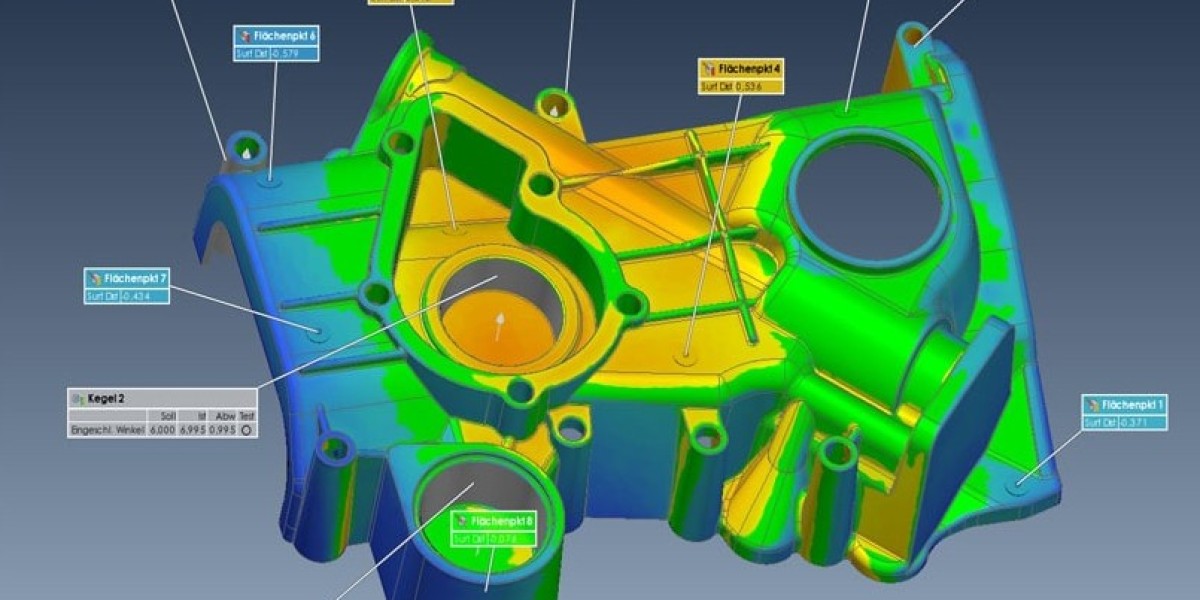
Advanced 3D inspection enables early-stage verification by comparing manufactured parts directly against CAD models.
Color deviation maps clearly highlight areas that exceed specified tolerances, allowing engineers to identify root causes before defects multiply throughout production.
The result is improved process stability, reduced waste, and better utilization of manufacturing resources.
3. Complex Components Are Difficult to Measure
Modern products rarely consist of simple geometric shapes. Aerospace components, automotive assemblies, medical devices, turbine blades, and injection-molded parts often contain intricate surfaces that challenge traditional inspection techniques.
Manual measurement tools may struggle to access hidden features, freeform surfaces, or deep internal geometries.
This limitation increases inspection time while reducing confidence in measurement accuracy.
Advanced laser scanning technologies rapidly capture complete surface geometry without physical contact.
The resulting digital models provide comprehensive dimensional information, enabling manufacturers to inspect complex components with exceptional precision.
This capability becomes increasingly valuable as product complexity continues to grow across advanced manufacturing industries.
4. Slow Inspection Processes cause Production Delays
Inspection should support production—not become a bottleneck.
Traditional inspection workflows often require multiple setups, manual measurements, repeated verification, and extensive documentation.
As production volumes increase, these activities consume valuable manufacturing time.
High-speed digital inspection significantly accelerates quality verification by capturing complete part geometry within minutes.
Automated comparison against CAD data further reduces manual analysis while improving consistency.
Faster inspection enables quicker production decisions, helping manufacturers maintain delivery schedules without compromising quality standards.
5. Customers Demand Higher Quality Documentation
Today's customers expect more than dimensional compliance.
Many industries require detailed inspection reports that demonstrate full traceability and documented quality assurance.
Traditional measurement reports may provide only limited dimensional information, making it difficult to validate every critical feature.
Advanced inspection technologies generate highly detailed reports containing deviation analysis, dimensional comparisons, GD&T validation, color maps, and comprehensive measurement data.
These reports improve transparency while strengthening confidence between manufacturers, suppliers, and customers.
Organizations pursuing international certifications or supplying regulated industries particularly benefit from digital inspection documentation.
Why Modern Manufacturing Is Moving Toward Digital Inspection
Manufacturing is becoming increasingly data-driven.
Industry 4.0 initiatives rely on accurate measurement data to optimize production, reduce variability, and improve operational efficiency.
Digital inspection supports this transformation by generating precise datasets that integrate with engineering, production, and quality management systems.
Instead of relying solely on pass-or-fail measurements, manufacturers gain valuable insights into process capability and long-term production trends.
This information supports continuous improvement while enabling proactive quality management.
Industries That Benefit Most from 3D Inspection Services
The advantages of advanced inspection extend across numerous industries where precision directly influences product performance.
Key sectors include:
Automotive manufacturing
Aerospace and defense
Heavy engineering
Medical device manufacturing
Energy and power generation
Tool and die manufacturing
Industrial equipment production
Plastic and injection molding
Foundry and casting industries
Consumer electronics manufacturing
Each of these industries faces increasing demands for dimensional accuracy, repeatability, and documented quality assurance.
Choosing the Right Inspection Strategy
Selecting the appropriate inspection methodology depends on several operational factors.
Manufacturers should evaluate:
Component complexity
Required measurement accuracy
Production volume
Inspection turnaround time
Regulatory requirements
Customer documentation needs
Integration with existing quality systems
An effective inspection strategy balances precision with productivity while supporting long-term manufacturing objectives.
Why Local Expertise Matters
For manufacturers seeking rapid project execution, access to local inspection specialists offers significant operational advantages.
Working with providers offering 3D inspection services in Chennai enables faster response times, reduced logistics challenges, and improved collaboration throughout inspection projects.
Local support becomes especially valuable for large industrial components, production troubleshooting, on-site verification, and urgent quality investigations.
As manufacturing continues to evolve, organizations increasingly rely on 3D inspection services in Chennai to strengthen quality control while maintaining operational efficiency.
Future Outlook
The future of manufacturing quality lies in intelligent inspection.
Artificial intelligence, automation, digital twins, and predictive analytics are transforming how manufacturers monitor production quality.
High-resolution digital inspection data will play a central role in enabling smarter manufacturing decisions, reducing variability, and supporting continuous process optimization.
Organizations investing in advanced inspection today position themselves for greater resilience and improved competitiveness as manufacturing technologies continue to evolve.
Conclusion
Manufacturing excellence depends on accurate measurement, reliable quality control, and continuous process improvement.
Frequent defects, rising scrap rates, complex product geometries, slow inspection workflows, and increasing customer quality expectations are all strong indicators that traditional inspection methods may no longer be sufficient.
Implementing 3D inspection services enables manufacturers to detect dimensional deviations earlier, improve production consistency, reduce operational costs, and make informed engineering decisions based on precise digital data.
R M Engineering Technologies is a specialist provider of on-site, mobile laser scanning services. We deliver a fast and cost-effective solution for the collection of physical data of an object in any desired environment.